
 80813-00200


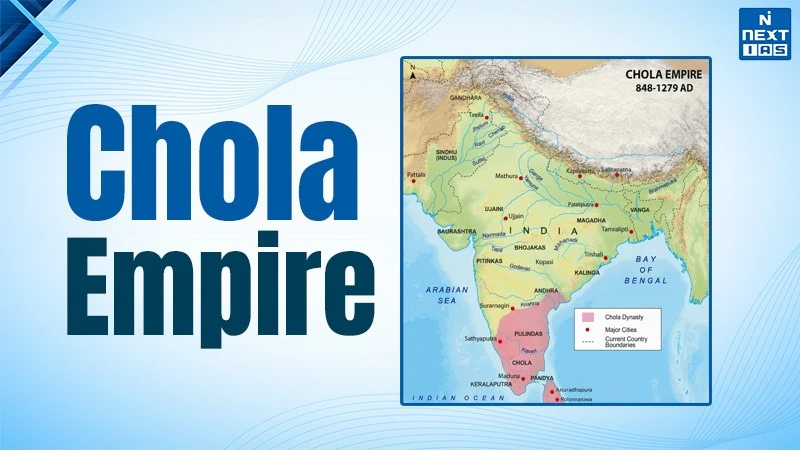
Chola Empire was one of the great kingdoms that ruled over South India during the 9th century CE under the leadership of Vijayalaya Chola. Chola kings like Rajaraja Chola I and Rajendra Chola I made it into an empire. Cholas conquered much of southern India and were able to spread their maritime reach all the way to Sri Lanka and Southeast Asia.
Some of the Cholas' strengths include effective administrative skills, local government of villages, naval prowess, irrigation facilities and thriving trade. Chola kings were patrons of Tamil literature, religion and architecture. An impressive example of Dravidian architecture is the Brihadisvara temple of Thanjavur built by Rajaraja I.
Chola Empire History
- Geographically, the Chola Empire was located between the Pennar and Velar rivers in present-day Tamil Nadu.
- The geographic location of the Cholas helped them gain control over a rich region, which helped in their prosperity and economy.
- With rivers as natural boundaries, it became easier for them to have access to water for agriculture purposes.
- Uraiyur was the first capital of the Cholas and was famous for the cotton trade in the region.
- Due to fertile land in the vicinity, Uraiyur became the centre of cotton production and its trade made the Chola Empire rich and prosperous.
- The city was also known for its trading and commerce in South India.
- The invasion of Sri Lanka by Chola king Elara in the 2nd century B.C. was one of the important events in early Chola history.
- The king of Cholas conquered and ruled the island of Sri Lanka for around 50 years.
- It was one of the earliest expansions by the Cholas outside of the Indian mainland.
- Elara’s rule over Sri Lanka was one of the fair rules and his enemies also respected him.
Founder of Chola Kingdom
- Vijayalaya Chola, the founder of the Chola Empire, established the dynasty in the 9th century by capturing the city of Thanjavur from the Mutharaiyar rulers around 850 CE.
- Originally a feudal lord under the Pallavas, Vijayalaya took advantage of the declining power of the Pallavas and Pandyas to carve out a kingdom for himself.
- His reign marked the revival of Chola’s power after centuries of obscurity, laying the foundation for one of the most powerful and influential empires in South Indian history.
Chola Empire Important Rulers
Karikala Chola (Early Chola Empire – 2nd Century AD)
- One of the best-known rulers of the Early Chola Empire, Karikala, was the one who developed Puhar (also known as Kaveripattanam) into a prosperous trading centre.
- An extensive embankment was built by him on the banks of the Kaveri river to prevent flooding and encourage agricultural activities.
- His military accomplishments, especially the victory of the Battle of Venni, allowed him to dominate the Cheras, Pandyas and other chieftains.
- The Chola navy was improved during his reign, which resulted in increased maritime trade activities.
Vijayalaya Chola (Mid 9th Century AD)
- He is regarded as the founder of the Imperial Chola dynasty and marked the revival of the Chola Empire in the 9th century.
- Tanjore (Thanjavur) was seized by him from the Mutharaiyars and made into the new capital of the Cholas.
Aditya I (871 – 907 AD)
- Aditya I ruled after his father Vijayalaya and helped expand the Chola dynasty considerably through defeat of the Pallavas.
- He seized the lands of the Pallavas, thus bringing to an end their dominance, and laid the foundation of the supremacy of the Cholas in South India.
- Military victories of Aditya I prepared ground for the reign of his son Parantaka I.
Parantaka I (907-955 AD)
- Parantaka I extended the Chola Empire by annexing the territories of the Pandyas, and expanding the boundaries of the empire to the northern regions of Sri Lanka.
- Through his rule, he made the Chola Empire one of the most powerful empires in South India.
- During his reign, emphasis was placed on development of agriculture and building temples.
Rajaraja I (985-1014 AD)
- Rajaraja I was one of the most prominent rulers of the Chola dynasty. He expanded the boundaries of the Chola Empire considerably by conquest of lands in South India, Sri Lanka, and Maldives, thus establishing the Chola Empire as a maritime empire.
- His government was highly efficient; he had organized bureaucracy and naval fleet.
- Rajaraja I is famous for constructing the Brihadeeswarar Temple in Thanjavur.
Rajendra Chola I (1014-1044 AD)
- Rajendra Chola I, son of Rajaraja I, expanded the empire’s territory even more through his conquests, particularly his naval expeditions in Southeast Asia to the Srivijaya Empire.
- Furthermore, he conquered regions in northern India, which became the peak of Chola supremacy.
- The king of the Chola Empire also founded a new capital at Gangaikonda Cholapuram and built the Gangaikonda Cholapuram Temple.
Rajadhiraja Chola (1044-1054 AD)
- Rajadhiraja Chola, son of Rajendra Chola I, maintained his father’s military tradition and solidified the Cholas’ supremacy.
- The ruler waged many successful wars in Sri Lanka and against the Chalukyas before he died during one of his battles, signaling the start of a steady decline in the Chola Empire’s status.
Kulottunga I (1070-1122 AD)
- Kulottunga I stands out as the emperor who brought stability back to the Chola Empire amid political chaos.
- During his rule, there was consolidation of power and stability within the empire.
Rajaraja Chola III (1216-1246 AD)
- The reign of Rajaraja III saw unrest within the empire along with increasing threats from external sources such as the Hoysalas and the Pandyas.
- The inability of Rajaraja III to hold onto the empire saw the start of the downfall of the empire.
Rajendra Chola III (1246-1279 AD)
- Rajendra Chola III was the last ruler of the Chola dynasty. The reign of Rajendra Chola III was the last period of the Chola Empire, which had faced immense pressures from the Pandyas.
- During this period, the empire finally collapsed, leaving behind the Pandyas as the ruling power in the south.
Capital of the Empire
- The capital of the Chola Empire was Thanjavur, otherwise called Tanjore, which was founded as the political and cultural capital of the dynasty by Vijayalaya Chola.
- The city of Thanjavur acted as the centre for Chola politics, art, and architecture. It prospered greatly during the reigns of other rulers like Raja Raja Chola I, who constructed many magnificent temples in the city, including the famous Brihadeeswara Temple.
Administration of Chola Dynasty
- The administration of the Chola Empire was very systematic and efficient, with the existence of a centralized system under the rule of the king, who was regarded as the supreme authority.
- The Chola Empire was subdivided into several administrative units like mandalams, nadus, and kottams. Each of these units was governed by the officials appointed by the king.
- Local self-government was quite common in the empire, where the villages were managed by sabhas in respect of various aspects such as irrigation, land revenue, and law and order.
- There existed a sophisticated bureaucratic system in the Chola Empire, which involved the collection of land revenue, the organization of army, and infrastructure development, including building temples, roads, and irrigation facilities.
Economic Strength
- The Chola economy was primarily supported by the cotton trade, a significant wealth source.
- The Chola Empire has prosperous trade led to the emergence of key urban centres like Puhar (Kaveripattanam) as vital commercial hubs.
- These two cities were essential for commerce, attracting merchants from different regions due to their flourishing markets.
- They also became centres for export, especially in textiles and other goods.
Naval Power
- The Cholas Empire has maintained a highly effective naval force, one of the first in South Indian history to project power over the seas.
- This naval strength enabled them to control the Bay of Bengal and secure trade routes extending to Southeast Asia.
- The Chola Empire’s navy protected merchant ships and expanded its influence over nearby island nations, including parts of Sri Lanka.
- Their naval prowess also spread Indian culture, religion, and trade networks to Southeast Asia.
Decline of Early Cholas
Early Cholas experienced decline in the post-Sangam era because of the emergence of other powerful dynasties like the Pandyas and Pallavas. Insecurity, succession issues, and loss of territory were some reasons that caused the fall of the Cholas. By the 3rd century CE, the Cholas had lost most of their political significance in Tamilakam.
Kalabhras disturbed the political system during the 3rd to 6th centuries. Despite the existence of the Cholas as a regional kingdom, they maintained themselves under political dominance for many years. They managed to be revived in the 9th century CE under Vijayalaya Chola, which marked the commencement of the Imperial Chola era.
FAQs about Cholas
Who was the founder of Chola empire?
Vijayalaya Chola was the founder of the Chola Empire.
Which kingdom destroyed the Chola rule?
The Pandyas, followed by the Hoysalas, contributed to the decline of the Chola rule.
