
 80813-00200


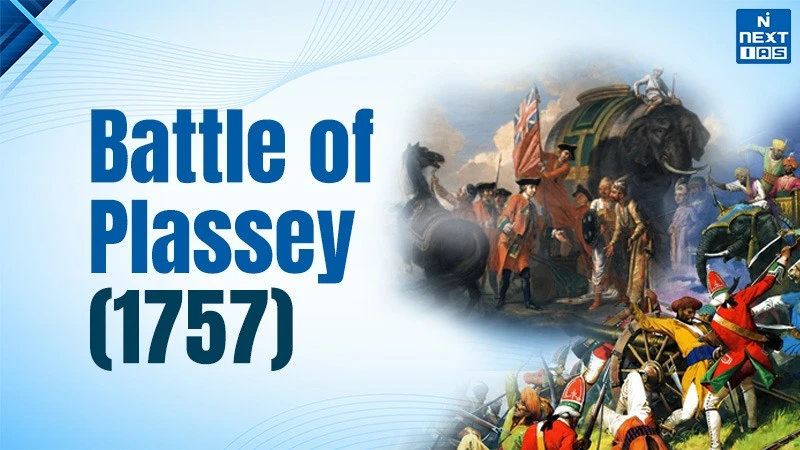
The British East India Company (EIC) was engaged in huge corruption and also surpassing the superiority of Nawab of Bengal Siraj-ud-Daulah. The fortification of Fort William at Calcutta without the prior approval of the Nawab of Bengal made him angry. This growing resentment led to the Battle of Plassey on 23rd June 1757.
The then-governor general, Robert Clive secretly made a deal with Mir Jafar who was the military commander of the Siraj-ud-Daulah to betray the Nawab in the battle of Plassey.
In the battle, the Nawab was defeated by the British East India Company, which consolidated British dominance in the Bengal region of India. The decisive battle transformed a private trading company into a political power in British India.
Timeline of Battle of Plassey (1757)
| S.No. | Period | Event | Importance |
|---|---|---|---|
| 1 | April 1756 |
|
|
| 2 | Early 1756 |
|
|
| 3 | 20 June 1756 |
|
|
| 4 | January 1757 |
|
|
| 5 | 9 February 1757 |
|
|
| 6 | March to June 1757 |
|
|
| 7 | 23 June 1757 |
|
|
| 8 | 23 June 1757 during battle |
|
|
| 9 | 23 June 1757 |
|
|
| 10 | 24 to 29 June 1757 |
|
|
| 11 | After 1757 |
|
|
Significance of the Battle
The battle of Plassey was fought on 23 June 1757 was a decisive battle in the history of India. The victory of the East India company over the nawab of Bengal siraj-ud-daula reflected their political influence in the region and the military base needed to expand British power in India. The Significance of the battle of Plassey are explained in the following points.
- The battle of Plassey marked the beginning of the East India Company from just a trading body into a political and territorial power. This allowed the company to interfere directly in the administration of Bengal. Mir Jafar was made the Nawab of Bengal but he was completely dependent on the company.
- Bengal was one of the wealthiest provinces of India. The company received a huge amount of money, trade privileges and access to the revenue of the Bengal region. These revenues helped them to maintain a stronger army and sponsored future conquests in the other regions in India.
- The battle increased British prestige and weakened their European rival powers particularly the French. It showed that the East India Company may use diplomacy, military army and alliances with Indian rulers to achieve political control.
- The battle of Plassey exposed the weakness of the rulers in Bengal due to internal rivalry among the rulers of Bengal. The failure of Mir Jafar to support Siraj-ud-Daulah was a crucial event and a decisive factor for the British victory.
The battle of Plassey prepared the pathway for the battle of Buxar in 1764 which led to the British colonial rule over other parts of India.
Difference Between Battle of Plassey and Buxar
| S.No. | Basis | Battle of Plassey | Battle of Buxar |
|---|---|---|---|
| 1 | Date |
|
|
| 2 | Place |
|
|
| 3 | British commander |
|
|
| 4 | Opponents of the Company |
|
|
| 5 | Immediate causes |
|
|
| 6 | Nature of battle |
|
|
| 7 | Result |
|
|
| 8 | Political impact |
|
|
| 9 | Economic gain |
|
|
| 10 | Relation with Mughal Emperor |
|
|
| 11 | Historical significance |
|
|
| 12 | Aftermath in Bengal |
|
|
FAQs about Plassey Battle
What is battle of Plassey?
The battle of Plassey was fought between the army of the East India Company and Siraj-ud-Daulah army of Bengal.
When was the Battle of Plassey fought?
The Battle of Plassey was fought on 23rd June 1757.
Why did the battle of Plassey became famous?
The Battle of Plassey became famous due to its decisive beginning of British political dominance and the regional expansion in India.
What was the result of the battle of Plassey?
The battle of Plassey resulted in the victory of the British East India Company over Nawab of Bengal Siraj-ud-daulah. Mir Jafar became the Nawab under British influence in Bengal.
