
 80813-00200


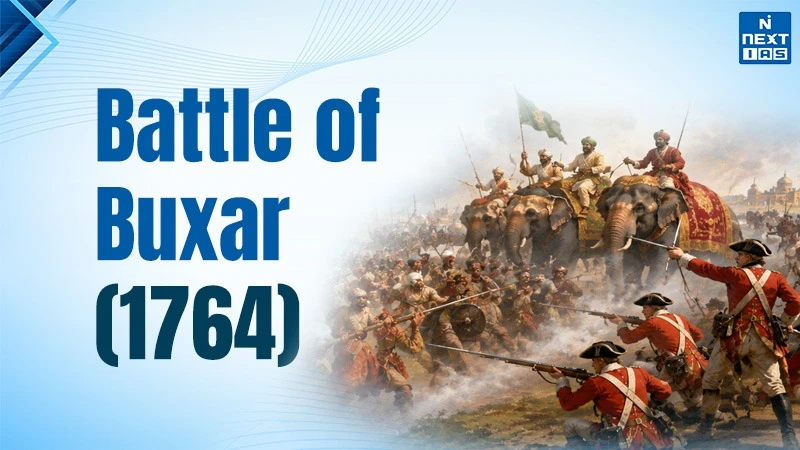
The Battle of Buxar was fought on 22 October 1764 between the British East India Company under Major Hector Munro and the tripartite alliance of Nawab of Bengal Mir Qasim, Mughal Emperor Shah Alam II and Nawab of Awadh Shuja-ud-daulah. Although the Britishers including Indian sepoys were having around 17,000 troops but using superior artillery and trained personnel, they defeated about 40,000 troops of the combined armies of the Mughal empire. Buxar was a decisive battle that reaffirmed British dominance over Bengal and Bihar after their victory in the Battle of Plassey in 1757.
The Battle of Buxar 1764 was concluded with the Treaty of Allahabad 1765 wherein the Mughal Emperor granted the Diwani Rights or the rights to collect tax revenues over Bengal, Bihar and Odhisha. At that time, these 3 provinces were the wealthiest in India and for the 1st time a private company became the tax collector of an empire. Britishers used Indian tax money to purchase Indian goods and exported the items to England for profit.
In 1765, the Dual System of Governance where Diwani were given to Britishers & Nizamat, the responsibility of administration, law and order was retained by the Mughal empire. It gave power without responsibility to the East India Company who drained the wealth of Bengal that finally led to the Great Bengal Famine in 1770.
Timeline of Battle of Buxar (1764)
| S.No. | Year | Event | Importance |
|---|---|---|---|
| 1 | 1757 | Battle of Plassey |
|
| 2 | 1760 | Mir Qasim became Nawab of Bengal |
|
| 3 | 1762 to 63 | Trade-duty dispute |
|
| 4 | 1763 | Mir Qasim ended internal duties |
|
| 5 | 1763 | Anglo-Mir Qasim conflict |
|
| 6 | 1764 | Triple alliance formed |
|
| 7 | 22 October 1764 | Battle of Buxar |
|
| 8 | Late 1764 to 1765 | Company negotiations |
|
| 9 | 16 August 1765 | Treaty of Allahabad |
|
| 10 | 1765 onwards | Dual Government in Bengal |
|
Causes of the Battle of Buxar
- Misuse of Trade Privileges: The company servants were given the royal firman and dastaks (duty free passes) to conduct private trade. However, they misused both of them which resulted in high revenue loss to Bengal and caused unfair competition to Indian merchants.
- Reforms by Mir Qasim and Abolition of duties: The Nawab of Bengal Mir Qasim looked into the misuse of trade privileges. Thus, he abolished all internal duties in 1763 to create equal and just conditions. The company got annoyed with the abolishment of the privileges given to the company.
- The Puppet Rule: The British wanted the Nawab of Bengal Mir Qasim to become a puppet like Mir Jafar. However, he asserted sovereignty and shifted his capital to Munger and reorganised the army. This has provoked the company to take necessary precautions.
- Formation of Alliance against British: Mir Qasim formed a group with Shuja-ud-daula and Mughal Emperor Shah Alam II. It led to a tri-partite coalition against the British East India Company at Buxar in 1764.
The Treaty of Allahabad
The Treaty of Allahabad was signed in August 1765 after the decisive victory of the British East India Company in the battle of Buxar in 1764. Under the treaty, the company made separate settlements with Mughal Emperor Shah Alam II and Nawab Shuja-ud-daula of Awadh.
- Shah Alam II issued the Diwani which grants the company the right to collect revenue from the regions of Bengal, Bihar and Orissa.
- The company agreed to pay the Emperor an annual payment of Rs. 26 lakh. Shuja-ud-daula was restored to Awadh as a buffer state. However, it had to pay an indemnity of war of Rs. 50 Lakh. Additionally, the regions of Allahabad and Kora were ceded to Shah Alam II.
- The treaty of Allahabad gave the East India Company a legal collection right and huge revenue resources to expand its regional power.
- The treaty also made the Mughal emperor dependent on the company for their protection. The grant of Diwani led to the Dual Government in Bengal in 1765 to 1772. Here, the company controlled the revenue whereas the Nawab nominally managed administration.
- Therefore, the treaty of Allahabad marked a decisive step in establishing British political and economic dominance in India.
Dual Government in Bengal
- Division of Powers: After the treaty of Allahabad, Robert Clive introduced the dual system or dyarchy in Bengal. It separated the Diwani (revenue and civil justice) from Nizamat (police, defence, criminal justice). The company got Diwani rights from the Mughal emperor and the Nizamat were given to the Nawab.
- Power without responsibility: The East India Company was given to control the land revenue and finance but they had no administrative duty. The Nawab was responsible for law and order but lacked sufficient military strength and funds.
- Administrative collapse: The separation of Diwani and Nizamat led to high corruption, excessive revenue demand, neglect of agriculture and trade which finally resulted in the Bengal Famine of 1770.
- Abolition of Dual Government: Warren Hastings abolished the dual government in 1772. It brought both revenue and administration under the direct control of the company which made Bengal a Presidency.
Difference between Battle of Buxar and Plassey
| S.No. | Basis | Battle of Plassey | Battle of Buxar |
|---|---|---|---|
| 1 | Date |
|
|
| 2 | Place |
|
|
| 3 | British commander |
|
|
| 4 | Opponents of the Company |
|
|
| 5 | Immediate causes |
|
|
| 6 | Nature of battle |
|
|
| 7 | Result |
|
|
| 8 | Political impact |
|
|
| 9 | Economic gain |
|
|
| 10 | Relation with Mughal Emperor |
|
|
| 11 | Historical significance |
|
|
| 12 | Aftermath in Bengal |
|
|
FAQs about Buxar Battle
Who won the Battle of Buxar?
The British East India Company won the Battle of Buxar.
When was the Battle of Buxar fought?
The Battle of Buxar was fought on 22nd October 1764.
What is the Battle of Buxar?
The Battle of Buxar was a decisive war fought between the British EIC and the combined forces of Mir Qasim, Shuja-ud-daula and Shah Alam II in 1764.
What were the consequences of the battle of Buxar?
The consequences of the battle is that it established the British East India Company as a major political power. The battle also gave the Diwani rights over Bengal, Bihar, and Odisha through the treaty of Allahabad in 1765.
