
 80813-00200


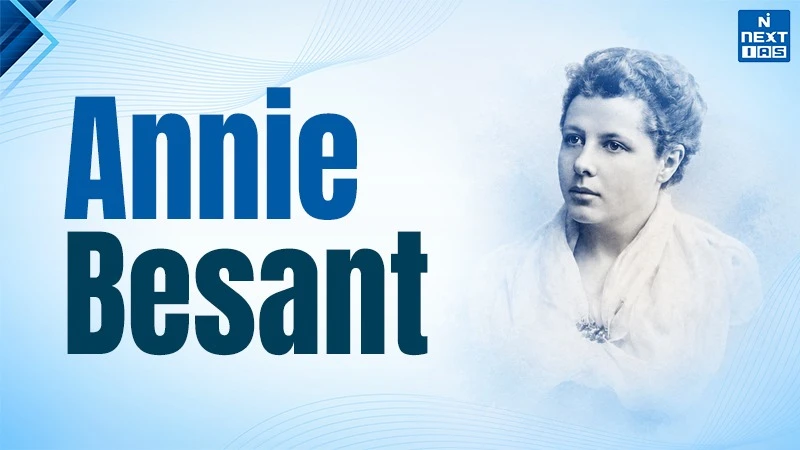
Anie Besant was the 1st female president of Indian National Congress (INC) in 1917. She launched the All-India Home Rule League in 1916 in India. She co-founded the Central Hindu College in Varanasi in 1898. It was later developed into the Banaras Hindu University (BHU) including the efforts of Madan Mohan Malviya. Annie Besant was a British born reformer and later became the voice for Indian people demanding self-rule for India under the British. She launched two newspapers 'New India' and 'Commonweal' in 1914 which strongly criticized colonial rule in India.
Biography of Annie Besant
Annie Besant was born as Annie Wood on 1st October 1847 in London, England. She began working as a writer, lecturer and social reformer in Britain. She raised her voice for the rights of workers and women, birth control, secular education and political reforms. Her association with the Fabian society in 1885 showed her interest in gradual social reforms in the society. She joined the Theosophical Society in 1889 and arrived in India in 1893. She became the president of the theosophical society in 1907.
Annie Besant founded the Central Hindu College at Benares in 1898. It later became an important centre of Banaras Hindu University (BHU). She launched the All India Home Rule League in 1916 and demanded self-rule for Indian people within the British Empire. She was elected as the 1st women President of the Indian National Congress (INC) in 1917. Annie Besant died on 20th September 1933 at Adyar in Madras, India.
Formation of Fabian Society
The Fabian Society was founded in London in 1884. The British intellectuals and reformers who were in the support of gradual, democratic and constitutional reforms helped in its formation. The name of the society emerged from the roman general Quintus Fabius Maximus also known for using strategic methods rather than direct confrontation.
The Fabian Society led welfare measures, labour rights, universal education and social equality. Annie Besant joined the Fabian society in 1885 and took part in the debates on social justice, condition of workers and public welfare. Her association with the society shaped her belief that reform could be achieved through education, organisation, public opinion and democratic politics.
Formation of Theosophical Society
The Theosophical Society was founded in New York in 1875 by Helena P. Blavatsky and Henry S. Olcott. It promoted universal brotherhood without discrimination of race, creed, gender, caste or color. The society encouraged the comparative study of religion, philosophy and science. It investigated the unexplained laws of nature and human capacity. The international headquarter of the theosophical society was established at Adyar in Madras in 1882.
Annie Besant joined the organization in 1889 and came to India in 1893, and became the president of the theosophical society in 1907. She promoted respect for spiritual traditions in India, self confidence among people for their culture, and educational modernisation.
Educational Reforms by Annie Besant
| S.No. | Initiative or Institution | Year | Contribution to Education |
|---|---|---|---|
| 1 | Settlement in Benares | 1896 |
|
| 2 | Central Hindu School and College, Benares | 1898 |
|
| 3 | Promotion of national education | Early 20th century |
|
| 4 | Support for women's education | Early 20th century |
|
| 5 | Contribution in foundation of BHU | 1916 onwards |
|
Annie Bessant as INC President
Annie Besant became the 1st women President of Indian National Congress (INC) at the Calcutta session in 1917. It further led to the strengthening of the Home Rule agitation. As the president of India, she demanded responsible government and self-rule for India. She argued for the political rights of Indian people for their participation in the 1st world war. Her presidency reflected the growing role of women and worldwide supporters in the national movement.
Home Rule Movement
Annie Besant launched the All-India Home Rule League in 1916 to demand Home Rule or self government for Indians within the British Empire. The demands of Home Rule were broadly similar to the demand of dominion status by some of the nationalists. The Home rule league used public meetings, pamphlets, branches, political education and newspapers to propagate the nationalist consciousness in India.
The newspapers such as New India and Commonweal provided the platforms for the demand of self rule in India. The British government detained her in June 1917 but it further provoked nationwide protests and increased her popularity. The freedom movement of the Home rule league of Bal Gangadhar Tilak revived the nationalist politics and prepared a ground for later national mass movements.
Role of Annie Besant in India's Freedom Struggle
| S.No. | Area | Role of Annie Besant | Importance |
|---|---|---|---|
| 1 | Nationalist journalism |
|
|
| 2 | Home Rule Movement |
|
|
| 3 | Political mobilisation |
|
|
| 4 | Detention by British police |
|
|
| 5 | Indian National Congress |
|
|
| 6 | Educational nationalism |
|
|
| 7 | Theosophical work |
|
|
FAQs on 1st Women President of INC
Who was Annie Besant?
Annie Besant was a British reformer, theosophist, educationist and women's rights activist.
When did Annie Besant arrive in India?
Annie Besant arrived in India in 1893 to work for the Theosophical Society.
Which newspaper was started by Annie Besant?
Annie Besant renamed the 'Madras Standard' as 'New India' and started the weekly newspaper commonweal in 1914.
