
 80813-00200


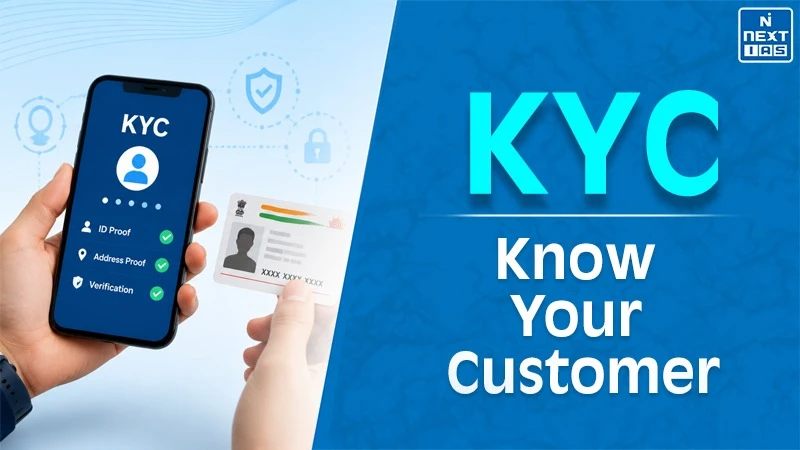
The Know Your Customer (KYC) is a regulatory practice adopted for sure and secure verification through fingerprint, iris or OTP based system. KYC is primarily used by financial organizations to confirm the identity of their clients or customers and avoid money laundering, terror financing and minimizing false verification.
The Central KYC Records Registry (CKYCRR) allots a 14 digit unique CKYC identification number which can be used to identify individuals anywhere in real time, avoiding repeated verification.
It ensures that real and identifiable individuals must gain complete access to the formal banking sector. Through gathering and verifying the required documentation, the KYC method enables organizations to know more about their customers.
Know Your Customer (KYC) यानी ‘अपने ग्राहक को जानो’ एक प्रक्रिया है जिसमें बैंक और वित्तीय संस्थाएं अपने ग्राहक की पहचान और पते की पुष्टि करती हैं। इसके लिए आधार, पैन, पासपोर्ट, ड्राइविंग लाइसेंस जैसे दस्तावेज़ लिए जाते हैं। KYC का मुख्य उद्देश्य मनी लॉन्ड्रिंग, धोखाधड़ी और आतंकवाद को वित्तपोषण रोकना है।
Objectives of KYC Verification
- The fundamental objective of KYC is to ensure that the identities of the customers are correctly known by the financial institutions. It ascertain with whom they are transacting business and eliminate any impersonation or identity theft.
- The KYC process includes determining the correct identity, residential address, and beneficiary's ownership of accounts and the true purpose of the relationship between the customer and the financial institution.
- It also prevents the financial system from being misused in activities such as money laundering, financing of terror activities, fraud and tax evasion. The suspicious activity can be detected and reported to the appropriate authorities through risk-based customer due diligence.
- The KYC maintains transparency and trust in financial markets by ensuring that all participants are traceable and subject to appropriate oversight.
- The Know Your Customer (KYC) data helps institutions to better understand the profiles of customers and their transaction behaviour. It enables more responsible credit decisions and product suitability assessments.
- In the Indian context, a strong framework of KYC supports financial inclusion initiatives such as bank accounts for the unbanked people.
- For India, the KYC procedures are helpful in increasing financial inclusion while protecting from possible misuses of simple accounts.
Important Components of KYC
| S.No. | Component | Details |
|---|---|---|
| 1 | Customer Identification Program or CIP |
|
| 2 | Customer Due Diligence (CDD) |
|
| 3 | Enhanced Due Diligence (EDD) |
|
| 4 | Beneficial Ownership Identification |
|
| 5 | Sanctions / PEP / Adverse Media Screening |
|
| 6 | Ongoing Monitoring |
|
Procedure and Steps to Follow in the Know Your Customer Process
- Firstly, the bank conducts document collection and verification procedures. The KYC begins from the customer registration process where a person comes to the bank with the aim of opening an account and provides identification and address documents as well as certain basic personal or corporate information about himself or herself.
- The customer information is then verified using official records or publicly available information, and screening against any sanctions.
- The risk level (low, medium or high) of the customer is assigned depending on several factors of the customer such as their nature of work, business model and transactions and the extent of due diligence carried out depends on the risk level assigned.
- After conducting all the necessary checks on the customer and getting approval for the account, the KYC process does not cease.
- The institution is expected to perform continuous monitoring of transactions, periodically updating the KYC information, and conducting a review in case of any suspicion of suspicious activity.
Major Types of KYC System
| S. No. | Type | Key features |
|---|---|---|
| 1 | Physical / Offline KYC |
|
| 2 | e-KYC (Electronic KYC) |
|
| 3 | Video KYC |
|
| 4 | Simplified / Small Account KYC |
|
| 5 | Central / Unified KYC |
|
E-KYC Process in Banking
- e-KYC or electronic know your customer is a method used by banks to digitally verify the identity and address of the customer without having any documents or visiting a branch.
- In India, the most popular method of conducting e-KYC is through the use of Aadhaar.
- Here, the customer explicitly provides permission or consent to the UIDAI, enters their Aadhaar number and goes through authentication through OTP or biometric authentication.
- The information such as name, age, gender, address, and photograph are provided to the bank. The bank takes such information as a valid official document under the PML regulations.
- The customer registers through the bank’s website or app, provides their basic information and Aadhaar number or PAN, completes the OTP or biometric or video KYC and gets instant approval after successful verification.
FAQs about KYC
What is the full form of KYC?
The KYC full form is Know Your Customer.
What is KYC in the Bank?
KYC is a mandatory verification process where a bank utilizes to confirm the identities of their customers.
