
 80813-00200


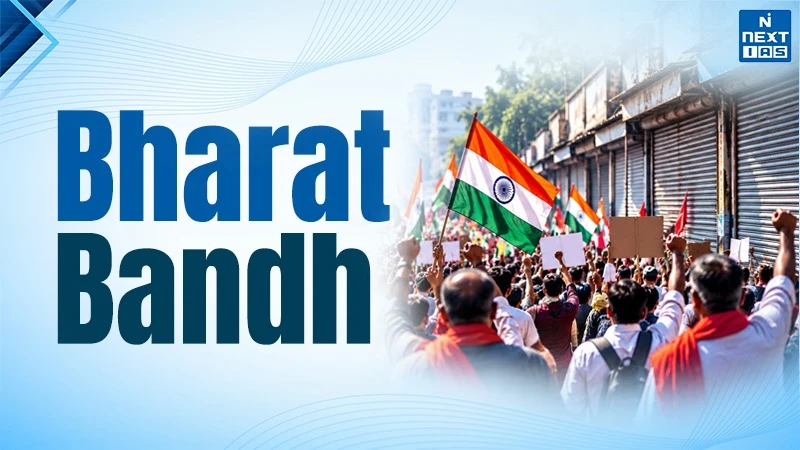
The Bharat Bandh means a nationwide call for shutting down activities across India either by organisations, trade unions, farmers' associations or political parties in order to highlight particular issues. This includes a range of activities including transport, market places, work places, etc., though the level of disruption caused differs from place to place.
The Bharat Bandh constitutes a kind of political manifestation and could help bring issues into open discussion. In an interesting move, the Supreme Court has clarified that a bandh is not the same thing as a general strike or hartal and that there is no right to enforce a bandh if it obstructs the fundamental rights of others.
Historical Evolution
The practice of Bharat Bandhs in India originated from the larger practice of hartals and strikes, which were held during the fight for independence. After the country won its freedom, Bharat Bandhs were adopted by various trade unions, political factions and social organisations as a mode of protesting against the government's policies.
Some of the major nationwide protests in India have been held over issues like economic reforms, labor laws, price rise and agrarian laws. Methods of protest too have progressed from traditional practices of demonstration and march towards newer forms of protests. Social networking sites have revolutionised the process of mobilization.
Major Reasons Behind Bharat Bandh
- Demands Pertaining to Labour and Employment: The reasons for calling a Bharat Bandh could be those related to issues like remuneration, job security, rights of labourers, social security, conditions of work and employment.
- Issues Pertaining to Agriculture: Farmer associations could launch a Bharat Bandh because of various issues related to agriculture.
- Price Hike and Economic Issues: Price hikes of basic necessities, fuel, food, and other necessities could also lead to the launch of a Bharat Bandh.
- Government Policies and Legislations: Organisations could organize a Bharat Bandh in opposition to some particular policy, reform or legislation of the government.
- Social and Political Issues: Various other wider issues related to social justice and welfare could also become the reason for a Bharat Bandh.
Bharat Bandh vs Strike vs Hartal
| Basis | Bharat Bandh | Strike | Hartal |
|---|---|---|---|
| Meaning | Nationwide shutdown/protest | Work stoppage | Voluntary closure/protest |
| Participants | Multiple groups | Usually workers/employees | Broader public participation |
| Scope | National | Organisation/sector-specific | Local or wider |
| Objective | Raise broader demands | Employment-related demands | Protest against an issue |
Effect of Bharat Bandh
- Transportation: Public transport including buses, taxis, three-wheelers, and others may suffer disruption due to the bandh, leading to inconvenience to travelers. However, there is variability based on different locations.
- Educational Institutions: Schools, colleges, and universities may not function because of disruption in the activities expected from them.
- Banking Facilities: Bank branches and other financial institutions may get affected if bank employees join the bandh, but banking through digital channels is likely to continue.
- Business Places: Shops, markets, malls, and other commercial establishments may remain closed due to their participation in the bandh.
- Government Departments: Reduced working staff and operational issues are expected in government departments as per the participation levels.
- Essential Services: Hospitals and other essential services such as electricity and water supply are considered first to keep minimum disruption.
Constitutional Status
- Article 19 and Freedom of Protest: Article 19(1)(a) is an assurance of freedom of speech and expression while Article 19(1)(b) is an assurance of the right to assemble peaceably and unarmed.
- Reasonable Restrictions: It should be noted that these freedoms are subject to reasonable restrictions, especially in matters of public order, as mentioned in Article 19.
- Supreme Court Comments: The Supreme Court has affirmed peaceful protest as a constitutional freedom while keeping aside activities that interfere with the rights and freedoms of other citizens. Courts have also stated that a bandh cannot become a reason for interfering with public life or property.
- Freedoms of Non-Bandh Participants: Citizens who are not a part of the bandh also continue to enjoy their constitutional rights and freedoms, including right to move around freely and carry on one’s trade/business.
- Maintenance of Public Order and Access to Basic Facilities: In view of maintaining public order and access to essential services, authorities are entitled to take legal steps. This means that any protest should be kept in perspective of rights, security and freedoms of citizens in general.
Major Bandhs in India
| Date | Organising groups | Main demand/issue | Impact |
|---|---|---|---|
| 20 September 2012 | Opposition parties, including BJP and Left parties | Protest against diesel price hike, LPG subsidy restrictions and FDI in multi-brand retail | Transport, markets and commercial activity were disrupted in several areas. |
| 25 September 2020 | Farmer organisations, with support from several trade unions and political groups | Opposition to the three farm laws enacted in 2020 | Markets, transport and other activities were affected in several regions. |
| 8 December 2020 | Farmer unions, supported by various opposition parties and organisations | Demand for repeal of the three agricultural laws | Road and rail movement, markets and business activity were affected in several states. |
| 27 September 2021 | Samyukt Kisan Morcha and participating farmer organisations | Opposition to the three farm laws and demand for their repeal | Several states reported closure of markets and disruptions to transport and other activities. |
| 12th February 2026 | Trade Unions | Anti workers Policies | Services in electricity, banking, insurance, transport, health, education, gas and water supply affected |
| June 6 to July 25, 2026 | Cockroach Janta Party (CJP) | The resignation of officials over the NEET-UG paper leak and exam issues | Students gather at Jantar-Mantar from all over the country |
| 21st August 2026 | Reservation Hatao Andolan (RHA) | Shifting reservations from caste-based criteria to economic criteria | Closer reported in several states |
Limitations and Problems Faced by Bharat Bandh
- Disruption of Economic Activities: A countrywide shutdown could temporarily impact trade, transportation, industry, and other economic activities especially when there is a large participation.
- Difficulty for Travelers and Businesses: Disturbances in public transport and shutting down of businesses or markets could pose problems for travelers and the business owners.
- Effect on Essential Services: Long disruptions could have an effect on access to health care, transportation, education, and other essential services.
- Problem of Coercion: The shutting down of the shops or business or any institution could be an issue when people who don’t want to participate are forced against their will.
- Loss of Income and Reduced Productivity: There is the loss of income for daily wage earners and businesses whereas shutting down work reduces productivity.
- Maintaining a Balance Between Rights: One of the main problems faced is that of balancing the right to peaceful demonstration with the right of those who do not participate to travel, work, trade, and access essential services.
FAQs
What is a Bharat Bandh?
It is a nation-wide protest or strike called for by different groups to emphasise their demands or dissent against certain policies and issues.
Who can organise a Bharat Bandh?
Trade Unions, Farmers' Unions, Political Parties, Social Organizations and other such organizations can organise a Bharat Bandh.
Is participation in Bharat Bandh compulsory?
No, citizens and business entities do not participate in Bharat Bandh automatically. Participation and non-participation both should respect each other.
Which facilities will not operate during Bharat Bandh?
Transport services, Markets, Educational Institutions, Banks and Workplaces etc. might not function during a Bharat Bandh, however, emergency and essential services continue as usual.
