


Syllabus: GS2/IR; GS3/Infrastructure; Internal Security
Context
- Recent sanctions for border infrastructure in Arunachal Pradesh, alongside India’s External Affairs Minister’s remarks on increased frontier activity, have renewed concerns about India’s infrastructure preparedness against China.
Need for Modern Infrastructure Along India–China Border
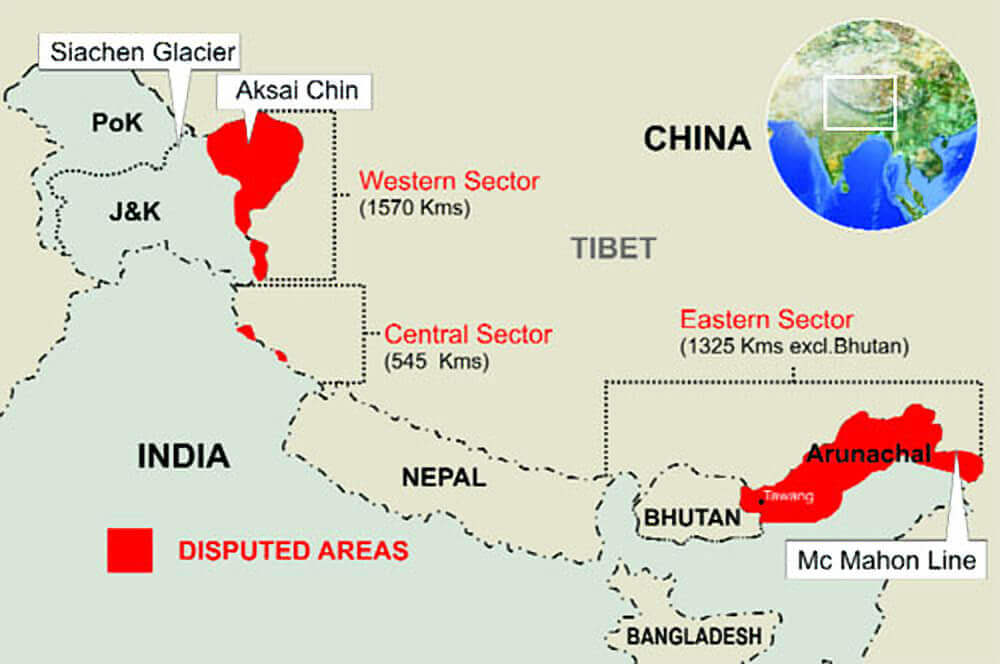
- India and China share an approximately 3,488-km disputed border, where the Line of Actual Control (LAC) remains mutually undelineated. Infrastructure development is therefore closely linked to national security and territorial claims.
- Modern border infrastructure is essential for:
- Military Preparedness: Roads, tunnels, railways and airfields enable rapid troop mobilisation, equipment movement and emergency reinforcement.
- Logistical Resilience: All-weather connectivity ensures uninterrupted supplies of food, fuel, ammunition and medical assistance.
- Territorial Security: Permanent settlements and regular administrative presence strengthen India’s ability to manage remote frontier regions.
- Socio-economic Development: Connectivity improves livelihoods, healthcare, education and tourism while discouraging migration from border villages.
- Disaster Management: Reliable transport and communication networks improve responses to landslides, avalanches and other Himalayan hazards.
Understanding the Infrastructure Gap Between India and China
- China’s Long-Term Strategic Approach: China has developed an extensive network of highways, railways, airfields, communication systems and Xiaokang (moderately prosperous) border villages. Its advantage rests on two factors:
- Long-term Investment: China’s 14th Five-Year Plan (2021–2025) envisaged investments exceeding 600 billion yuan in major projects across Tibet, although not all were border-specific.
- Legal Backing: China’s Land Border Law, effective January 2022, provides a statutory framework for border defence, infrastructure development and settlements.
- Together, these measures strengthen military logistics and reinforce China’s territorial claims through a permanent presence.
- India’s Improving but Uneven Response: India accelerated frontier development following the 2017 Doklam standoff and 2020 Galwan Valley clashes.
- However, China’s integrated planning contrasts with India’s historically fragmented approach, which involves multiple ministries, security agencies and State governments.
- The infrastructure gap concerns not merely road length but also connectivity, operational reliability and the capacity to sustain deployments throughout the year.
Key Constraints & Hurdles: Logistical and Geographical
- Difficult Himalayan Terrain: High altitudes, unstable slopes, earthquakes, landslides, heavy snowfall and short construction seasons increase costs and delay projects.
- Administrative Fragmentation: Coordination among the Ministries of Defence, Home Affairs, Railways, State governments and environmental authorities often slows approvals and execution.
- Limited Strategic Railway Connectivity: The proposed 489-km Bilaspur–Manali–Leh railway, involving approximately 270 km of tunnels, has a prepared Detailed Project Report (DPR), but construction sanction remains pending.
- Logistical Limitations: Dependence on road transport creates vulnerabilities during severe weather. Airlift provides flexibility but cannot replace high-capacity surface networks.
- Last-mile Development Gaps: Inadequate electricity, telecommunications, healthcare and livelihood opportunities make sustained civilian habitation difficult.
Recent Infrastructure Initiatives by India
- Increased Investment in Border Roads: The Border Roads Organisation (BRO) recorded expenditure of ₹16,690 crore in 2024–25. Its capital budget allocation increased from ₹7,146.50 crore in 2025–26 to ₹7,394 crore in 2026–27.
- Strategic Road and Tunnel Projects:
- Atal Tunnel and Sela Tunnel: Improve connectivity towards Ladakh and Tawang, respectively.
- Zojila and Shinkun La Tunnels: Aim to strengthen all-weather access to Ladakh.
- Arunachal Frontier Highway (NH-913): Recent approval of approximately 1,500 km at ₹44,000 crore, with work initiated on eight packages covering 266 km.
- New Border Roads and Bridges: Recent reports indicated clearance of 26 roads under Indo-China Border Roads (ICBR) Phase-III and ITBP approval for 33 bridges in Arunachal Pradesh. The road programme’s details had not yet been formally announced publicly.
- Vibrant Villages Programme (VVP), 2023: It targets development along India’s northern borders through better connectivity, public services and livelihoods.
- The Arunachal Pradesh government reported 1,099 completed projects out of 2,414 projects covering 455 border villages.
Way Forward: Building a Resilient Frontier
- Establish Integrated Governance: Consider a Border Infrastructure Development Authority with statutory coordination powers and assured multi-year financing.
- Adopt Evidence-based Planning: Develop a Composite Frontier Infrastructure Index to identify gaps in connectivity, logistics, communications and operational readiness across sectors.
- Expand Institutional Participation: BRO should prioritise strategic forward connectivity, while NHAI, NHIDCL and capable private companies strengthen supporting transport networks.
- Improve Technological Capacity: Use satellite monitoring, geospatial mapping, advanced tunnelling and climate-resilient engineering, supported by independent quality audits.
- Strengthen Inhabited Border Villages: Ensure reliable power, broadband, healthcare, education and sustainable livelihoods, while involving local communities in development.
- Maintain Ecological Safeguards: Infrastructure expansion must incorporate environmental assessments, slope stabilisation and disaster-resilient construction.
Conclusion
- India needs to move beyond crisis-driven construction towards long-term, integrated frontier development.
- Secure borders require not only military infrastructure but also resilient logistics, functioning institutions and thriving border communities.
- Such an approach can strengthen both national security and inclusive regional development.
| Daily Mains Practice Question [Q] Border infrastructure is not merely a means of improving military mobility but an instrument of territorial security and regional development. Examine the major challenges in developing infrastructure along the India–China border. |
Previous article
Constitution of India: An Inseparable Part of Our Life Journeys
Next article
Bridging India’s Critical Border Infrastructure Gap
