


Syllabus: GS3/ Economy
In News
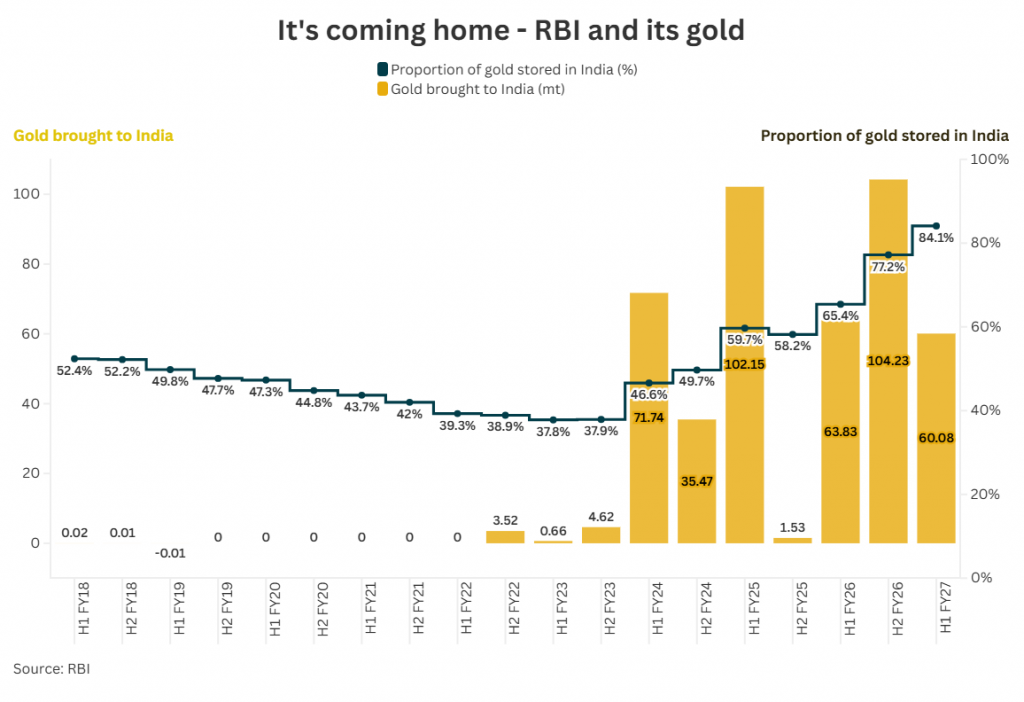
- The RBI’s half yearly report on the management of foreign exchange reserves shows that it now keeps 84% of its gold in India, more than double the 39% it held in the country four years ago.
More on the News
- Gold Held in India: It rose to 740.13 tonnes at the end of September 2026, from 680.05 tonnes at the end of March 2026, out of total holdings of 880.52 tonnes.
- Steady Repatriation: The RBI has moved more gold to India every year since October 2022, bringing back a record 168.06 tonnes in 2025-26.
| Forex Reserves |
| – They are the assets held by the central bank in foreign currencies and gold, used to pay for imports, repay external debt and stabilize the rupee. |
| – Foreign Currency Assets (the largest part), gold, Special Drawing Rights (SDRs) and the Reserve Tranche Position with the IMF. |
Why is Gold Considered a Reserve Asset?
- Universally Accepted: Gold is accepted by every country and can be sold, swapped or pledged anywhere in the world, even when a currency loses trust.
- Store of Value: Gold has kept its purchasing power over centuries, which makes it a long term hedge against inflation.
- Hedge Against Currency Risk: When the dollar weakens or the rupee falls, gold prices usually rise, which protects the value of reserves.
- Safe Haven in Crises: During wars, financial crises and pandemics, investors move to gold, so its value tends to rise when other assets fall.
- E.g. Gold prices hit record highs during the COVID pandemic and the West Asia conflict.
- Diversification: Gold moves differently from bonds and currencies, so holding it reduces overall risk in the reserve portfolio.
- Sanctions Proof: Gold kept at home cannot be frozen through the global payments system, unlike dollar assets.
- Collateral in Emergencies: Gold can be pledged to raise foreign currency quickly.
- E.g. India pledged gold in 1991 to avoid defaulting on its external payments.
- Confidence Signal: Large gold holdings signal financial strength to markets and credit rating agencies.
| Gold in the Monetary System |
| Gold Standard: Until the early 20th century, many currencies were directly convertible into a fixed amount of gold. |
| Bretton Woods System (1944 to 1971): The US dollar was fixed to gold at USD 35 an ounce, and other currencies were fixed to the dollar. It ended in 1971 when the US stopped converting dollars into gold. |
| At Present: No currency is backed by gold, but the IMF counts monetary gold as part of official reserves, and central banks remain among the largest holders of gold. |
Where does the RBI keep its gold?
- In its own vaults in India, and abroad with the Bank of England and the Bank for International Settlements (BIS).
- London is the centre of the global gold market, so gold kept there can be traded, swapped or pledged quickly.
- In 2024, the RBI brought back about 100 tonnes from the UK, one of the largest such moves since 1991.
Gold and Indian Households
- Private Holdings: Indian households are estimated to hold over 25,000 tonnes of gold, many times the RBI’s holdings, mostly as jewellery.
- Import Burden: India imports most of its gold, which adds to the current account deficit and pressure on the rupee.
- Government Schemes: The Gold Monetisation Scheme (2015) and Sovereign Gold Bonds (2015) aimed to bring idle gold into the formal system and reduce imports. New SGB issues and the medium and long term deposits under the Gold Monetisation Scheme were discontinued in 2025 due to high costs from rising gold prices.
Why is the RBI Bringing Gold Home?
- Reserves can be used as a weapon: After Russia invaded Ukraine in 2022, the US and its allies froze Russia’s foreign reserves. This showed that assets kept abroad can be blocked in a conflict.
- More control and security: Gold at home cannot be frozen or seized by another country, which supports India’s strategic autonomy.
- A global trend: The World Gold Council’s 2026 survey found that 9% of central banks raised their domestic storage in the past year, up from 5% a year earlier.
- 1991 BoP Crisis: During the balance of payments crisis, India had to pledge 67 tonnes of gold abroad to the Bank of England and the Bank of Japan to help meet immediate external payment obligations and restore confidence.
Concerns
- Lower Liquidity: Gold stored in London can be quickly sold, swapped or pledged in global markets. Gold in India is harder to use in an emergency.
- Storage and Security Costs: Domestic vaults need high security, insurance and auditing.
- No Returns: Unlike bonds, gold earns no interest, so a larger gold share means lower income on reserves.
- Price Volatility: Sharp swings in gold prices change the value of reserves without any change in quantity.
Way Forward
- Diversified Reserves: Gradually balance dollar assets with gold and other currencies without disrupting returns.
- Develop Domestic Gold Markets: Strengthen the India International Bullion Exchange at GIFT City so that gold held in India becomes easier to trade.
- Rupee Internationalisation: Expand rupee trade settlement to reduce dependence on the dollar over the long term.
Source: IE
Previous article
News In Brief 26-11-2026
Next article
Ambedkar’s Idea of Conscience in Democracy
