


Syllabus: GS3/Economy
Context
- The government approved 12 new projects under the Electronics Component Manufacturing Scheme (ECMS).
About
- Tamil Nadu accounts for four projects, Gujarat and Maharashtra two each, while Punjab, Uttar Pradesh, Madhya Pradesh and Karnataka account for one each.
- With these approvals, overall, 118 applications covering 34 products across 16 States have been approved under ECMS.
Electronics Component Manufacturing Scheme (ECMS)
- It was launched in 2025 and has a tenure of six years, with an optional one-year gestation period.
- Aim: To build a strong and self-sustaining ecosystem for electronics component manufacturing in the country.
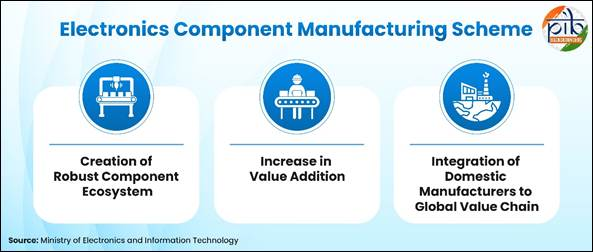
- The ECMS seeks to integrate India’s electronic industry with global value chains by encouraging production of essential components, sub-assemblies, and raw materials within the country.
Electronics Sector in India
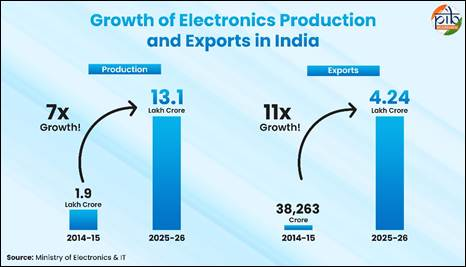
- Electronics production increased from ₹1.9 lakh crore in 2014–15 to ₹13.11 lakh crore in 2025–26.
- Electronics exports grew from ₹38,000+ crore to ₹4.24 lakh crore during the same period.
- India is the second largest mobile phone producer in the world.
- India has achieved near self-reliance in mobile production- from importing 78% of its requirements in 2014–15 to manufacturing almost all devices domestically today.
- Top 5 export destinations for Indian electronic goods in FY 2024–25 are the United States, United Arab Emirates, the Netherlands, the United Kingdom, and Italy.
- Electronics manufacturing created 25 lakh jobs in the last 10 years.
- Future Projections: India has a vision of building a $500 billion domestic electronics manufacturing ecosystem by 2030–31.
Government Initiatives
- Make in India: Launched in 2014, aimed at boosting India’s manufacturing sector and economic growth.
- Transform India into a global hub for design and manufacturing.
- Phased Manufacturing Programme (PMP): Launched in 2017, aimed to promote domestic value addition in mobile phones and their parts.
- Increased investment and set up significant manufacturing capacities in India.
- Production Linked Incentive Scheme (PLI) for Large Scale Electronics Manufacturing: Introduced performance-linked incentives of 4%–6% on incremental sales for eligible target segments. The focus is on scaling domestic electronics and mobile manufacturing.
- PLI for IT Hardware: Offers production-linked incentives to boost domestic manufacturing and attract investment. PLI 2.0 builds on this to strengthen the manufacturing ecosystem, cut import reliance, and position India as a trusted global supply-chain hub.
- Semicon India Programme: The ₹76,000-crore Semicon 1.0 programme created a broader semiconductor and display manufacturing ecosystem. It complements electronics manufacturing with support for fabs, packaging, testing, design and related capabilities.
- Electronics Manufacturing Clusters (EMC) Scheme: This offers financial assistance of up to 50% of the project cost with a ceiling of ₹50 crore for every 100 acres of land for greenfield projects.
- Electronics Development Fund (EDF): Serves as a Fund of Funds investing in venture funds (Daughter Funds) to supply risk capital and promote market-driven innovation, product design, and startup growth in ESDM and IT.
- The Scheme for Promotion of Manufacturing of Electronic Components and Semiconductors (SPECS): The scheme will provide financial incentive of 25% on capital expenditure for the identified list of electronic goods that comprise downstream value chain of electronic products.
Conclusion
- The Electronics Components Manufacturing Scheme has emerged as a cornerstone of India’s electronics manufacturing strategy.
- The Union Budget 2026–27 enhanced its outlay to ₹40,000 crore, reflecting a strong policy commitment to expanding domestic production capacity.
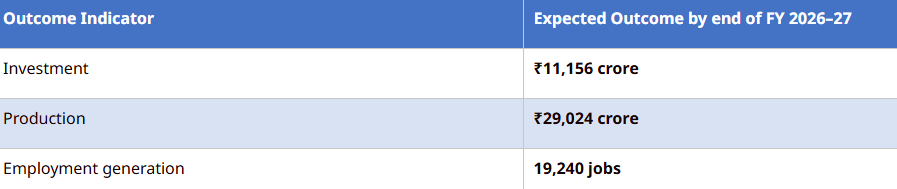
- ECMS has mobilised substantial investment, increased production, and generated significant employment.
Source: TH
Previous article
Revolutionising Agricultural Extension for Viksit Bharat 2047
