


Syllabus: GS1/Role of Women; GS2/Education’ GS3/ S&T
Context
- Data obtained under the Right to Information (RTI) Act reveals a substantial rise in female enrollment across various Indian Institutes of Technology (IITs), marking a pivotal moment in the journey toward greater inclusivity and gender equity in India’s premier institutions of higher education.
About
- The introduction of a 20% quota for women in the Indian Institutes of Technology (IITs) has proven to be a significant step towards gender inclusivity in India’s premier engineering institutions.
- It has led to a remarkable increase in the number of female students at IITs, demonstrating that affirmative action can effectively bridge gender gaps in traditionally male-dominated fields.
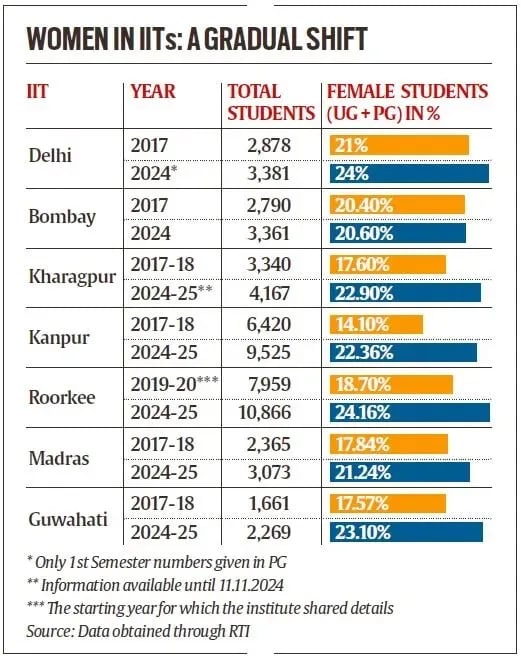
- According to the data, IITs Delhi and Bombay crossed the 20% threshold as early as 2017 — even before the quota was implemented.
Beyond Numbers: Cultural and Infrastructural Shifts
- The quota has not only increased the number of women in IITs but has also led to essential infrastructural and cultural changes.
- Many IITs have expanded hostel facilities, constructed more washrooms for female students, and introduced women’s sports teams, creating a more inclusive environment.
- These changes challenge the traditional narrative that STEM fields are predominantly for men and signal a future where women’s voices and innovations are integral to India’s technological advancement.
| Do You Know? – The female supernumerary quota in admissions to IITs was introduced in 2018 after the recommendations by a committee headed by the then IIT Mandi director Timothy Gonsalves. – Popularly known as ‘the required slight push’, this was aimed at repairing the skewed gender ratio on IIT campuses predominantly occupied by boys. – It recommended that instead of reserving seats in the already existing pool, additional seats were created for girls under the female supernumerary quota without affecting the general pool. – With 14% at the beginning of the academic year 2018-19, the number of female supernumerary seats rose to 19% in 2019-20. 1. The aim was to have 20% female supernumerary seats in all IITs by 2021-22. – The Joint Seat Allocation Authority oSAA), is an agency established by the Ministry of Education to manage and regulate the admission to 110 tertiary institutes administered by the Government of India. |
Concerns & Challenges
- Gender Gap: Women scientists may find it challenging to secure permanent positions or promotions, as seen in the case of Uma, a molecular biologist who faced career setbacks after taking maternity leave.
- Low Participation in the Labour Market: Women make up almost half (49.3%) of total employment across non-STEM occupations, but just 29.2% of all STEM workers.
- India has a high percentage of women enrolling in STEM fields (approx 40%), but their representation is significantly lower (around 14%).
- The numbers on the integration of STEM university graduates into the labour market show that the retention of women in STEM even one year after graduating sees a significant drop.
- Other concerns are work life balance, cultural and social factors, lack of mentorship and support networks, and low representation in leadership roles etc.
Key Government Initiatives
- Women in Science and Engineering-KIRAN (WISE-KIRAN): The Department of Science and Technology (DST) has launched several programs under the WISE-KIRAN scheme with the aim to enhance women’s participation in STEM through various support mechanisms, including fellowships and leadership programs.
- It has benefited over 340 women scientists, providing them with opportunities to advance their careers.
- Vigyan Jyoti: It has been instrumental in encouraging young girls to pursue STEM education, and has impacted over 29,000 girls, promoting STEM fields as viable career options.
- Prime Minister’s Early Career Research Grant (PM ECRG): It supports young researchers, including women, with flexible budgets for impactful projects.
- Women Scientist Scheme (WOS):
- WOS-A: Research in Basic/Applied Science.
- WOS-B: Societal programs through science and technology interventions.
- WOS-C: Intellectual Property Rights (IPR) training.
- Science and Engineering Research Board (SERB) – POWER (Promoting Opportunities for Women in Exploratory Research):
- SERB-POWER Fellowship: Supports women researchers.
- SERB-POWER Research Grants: Provides funding for research projects led by women.
- Biotechnology Career Advancement and Re-orientation Programme (Bio-CARe): Supports women scientists in biotechnology.
- INSPIRE (Innovation in Science Pursuit for Inspired Research):
- SHE (Scholarship for Higher Education): Provides scholarships to girls pursuing higher education in science.
Road Ahead
- According to the All India Survey on Higher Education (AISHE) for 2021-22, women comprise only 11.3 lakh of the total enrolled students in engineering and technology, compared to 27.6 lakh men.
- Bridging this gap requires continued efforts to ensure that gender-neutral policies, mentorship, and a culture of inclusivity allow women to realize their full potential.
Conclusion
- The quota for women at IITs is a testament to the effectiveness of inclusion policies. It has not only increased female representation but also fostered a more inclusive and supportive environment for women in STEM.
- As more women enter these prestigious institutions, they will undoubtedly contribute to shaping India’s intellectual and technological future.
| Daily Mains Practice Question [Q] To what extent does the implementation of quotas for women in higher education serve as evidence for the effectiveness of inclusion policies in higher education, considering factors like academic performance, diversity, and overall institutional impact? |
Previous article
Enhancing Governance in India in a Digital Way
Next article
Debate Over River Interlinking in India
