


Syllabus: GS2/Governance; GS3/Water Conservation
Context
- Water budgeting has emerged as an important tool for improving rural water governance amid rising water stress, groundwater depletion, and increasing agricultural demand in India.
What is Water Budgeting?
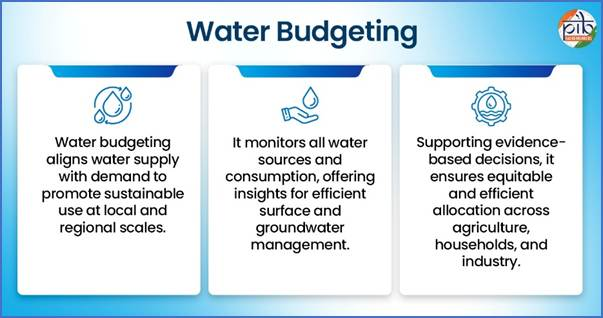
- Water budgeting involves a systematic assessment of water availability and demand within a defined geographical unit such as a village, watershed, block, or district, with the objective of balancing water use with renewable availability.
- It estimates all sources of water availability such as rainfall, surface water, and groundwater recharge against total demand from agriculture, households, livestock, and industry.
Why India Needs Water Budgeting?
- From a governance perspective, water budgeting supports informed and evidence-based decision-making. It helps identify surplus and deficit areas while ensuring efficient water allocation across sectors.
- India has 17.5 percent of the global population and 11.6 percent of the world’s livestock. This creates significant demand on water resources. Agriculture accounts for 80 to 90 percent of water use in rural areas.
Government Initiatives
- Jal Jeevan Mission (JJM): It was launched in 2019 to provide Functional Household Tap Connections (FHTCs) to rural households, and has brought tap water to nearly eight out of every 10 rural households.
- The mission improves health and sanitation, reduces the burden on women, strengthens decentralised water management, and has now been extended till 2028.
- Atal Bhujal Yojana (ATAL JAL): It focuses on sustainable groundwater management in water-stressed regions. Its key features include community participation, water budgeting, aquifer mapping, and behavioural change.
- It marks a shift from supply-side to demand-side management.
- National Water Mission (NWM): It recognises water budgeting as a foundational element of Integrated Water Resources Management (IWRM).
- Pradhan Mantri Krishi Sinchayee Yojana (PMKSY): Its objective is ‘Per Drop More Crop’. Its components are micro-irrigation, drip and sprinkler systems, and water-efficient agriculture.
- Atal Mission for Rejuvenation and Urban Transformation (AMRUT) Mission: It aims to improve urban water supply, develop sewage treatment systems, and promote wastewater reuse.
- Urban India faces increasing pressure from rapid population growth and pollution.
- Namami Gange Programme: Integrated river rejuvenation programme focusing on pollution control, sewage treatment, biodiversity conservation, and riverfront development.
- It reflects a basin-based approach to river governance.
- Varuni Web Application: A digital platform that supports block-level water budgeting using data-driven assessments.
- Helps local authorities identify water surplus and deficit areas.
- Jalyukt Shivar Abhiyan (JSA): Launched in 2014, it aims to drought-proof villages through groundwater recharge and water conservation. It has helped make over 11,000 villages drought-free, increased groundwater levels by 1.5–2 metres, and improved agricultural productivity by 30–50%.
Challenges
- Institutional Fragmentation: Multiple agencies handle irrigation, drinking water, groundwater, sanitation, and urban water supply.
- It creates policy overlaps, coordination failures, and weak accountability.
- Interstate Water Disputes: Conflicts such as Cauvery dispute, Krishna water dispute, and Ravi-Beas conflict show the limitations of cooperative federalism in water sharing.
- Predominance of Engineering-Centric Approach: Water management policies in India have historically focused on large-scale infrastructure such as dams, canals, and irrigation systems.
- This approach prioritises supply augmentation while neglecting ecological sustainability and demand management.
- Weak Data Systems: There is a lack of reliable, comprehensive, and accessible water data across the country.
- This leads to poor planning, inefficient allocation, and unregulated extraction of water resources.
- Agricultural Policies: Agricultural policies promoting water-intensive crops such as rice and wheat have led to excessive groundwater extraction.
- Climate Change: Changing rainfall patterns are increasing floods, droughts, and extreme weather events. It necessitates climate-resilient water governance.
- Pollution and Water Quality: According to CPCB reports, rivers are heavily polluted due to untreated sewage and industrial discharge; and groundwater contamination by arsenic and fluoride affects several States.
Way Forward
- States should institutionalise water budgeting at Gram Panchayat and watershed levels, as water is a State subject under Schedule VII, to strengthen participatory and evidence-based water governance.
- Encourage crop diversification and reduce the cultivation of water-intensive crops in water-stressed regions.
- Strengthen groundwater regulation through aquifer mapping, recharge measures, and community participation.
- Improve real-time water data collection, digital monitoring, and GIS-based planning tools.
- Build climate-resilient water infrastructure to address floods, droughts, and rainfall variability.
Source: PIB
Previous article
Deep-Tech Innovation as a Driver of India’s Growth
Next article
News In Short 30-05-2026
