


Syllabus: GS3/Economy
Context
- World Tourism Day 2026 is observed on 27 September under the theme “Digital Agenda and Artificial Intelligence to Redesign Tourism”,.
About
- World Tourism Day is an initiative of the United Nations World Tourism Organisation (UNWTO).
- It commemorates the adoption of the UNWTO statutes in 1970.
- It was first celebrated in 1980, the day highlights the contribution of tourism to socio-economic development and its role in advancing the Sustainable Development Goals (SDGs).
- The 2026 theme highlights the role of technology in shaping the future of tourism.
- Globally, travel and tourism contributed US$10.9 trillion, or 10% of global GDP, in 2024, while supporting 357 million jobs and generating US$1.9 trillion in international visitor spending.
Tourism Sector in India
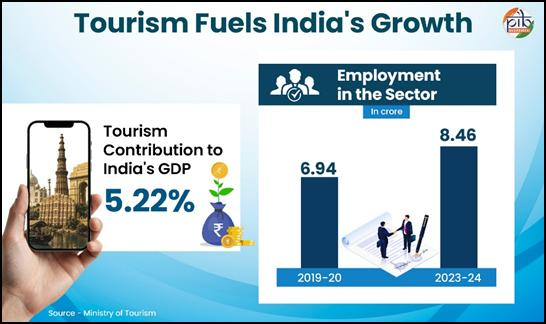
- The sector contributed 5.22% to GDP and supported 8.46 crore jobs in 2023-24.
- Domestic Tourist Visits reached 428.55 crore in 2025, while Foreign Tourist Visits rose to 2.53 crore.
- The foreign exchange earnings from tourism increased to ₹2,76,831 crore.
- The aim is for tourism to contribute 10% of the economy by 2047 — aligning with global benchmarks.
India’s Diverse Tourism Landscape
- Spiritual and Pilgrimage Tourism: Destinations such as Ayodhya, Kashi, Bodh Gaya, Amritsar, Tirupati and Puri attract pilgrims and visitors from across India and abroad.
- Buddhist Circuits and Cultural Linkages: India’s Buddhist heritage connects it with communities and travellers across Asia.
- The main sites covered under the circuit span the life of Buddha from his birth to his Parinirvana and comprise Bodh Gaya, Vaishali, Rajgir, Kushinagar, Sarnath and Shravasti, along with Kapilavastu and Lumbini.
- Four Holiest Buddhist Sites (Chaturmahāsthāna):
- Lumbini (Nepal): Birthplace of Gautama Buddha.
- Bodh Gaya (Bihar): Attained Enlightenment under the Bodhi Tree.
- Sarnath (Uttar Pradesh): First sermon (Dhammachakra Pravartana).
- Kushinagar (Uttar Pradesh): Mahaparinirvana (death).
- Heritage and Cultural Tourism: India’s heritage is reflected in its forts, palaces, temples, archaeological sites, museums and historic cities.
- Classical dance and music, festivals, handicrafts and regional cuisines allow visitors to experience traditions that continue to thrive across generations.
- Wellness, Yoga and Medical Tourism: India’s longstanding traditions of Yoga, Ayurveda and other traditional systems of medicine give the country a distinctive place in wellness tourism.
- Eco Tourism and Wildlife Tourism: India’s diverse landscapes offer experiences ranging from wildlife safaris and birdwatching to trekking and nature trails.
- National parks, tiger reserves, wetlands, mangroves, forests and Himalayan landscapes provide opportunities to experience nature while supporting conservation.
- Coastal, Cruise and Experiential Tourism: Sea cruise passenger traffic increased from 1.08 lakh in 2014-15 to 4.62 lakh in 2025-26.
- International cruise terminals at Visakhapatnam, Mumbai and Chennai have been upgraded and operationalised. The East Coast Cruise Circuit has also been expanded with the addition of Puducherry.
- MICE Tourism:Meetings, Incentives, Conferences and Exhibitions, or MICE tourism, is an important part of India’s tourism strategy.
- The Ministry of Tourism has formulated a National Strategy and Roadmap for the MICE Industry to support the sector’s growth.
- India is strengthening its MICE infrastructure through major venues such as Bharat Mandapam, Yashobhoomi at Delhi and Jio World Centre at Mumbai.
Challenges
- Infrastructure Deficiencies: Many tourist destinations in India suffer from inadequate infrastructure, including poor road conditions, insufficient public transportation, and inadequate facilities in popular tourist areas.
- Environmental Degradation: Increased tourism leads to environmental problems such as pollution, overuse of natural resources, and damage to wildlife and ecosystems.
- Lack of Standardization: There is a lack of standardized quality control across various services in the tourism sector, from hotels and restaurants to tour operators. This inconsistency affects the overall tourist experience.
- Seasonality: Many tourist destinations face seasonal fluctuations, with high tourist numbers during peak seasons and low numbers during off-seasons.
- Marketing and Promotion Challenges: Effective marketing strategies are often lacking, and there is a need for better promotion of lesser-known destinations.
- Cultural Sensitivity and Management: Managing cultural heritage responsibly while balancing tourism needs is challenging.
Government Initiatives
- Enhancing Connectivity and Investment: In the 2025 budget, the Finance Minister announced a landmark initiative to develop 50 top tourist destinations in partnership with states through a challenge mode.
- This initiative aims to elevate tourism infrastructure, improve ease of travel, and strengthen connectivity to key sites.
- Swadesh Darshan Scheme: It was launched by the Ministry of Tourism in 2014–15 to develop tourism circuits around identified themes across the country.
- Under the scheme, the ministry has sanctioned 76 projects across 15 thematic tourist circuits. Of these, 75 projects have been physically completed.
- Building on this, Swadesh Darshan 2.0 adopts a destination-centric approach, focusing on sustainable and experience-based tourism.
- PRASHAD Scheme: The Pilgrimage Rejuvenation and Spiritual Heritage Augmentation Drive (PRASHAD) was launched in 2014-2015 to develop tourism infrastructure at identified pilgrimage and heritage destinations.
- The scheme provides financial assistance to States and Union Territories for integrated development of these destinations, with interventions focused on visitor facilities, accessibility, cleanliness, safety, and local livelihoods.
- Special Assistance to States for Capital Investment (SASCI): It supports the development of iconic tourist destinations to global standards. It focuses on better tourism infrastructure, connectivity and visitor facilities.
- Under Capacity Building for Service Providers (CBSP), the Ministry of Tourism provides short-term training for skilling, upskilling, and reskilling.
- It covers local communities, tribal areas and youth from underprivileged backgrounds. Hunar Se Rozgar Tak is also implemented under the scheme.
- Atithi Devo Bhava Campaign: This initiative promotes hospitality and the cultural ethos of treating guests with utmost respect and care.
- It includes training programs for service providers in the tourism sector.
- Visa Reforms: The introduction of e-visa facilities for citizens of many countries has simplified the process for obtaining a visa to visit India. This move aims to attract more international tourists.
- Support for Sustainable Tourism: The government is promoting eco-friendly and sustainable tourism practices through various schemes and guidelines, including the promotion of responsible tourism.
- Measures to Facilitate Employment-Led Growth in the 2025-26 Budget:
- Providing MUDRA loans for homestays;
- Providing performance-linked incentives to states for effective destination management, including tourist amenities, cleanliness, and marketing efforts and;
- introducing streamlined e-visa facilities along with visa-fee waivers for certain tourist groups.
Conclusion
- The World Tourism Day 2026 theme reflects this changing landscape, where Technology, Data and Artificial Intelligence are becoming integral to the tourism experience.
- India’s expanding digital platforms, AI-enabled services, destination development, connectivity and skill-building efforts are helping create a more seamless and connected tourism ecosystem.
Source: PIB
Previous article
Should Voting Be a Fundamental Right?
Next article
Strengthening Dam Safety in India
