


Anti-Goonda Bill, 2026
Syllabus: GS2/Governance
In News
- The President of India returned the West Bengal Public Safety and Control of Anti-Social Activities Bill, commonly known as the ‘anti-Goonda’ Bill, to the state for reconsideration.
Bengal anti-Goonda Bill
- It is a preventive detention statute aimed at “goondas” and “anti-social activities”
- Detention Period: It allows authorities to detain a person for up to 12 months — without trial — and bar (or extern) them from entering a specified “area, district or districts” for up to the same period to prevent ‘anti-social’ activity.
- Definitions: It has expansive definitions of the term ‘goonda’, as well as ‘anti-social activity’.
- A goonda is a person who is “generally reputed to be desperate and dangerous to the community” or is a “Habitual Offender.”
- An “anti-social activity” covers conduct that directly or indirectly causes “alarm or insecurity among the public, danger to life or property, disturbance of public order, unlawful dispossession, or illegal mining, quarrying, sand or forest activity that drains the public exchequer.”
- Search and seizure : It also allows for search and seizure, punishes the harbouring of a detained or externed person, grants officials good-faith immunity, and makes offences cognizable and non-bailable.
Controversies
- Three Public Interest Litigations challenging the Bill were moved in the Calcutta High Court over its sweeping provisions,
- The High Court dismissed the three PILs mentioned above, saying the petitions were premature because the Bill had not yet received the President’s assent to become a law
- President Droupadi sent back the West Bengal Public Safety and Control of Anti-Social Activities (‘anti-Goonda’) Bill to the State Legislature for review.
- The Center argued that the provisions for offences under the Narcotic Drugs and Psychotropic Substances (NDPS), 1985, overlap with the preventive-detention regime under the Prevention of Illicit Traffic in Narcotic Drugs and Psychotropic Substances Act, 1988, leading to parallel mechanisms and possibly repugnancy under Article 254.
Constitutional Provisions
- Under Article 200, a State Bill generally requires the Governor’s assent to become law. The Governor may assent, withhold assent, or reserve the Bill for the President’s consideration.
- Reservation is mandatory if the Bill would weaken the powers of the High Court and endanger its constitutional position.
- The Governor may also return a non-Money Bill for reconsideration; if the legislature passes it again, the Governor cannot withhold assent.
- Article 201 provides that a State Bill may be reserved by a Governor for the consideration of the President who may give consent or withhold assent.
- In case of a non-Money Bill the President may also request the Governor to re-submit the Bill to the State Legislature for reconsideration.
- It must be reconsidered by the legislature within six months and if again passed with or without revisions, the Bill is delivered to the President for review.
Status in Other States
- Goonda laws exist in several states, most notably in Gujarat, as the Prevention of Anti-Social Activities Act, 1985.
- The Bharatiya Nyaya Sanhita also has provisions to deal with organised crime.
- Preventive detention is permitted under Article 22 of the Constitution with certain safeguards. Such issues are legislated under “public order,” which is a state subject.
Source :IE
Declining Sugar Production in Uttar Pradesh
Syllabus: GS3/ Agriculture
Context
- The sugar production in Uttar Pradesh has declined from 126.4 lakh tonnes in 2019–20 to 89.5 lakh tonnes in 2025–26, due to the spread of red rot disease in the widely cultivated Co-0238 sugarcane variety.
Red Rot Disease in Sugarcane
- Red rot is a fungal disease caused by Colletotrichum falcatum, which affects the vascular system of sugarcane and disrupts the transportation of water and nutrients.
- The disease causes leaf yellowing, wilting, internal reddening of the cane, and eventually, the drying and hollowing of the stems, resulting in substantial yield losses.
Sugar Production in India
- India has been the largest consumer and second largest producer of sugar in the world.
- In India, Sugar production in the 2025–26 sugar season is estimated at around 279 lakh tonnes (lt).
- Production process: Sugar is produced from sugarcane by crushing the crop, extracting the juice, boiling it to form a syrup, crystallizing it, and centrifuging the raw sugar crystals.
- Location of Sugar Industry in India: Sugar industry is broadly distributed over two major areas of production:
- Uttar Pradesh, Bihar, Haryana and Punjab in the north and
- Maharashtra, Karnataka, Tamil Nadu and Andhra Pradesh in the south.
Geographical Conditions for Sugarcane Growth
- Climate: Requires hot (21°-27°C) and humid (75-150 cm) conditions.
- Excess rainfall reduces sugar content; insufficient rain produces fibrous crops. Cool, dry winters aid ripening.
- South India has tropical climate which is suitable for higher sucrose content giving higher yield per unit area as compared to north India.
- Soil: Prefers moisture-retentive soil but depletes fertility over time.
- Sugarcane is a tropical and subtropical cash crop mainly used for sugar, jaggery, ethanol, and bioenergy production in India.
- India has two major sugarcane-growing zones: the tropical zone (peninsular India) with higher yields and the subtropical zone (northern India) with lower productivity.
- Region: Uttar Pradesh, Maharashtra, Karnataka, Gujarat etc.
Source: IE
Launch Livestock Insurance Portal
Syllabus: GS3/Economy
In News
- The Department of Animal Husbandry & Dairying (DAHD) launched the Livestock Insurance Portal in New Delhi marking an important milestone in the digital transformation of livestock insurance services in the country.
Livestock Insurance Portal
- It will provide a single, integrated digital platform for livestock insurance, enabling streamlined policy issuance, claim processing, monitoring and reporting, in case of animals insured under the Livestock Insurance Scheme of the Department of Animal Husbandry & Dairying.
- It will also be available in 11 regional languages apart from Hindi and English, enabling livestock farmers to access information and services in languages familiar to them.
Do you know?
- Livestock Sector is an important subsector of agriculture in the Indian economy
- The livestock sector has recorded a compound annual growth rate (CAGR) of 12.77 percent since 2014-15.
- In the Union Budget 2026-27, Rs.6,153.46 crore has been allocated to the Department of Animal Husbandry and Dairying.
- India has the world’s largest livestock population, making livestock an important part of agriculture and rural livelihoods.
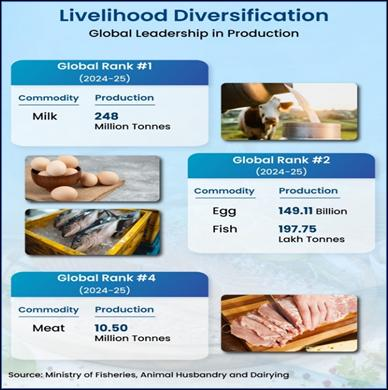
- India ranks 1st in milk production, contributing about 24.76% of global output. It ranks 2nd in egg production and 5th in meat production globally.
- Livestock provides organic manure, improves soil fertility and supports integrated crop-livestock farming, particularly in drought-prone areas.
Source :PIB
India’s First LNG Train
Syllabus: GS3/ Environment/ Energy
Context
- After launching the country’s first hydrogen train, India has now introduced its first LNG-powered train.
About
- Flagged off from Sabarmati, Gujarat, the train uses a diesel-LNG dual-fuel system.
- As part of the project, two 1,400 HP Driving Power Cars (DPCs) at the Sabarmati Integrated Coaching Depot have been converted to operate on both fuels.
- Under the dual-fuel system, LNG can replace up to around 40% of diesel consumption, helping reduce fuel use, costs and emissions such as carbon dioxide, nitrogen oxides and particulate matter.
Liquefied Natural Gas (LNG)
- Liquefied Natural Gas (LNG) is natural gas, primarily methane, cooled to around minus 162°C until it becomes a liquid. In liquid form, its volume is about 600 times smaller than in its gaseous state, making it easier to store and transport.
- India imports roughly half of its natural gas requirement as LNG, with Qatar alone accounting for nearly half of the country’s LNG imports.
- The United States is the world’s largest LNG exporter, while China is the largest importer.
Do you know?
- Indian Railways used around 293 crore litres of diesel in 2015–16 and has set a broader target of eliminating diesel use in its operations by 2030.
- The potential of LNG also extends beyond railways. It is emerging as an alternative fuel for long-haul trucks, where it can offer a significant cost advantage over diesel.
Source: IE
Amoeba Survives Heat Beyond Complex Life’s Limits
Syllabus: GS3/Science and Technology
Context
- NASA-supported scientists have discovered an organism that lives at extreme temperatures previously thought impossible for complex life.
About
- The study found Incendiamoeba cascadensis, or the “fire amoeba”, reproducing by cell division at 145 degrees Fahrenheit (63 degrees Celsius) in the heated waters of California’s Lassen Volcanic National Park.
- It has set a record for the upper temperature limit for all known eukaryotes.
- Eukaryotes have complex cells containing a nucleus and membrane-bound organelles, which are vulnerable to extreme heat.
- The discovery could broaden scientists’ understanding of where complex life might survive on Earth and beyond.
Prokaryotic and Eukaryotic Cells
- The cell is the basic unit of life and forms the building blocks of all living organisms. It was discovered by Robert Hooke In 1665.
- Some cells have membrane-bound organelles and some do not. Depending upon the internal structure of the cell, two types of cells are found in an organism namely Eukaryotic and Prokaryotic.
- Prokaryotic cells are simpler and smaller in size, while eukaryotic cells are more complex and larger.
Source: NASA
India’s First Port-based e-Methanol Production Facility to Supply Green Fuel
Syllabus: GS3/Environment
In News
- India has taken a major step towards becoming a global supplier of green maritime fuel with the foundation stone laid for the country’s first port-based e-methanol production facility at Deendayal Port Authority (DPA) in Kandla, Gujarat.
What is e-methanol?
- Methanol is a simple liquid fuel that ships can burn. It is called “green” or “e-methanol” depending on how it is made.
- Renewable electricity splits water into hydrogen (green hydrogen).
- That hydrogen is combined with captured carbon dioxide. Here the CO2 is biogenic, meaning it comes from biological sources such as biomass, so burning the fuel does not add fresh fossil carbon to the atmosphere.
- The result is methanol that can run in ship engines built for methanol.
Significance
- Shipping decarbonisation: Shipping emits a large amount of greenhouse gas. The International Maritime Organization (IMO) has set a goal of net-zero emissions from international shipping by or around 2050.
- India as a fuel supplier: The project positions India as an exporter of green fuel to global shipping.
- Link to national goals: The project supports the Net Zero by 2070 commitment and the Atmanirbhar Bharat mission. It also fits the National Green Hydrogen Mission, the Green Tug Transition Programme and the Maritime Amrit Kaal Vision 2047.
Source :DD
Digital Connectivity Rating (DCR) Platform
Syllabus: GS2/Governance
Context
- The Telecom Regulatory Authority of India (TRAI) launched the Digital Connectivity Rating (DCR) Platform.
About the DCR Platform
- It is an integrated digital system aimed at enabling consumers to view the digital connectivity ratings of properties and facilitating the end-to-end rating process.
- The platform also includes a mobile application for testing digital connectivity.
- It brings Property Managers (PMs), registered Digital Connectivity Rating Agencies (DCRAs) and consumers onto a common digital interface.
- Property Managers can register properties under categories such as public, government, commercial and private, submit rating applications, upload prescribed information and documents, select a registered DCRA and track the status of applications through the platform.
- The platform supports the prescribed assessment workflow for both constructed and under-construction properties.
- Significance: For consumers, the platform provides a public rating search page where properties can be searched by name, certificate ID or location.
- The platform establishes a transparent and standardised framework for assessing the digital connectivity readiness of properties.
- By making ratings publicly searchable and verifying the certificates, the platform will empower consumers with credible and comparable information.
Telecom Regulatory Authority of India (TRAI)
- Established: 1997 under the Telecom Regulatory Authority of India Act, 1997.
- Ministry: Ministry of Communications.
- Aim: To regulate telecom services, including fixation/revision of tariffs for telecom services which were earlier vested in the Central Government.
- One of the main objectives of TRAI is to provide a fair and transparent policy environment which promotes a level playing field and facilitates fair competition.
Source: DD
UN Declaration on Sea-Level Rise
Syllabus: GS3/ Environment
Context
- India welcomed the UN Declaration on Sea-Level Rise 2026, which highlighted the need for equity, climate justice and legal certainty for vulnerable island and coastal States at the 81st UN General Assembly.
About
- The UN Declaration on Sea-Level Rise, adopted by the UN General Assembly by consensus in 2026, is the first UN-wide political framework specifically addressing the legal, humanitarian and developmental consequences of rising sea levels.
- Background: The process for the UN Declaration on Sea-Level Rise began with UN General Assembly Decision 78/558 in 2024, which called for a high-level meeting on the issue and an action-orientated declaration negotiated by consensus.
- The 2026 high-level meeting subsequently led to the adoption of the Declaration.
- Nearly 900 million people currently live in low-lying coastal zones, while more than one billion people could face coastal hazards by 2050, highlighting the scale of the challenge.
Source: BL
