


Attorney General of India
Syllabus: GS2/Polity and Governance
Context
- A Supreme Court advocate sought statutory consent of the Attorney General of India to initiate criminal contempt action against the Chief Election Commissioner (CEC).
- The prior consent of the Attorney General of India is mandatory when a private individual or a third party files a criminal contempt petition in the Supreme Court under Section 15 of the Contempt of Courts Act, 1971.
Attorney General of India
- Article 76 of the Constitution provides for the office of the Attorney General of India.
- The President shall appoint a person who is qualified to be appointed a Judge of the Supreme Court to be Attorney-General for India.
- The Attorney General of India (AGI) is the highest law officer of the Union Government and serves as its principal legal adviser.
- Qualifications: A person must be a citizen of India; and have been a judge of a High Court for at least 5 years, or an advocate of a High Court for at least 10 years, or be a distinguished jurist in the President’s opinion.
- Functions and Duties:
- Gives legal advice to the Government of India on matters referred to him/her.
- Performs other legal duties assigned by the President.
- Represents the Union Government before the Supreme Court and High Courts.
- Can appear in all courts in India.
- Advises the government on constitutional and other legal matters.
- Rights and Privileges:
- Has the right to speak and take part in the proceedings of both Houses of Parliament, their joint sittings and parliamentary committees of which he/she may be named a member.
- Does not have the right to vote in Parliament.
- Enjoys the privileges and immunities available to a Member of Parliament.
- Tenure and Removal:
- The Constitution does not prescribe a fixed tenure.
- The Attorney General holds office during the pleasure of the President.
- The Constitution does not prescribe a specific procedure for removal.
Source: TH
QUAD-at-Sea Ship Observer Mission
Syllabus: GS2/IR
In News
- Indian Coast Guard (ICG) ship Shaunak sailed from Chennai for Perth, Australia, as part of the QUAD-at-Sea Ship Observer Mission.
QUAD-at-Sea Ship Observer Mission
- The Quad nations launched the inaugural ‘Quad-at-Sea Ship Observer Mission’.
- It is aimed at enhancing maritime interoperability and professional exchanges among India, Australia, Japan and the United States.
- Six officers, designated as ‘Sea Riders’, have embarked onboard Shaunak for the mission.
- It is aligned with the QUAD Foreign Ministers’ Joint Statement which reiterated the grouping’s commitment to a free, open, inclusive and rules-based maritime order in the Indo-Pacific.
Importance
- It reflects India’s MAHASAGAR (Mutual and Holistic Advancement for Security and Growth Across Regions) vision and the ICG’s emphasis on collective engagement and cooperation with partner maritime forces to contribute to a secure maritime environment across the Indo-Pacific.
Know about QUAD
- Origin: The QUAD emerged from humanitarian cooperation after the 2004 Indian Ocean tsunami. Japan proposed the framework in 2007, but it became inactive after Australia stepped back in 2008. It was revived in 2017 amid growing Indo-Pacific strategic concerns.
- Focus: Regional security, economic cooperation, maritime safety, infrastructure, and supply-chain resilience. It is not a formal military alliance.
- Vision: The 2021 QUAD Leaders’ Summit adopted the “Spirit of the Quad”, supporting a free, open and inclusive Indo-Pacific, based on democratic values, rule of law and freedom from coercion.
- Key Initiatives:
- QUAD At Sea Ship Observer Mission: Launched under the 2024 Wilmington Declaration to strengthen maritime domain awareness, interoperability and operational coordination.
- Malabar Exercise: Multilateral naval exercise involving all four QUAD countries, aimed at improving maritime coordination, interoperability and readiness.
- Quad Plus: Engagements have included countries such as South Korea, New Zealand and Vietnam, indicating scope for wider cooperation.
Source : TH
Bilateral Investment Treaty (BIT)
Syllabus: GS3/Economy
In News
- The Ministry of Finance has completed the review of India’s 2016 Model Bilateral Investment Treaty (BIT) and sent the revised framework for Cabinet Secretariat approval.
Bilateral Investment Treaty (BIT)
- It is essentially an agreement between two countries to protect investments made by investors of one country in the other.
- It provides foreign investors with certain legal safeguards against adverse government action and, in specified circumstances, allows them to seek international arbitration if a dispute cannot be resolved through domestic legal remedies.
- The current framework (2016 Model) requires a foreign investor to wait for five years before initiating a treaty-based arbitration against India.
Why the 2016 Model Needed Revision?
- Too much litigation before arbitration: For example, a foreign company facing a tax dispute would need to spend years in Indian courts first, which most global investors find impractical and risky.
- Narrow definition of “investment”: The 2016 model defines investment narrowly, covering mainly enterprises with real assets and risk, and leaving out things like portfolio investment or loans. This means many forms of foreign capital simply don’t get treaty protection at all.
- Weak Most Favoured Nation (MFN) clause: The model restricts investors from claiming better treatment that India may have given to another country under a different treaty. This makes India’s offer look less generous compared to other countries’ BITs.
Source :IE
Guidelines For Design of Access-controlled High-speed National Highways
Syllabus: GS3/Economy
In News
- The National Highways Authority of India (NHAI) has introduced comprehensive guidelines for the planning and design of access-controlled high-speed National Highways, other than Expressways.
About guidelines
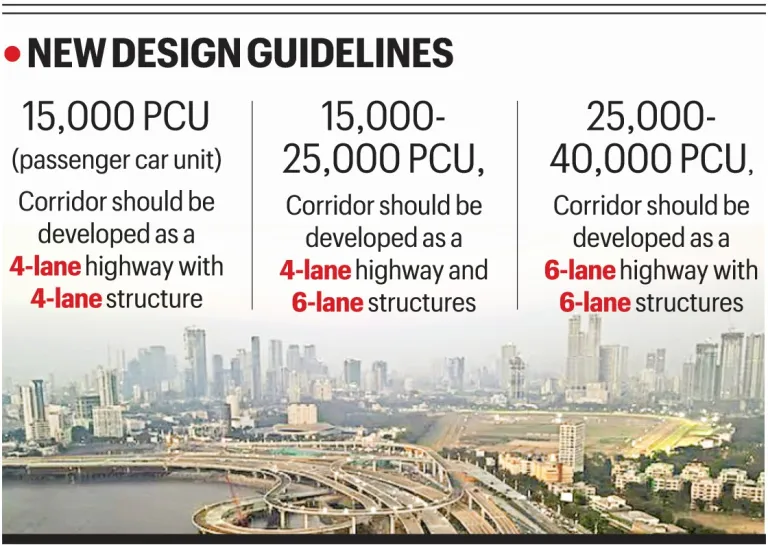
- The guidelines aim to bring uniformity in the preparation of Detailed Project Reports (DPRs), ensure consistency in technical standards, strengthen road safety and improve operational efficiency across the National Highway network.
- It will apply to all upcoming four- and six-lane Greenfield and Brownfield high-speed access-controlled National Highways.
- It is part of the Government’s long-term vision of developing a world-class National Highway network under Viksit Bharat 2047.
- Interchanges with ramps will be provided at crossings with Expressways, National Highways, State Highways and important arterial roads generating substantial traffic.
- Such interchanges will also be provided to facilitate connectivity with major traffic-generating destinations, including ports, airports, Multi-Modal Logistics Parks (MMLPs), industrial areas and major tourist destinations.
- The guidelines prescribe the construction of a one-metre-high boundary wall along the outer edge of the corridor to strengthen access control and prevent encroachments, unauthorised entry and the movement of stray cattle onto high-speed corridors,
Importance
- The comprehensive guidelines represent a significant step towards standardising the planning and design of fully access-controlled National Highways.
- The new guidelines provide a uniform set of technical and safety provisions for such corridors.
Source :DD
GI-Tagged Gulbarga Tur Dal
Syllabus: GS3/Economy
Context
- The Agricultural and Processed Food Products Export Development Authority (APEDA) facilitated the flag-off of a one MT consignment of GI-tagged Gulbarga Tur Dal from Karnataka to the Maldives.
About
- Gulbarga Tur Dal, also known as Kalaburagi Togari Bele, is a variety of pigeon pea, commonly known as Arhar Dal or Toor Dal, cultivated in the Kalaburagi region of Karnataka.
- Karnataka is the largest tur dal-producing state in India, contributing over 40 percent of national output, with Kalaburagi district alone producing the majority of the state’s yield.
- Gulbarga Tur Dal received Geographical Indication (GI) registration in 2019 and is recognised for its distinctive taste and quality.
Cultivation of Tur Dal
- Tur dal thrives in tropical and semi-arid regions, with an annual rainfall of around 600–650 mm and temperatures of 26°C–30°C during the rainy season.
- It grows well in black cotton soils because these soils retain moisture, which benefits the crop during dry spells. It can also thrive in loamy and well-drained alluvial soils.
Source: AIR
Keralam’s Revised Ecologically Sensitive Area Proposal
Syllabus: GS3/ Environment
Context
- Keralam has urged the Centre to reduce the proposed Ecologically Sensitive Area (ESA) in its Western Ghats region from 9,993.7 sq km to 8,590.69 sq km, restricting it to forest areas and excluding populated areas, agricultural land and plantations.
Background
- The 2013 Kasturirangan Committee report had proposed declaring 13,108 sq km covering 123 villages in Keralam as ESA.
- Following protests and concerns over livelihood impacts, the Oommen V. Oommen Committee recommended reducing the area to 9,993.7 sq km.
- Of this, 9,107 sq km was forest land and 886.7 sq km was non-forest area.
- Keralam is now seeking to exclude the 886.7 sq km of non-forest area, limiting the ESA to 8,590.69 sq km and 98 villages.
- The issue reflects the broader challenge of balancing Western Ghats conservation with livelihood and development concerns in densely populated regions.
Eco-Sensitive Areas (ESAs)
- ESAs are areas around protected areas such as national parks and wildlife sanctuaries that act as buffer zones, helping reduce the impact of human activities on biodiversity.
- They are governed under the Environment (Protection) Act, 1986 and were outlined in the National Wildlife Action Plan (2002–2016) of the MoEFCC.
- The Gadgil Committee and Kasturirangan Committee recommended identifying ecologically fragile areas, particularly in the Western Ghats, for stronger conservation.
Activities in ESAs
- Prohibited: Commercial mining, polluting industries, large hydroelectric projects, sawmills, commercial use of wood.
- Regulated: Tree felling, construction of hotels/resorts, commercial use of water, electrical cables, changes in agricultural practices.
- Permitted: Organic farming, rainwater harvesting, renewable energy, existing agricultural practices.
Kasturirangan committee report
- The High-Level Working Group (HLWG) chaired by Dr. K. Kasturirangan was constituted in 2012 to examine the recommendations of the Gadgil Committee on the conservation of the Western Ghats.
- The committee recommended designating 37% of the Western Ghats, covering approximately 59,940 sq. km, as an Ecologically Sensitive Area (ESA). It focused more on development balance and economic activities.
- It emphasised regulating development in identified sensitive areas while allowing more flexibility in other regions.
- It recognised the importance of sustainable livelihoods, but with less emphasis on forest rights.
- It argued for strengthening the existing framework of environmental clearances and setting up of a state-of-the-art monitoring agency.
Source: IE
Coffee Board Moves Towards Sustainability Certification for Coffee
Syllabus: GS3/Economy
Context
- The Coffee Board of India has developed sustainability standards and is in the process of implementing a certification process for Indian coffee.
About
- India, the world’s seventh-largest coffee producer and fifth-largest exporter, exported coffee worth more than $2 billion in 2025-26, with nearly 39% comprising value-added products.
- Indian coffee’s distinctive advantage lies in its traditional shade-grown cultivation, which the Board aims to leverage through the new sustainability standards.
- The certification will be done at three levels – first will be done by the Board based on self certification by the growers. The second level will involve independent third-party verification, while the third level will benchmark Indian standards against internationally recognised sustainability frameworks.
Coffee Production
- Brazil is the world’s largest coffee producer, contributing about 40% of global production, followed by Vietnam.
- India primarily produces two main varieties of coffee: Arabica and Robusta.
- Karnataka leads coffee production in India, followed by Kerala and Tamil Nadu.
Climatic Conditions
- Coffee plants require a hot and humid climate, with temperatures ranging between 15°C and 28°C and annual rainfall of 150–250 cm.
Coffee Board of India
- It is a statutory organization constituted under Section (4) of the Coffee Act, 1942 and functions under the administrative control of the Ministry of Commerce and Industry.
- The Board comprises 33 members, including the Chairman and the Secretary & Chief Executive Officer.
- The Board mainly focuses on research, extension, development, market intelligence, domestic and external promotion, and welfare measures.
Source: TH
Bio-Based Biodegradable Plastic Under BioE3
Syllabus: GS3/ Biotechnology
Context
- The Union Government has formally launched the commercial use of bio-based biodegradable plastic based on Polylactic Acid (PLA), developed by Balrampur Chini Mills Limited (BCML) under the BioE3 framework.
What is PLA?
- Polylactic Acid (PLA) is a bio-based polymer produced from renewable biological feedstocks, such as sugar-derived materials.
- In the PLA pathway, sugars can be fermented to produce lactic acid, which is then converted into PLA.
- PLA can be used to manufacture packaging materials, films, containers and other plastic products, depending on the grade and formulation.
BioE3 Framework
- BioE3 stands for Biotechnology for Economy, Environment and Employment.
- It seeks to promote high-performance biomanufacturing and the transition of biotechnology from laboratory research to commercially viable products.
- The framework focuses on areas such as:
- Bio-based chemicals and enzymes,
- Functional foods and Smart proteins,
- Precision biotherapeutics,
- Climate resilient agriculture,
- Carbon capture and its utilization,
- Futuristic marine and space research.
Source: PIB
Cool Leaders Award
Syllabus: GS3/Environment
Context
- The inaugural Cool Leaders Award was launched in September 2026, during the Global Cooling Pledge Assembly held in Singapore.
About
- The “Cool Leaders” award is a global recognition initiative launched by the UNEP Cool Coalition.
- It recognises outstanding leadership in advancing sustainable cooling and protecting people from extreme heat. The first Cool Leaders are:
- Singapore, for leadership in passive cooling and heat resilience.
- The United Arab Emirates, for leadership in district cooling and advancing cooling in global climate and development policy.
- Dong Mingzhu, Chairwoman of Gree Electric Appliances, for spearheading the development of ultra-efficient, low-carbon cooling technologies, including the Zero Carbon Source air-conditioning system.
- The UNEP Cool Coalition is a global platform driving system-level change on sustainable cooling.
- It was launched in 2019 as a flagship initiative of the UN Secretary-General’s Climate Action Summit.
- It brings together over 250 actors to deliver efficient, climate-friendly cooling solutions aligned with the Paris Agreement, the Kigali Amendment, and the 2030 Agenda.
About the United Nations Environment Programme (UNEP)
- The UN Environment Programme is the leading global voice on the environment, founded in 1972.
- It provides leadership and encourages partnership in caring for the environment by inspiring, informing, and enabling nations and peoples to improve their quality of life without compromising that of future generations.
- UNEP hosts the United Nations Environment Assembly, the world’s highest-level decision-making body on the environment, with a universal membership of all 193 United Nations’ Member States.
About the Global Cooling Pledge
- It was launched at COP28 in 2023 and is the world’s first collective global commitment to reduce the climate impact of cooling while expanding access to sustainable cooling.
- It aims to:
- reduce cooling-related emissions by at least 68% below 2022 levels by 2050,
- significantly increase access to sustainable cooling by 2030,
- and collectively increase the global average efficiency rating of new air-conditioning equipment sold by 50% by 2030 from the global 2022 installed baseline.
Source: UNEP
Previous article
Nuclear Waste Management in India
Next article
Should Voting Be a Fundamental Right?
