


Bab el-Mandeb Strait
Syllabus: GS1/Places; GS2/IR
In News
- The Bab el-Mandeb Strait is again under security threat after reports that Iran asked the Houthis to close the strategic waterway if the US attacks Iran.
Strait of Bab el-Mandeb
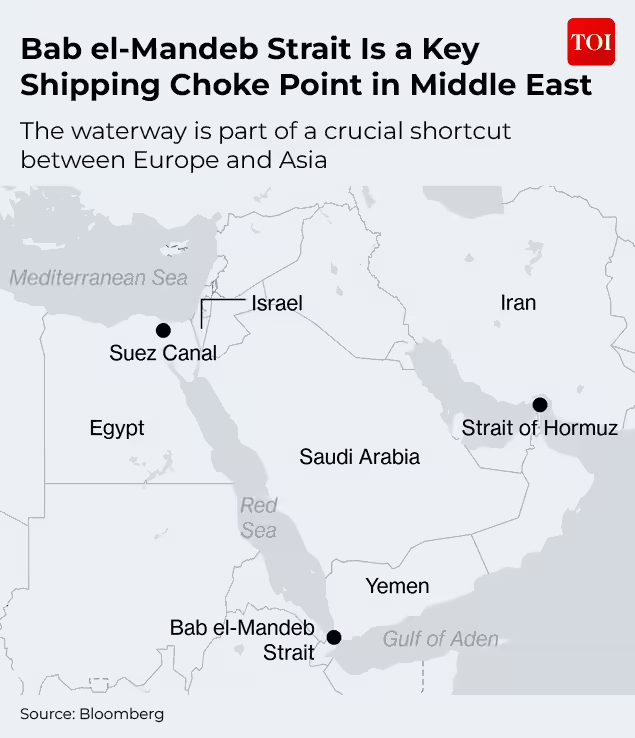
- It is a narrow waterway that connects the Red Sea with the Gulf of Aden.
- It connects to the Suez Canal and the Mediterranean Sea in the north and the Arabian Sea and the Indian Ocean to the east.
Importance
- The Strait is one of the world’s most important shipping and energy passages. Around 12% of global trade usually passes through it.
- In 2024 alone, about 4.1 billion barrels of oil and petroleum products passed through the Strait, roughly 5% of the global total.
- Closure of the route would force ships to sail around the Cape of Good Hope, adding 4,000–6,000 nautical miles and 10–20 days to transit times, increasing shipping costs and disrupting global supply chains.
Relevance for India
- Any disruption in this route could badly affect the Indian economy as almost one-third of India’s trade passes through this route.
- Amid growing geopolitical uncertainty, India should take a proactive role in forging a rules-based naval task force with France, Japan, Egypt and Saudi Arabia to protect commercial shipping, ensure freedom of navigation and safeguard its maritime and economic interests under the SAGAR vision.
Source: TH
Police Identification During Crowd Control
Syllabus: GS2/Governance
Context
- The deployment of some Delhi Police and Rapid Action Force (RAF) personnel in plain clothes or without visible nameplates during a recent protest in Delhi has sparked debate over police identification and accountability.
What does Indian law say?
- While certain operations, such as those involving intelligence collection, genuinely require hiding identification or even impersonation, regular policing is guided by statutory procedure and judicial guidelines.
- The Bharatiya Nagarik Suraksha Sanhita (Sections 148 to 160) allows only a Magistrate or a police officer to order the dispersal of an unlawful assembly. Although the law does not explicitly require officers to display their identity, legal experts argue that a police officer must be identifiable for such orders to carry legal authority.
- In D.K. Basu v. State of West Bengal (1997), the Supreme Court held that police officers making an arrest must bear clear and visible identification, reinforcing the principle of police accountability.
- In 2025, the Andhra Pradesh High Court questioned how citizens could recognise plainclothes personnel as police officers while they were performing official duties.
- So, while plain clothes may be justified in exceptional situations, their use during routine law-and-order duties remains a grey area.
Source: IE
India Unveils Its First Air Taxi Prototype
Context: GS3/ Science & Technology
Context
- The ePlane Company, an IIT Madras-incubated startup, has unveiled India’s first full-scale electric vertical take-off and landing (eVTOL) prototype (PT-01) of the e200X aircraft model.
- The commercial operations will be commenced by 2028, initially focusing on air ambulance services and subsequently expanding into passenger transportation.
What is an eVTOL?
- An eVTOL, electric vertical take-off and landing aircraft, is a battery-powered aircraft that can take off and land vertically like a helicopter before transitioning to forward flight like a conventional aeroplane.
- An eVTOLs does not require long runways. Most designs use multiple electrically powered propellers instead of a single large rotor, allowing them to lift off from relatively small spaces.
How is an eVTOL different from a helicopter?
- Both helicopters and eVTOLs can take off and land vertically, but they are built differently.
- Helicopters rely on one or two large rotors powered by aviation fuel. eVTOL aircraft instead use multiple electric motors and propellers powered by batteries.
- Many eVTOL developers also use distributed electric propulsion, where several propellers share the work of generating lift and thrust.
- Such designs improve redundancy because if one propeller fails, the remaining motors can continue generating lift, which enables the aircraft to descend safely.
Challenges to Commercial eVTOL Passenger Operations
- Aircraft Certification: Before a commercial aircraft may transport passengers it must be certified as airworthy by the aviation authorities. But regulatory authorities are still working on separate certification schemes.
- Regulatory standards vary, which might add costs and impede the international rollout.
- Infrastructure: eVTOL networks will necessitate purpose-built vertiports to accommodate aircraft take-off and landing, recharging and maintenance.
- Limitations of batteries. Batteries constitute a large percentage of the weight of an eVTOL, limiting the payload and flying range.
- The more passengers in a vehicle, the bigger the battery pack it will need, and the bigger the battery pack, the more weight it adds to the vehicle, and the less efficient it becomes.
- Regulations: Commercial operations will also need operating rules covering pilot licensing, air traffic management, maintenance standards and flight operations.
Source: BS
Pellet Guns
Syllabus: GS3/Internal Security
Context
- The Delhi Police has rejected reports of using pellet guns during the Cockroach Janta Party (CJP)-led student protest at Jantar Mantar.
What are Pellet Guns?
- They are a form of non-lethal crowd-control method used by police and military worldwide. The other popular measures are tear gas, water cannon, pepper spray, taser guns among others.
- Each cartridge contains hundreds of small lead pellets that spread over a wide area when fired.
- Although intended to minimise fatalities, pellet guns can cause serious injuries, particularly when fired at close range or when pellets strike sensitive body parts such as the eyes, as the pellets can penetrate soft tissues.
- In India, pellet guns were first introduced in 2010 during the unrest in Jammu and Kashmir as a less-lethal alternative to live ammunition, with the aim of reducing civilian fatalities.
- Standing operating procedures require security personnel to use minimum force and, where firing becomes unavoidable, to aim below the waist.
- Pellet guns used by Indian security forces are manufactured at the Ordnance Factory, Ishapore.
- Besides crowd control, pellet guns are also used for hunting and pest control.
Source: TH
Previous article
Plastic Currency in India
