


Syllabus: GS2/Health
Context
- As per a Study in the Lancet India may be using too many powerful ‘watch’ antibiotics.
Major Highlights
- Global Scenario: Antibiotic use across 186 countries and territories, representing 99.8% of the world’s population.
- They found that 72% of countries used more antibiotics overall than estimated to be necessary.
- 90% prescribed excessive quantities of antibiotics that contribute most to antimicrobial resistance.
- 60% continued to use antibiotics the World Health Organisation (WHO) considers should no longer be routinely prescribed.
- Indian Scenario: It suggests ‘reserve’ antibiotics are being underused despite the country’s resistance burden, while antibiotics that are no longer recommended continue to be prescribed more than expected.
- Only 27% of antibiotic use currently comes from the ‘access category,’ against an estimated requirement of 52.3%.
- In India some ‘watch’ antibiotics are potentially being used unnecessarily and some of this use could be replaced with ‘access’ antibiotics instead.
Antibiotics
- Antibiotics are medications that destroy or slow down the growth of bacteria. Doctors prescribe them to treat bacterial infections. They do this by killing bacteria and preventing them from multiplying.
- Alexander Fleming discovered penicillin, the first natural antibiotic, in 1928.
- Antibiotics cannot fight viral infections.
The World Health Organisation (WHO) groups antibiotics into three categories:
- Access: First-choice antibiotics for common infections that have a lower risk of driving resistance.
- Watch: Broad-spectrum antibiotics that should be used only for specific infections because they carry a higher risk of promoting antimicrobial resistance.
- Reserve: Last-resort antibiotics reserved for treating multidrug-resistant infections.
Antimicrobial Resistance (AMR)
- Antimicrobials: Antimicrobials are agents used to prevent, control and treat infectious diseases in humans, animals and plants.
- They include antibiotics, fungicides, antiviral agents and parasiticides.
- Antimicrobial Resistance (AMR) occurs when bacteria, viruses, fungi and parasites no longer respond to medicines, making people sicker and increasing the risk of disease spread, illness and deaths.
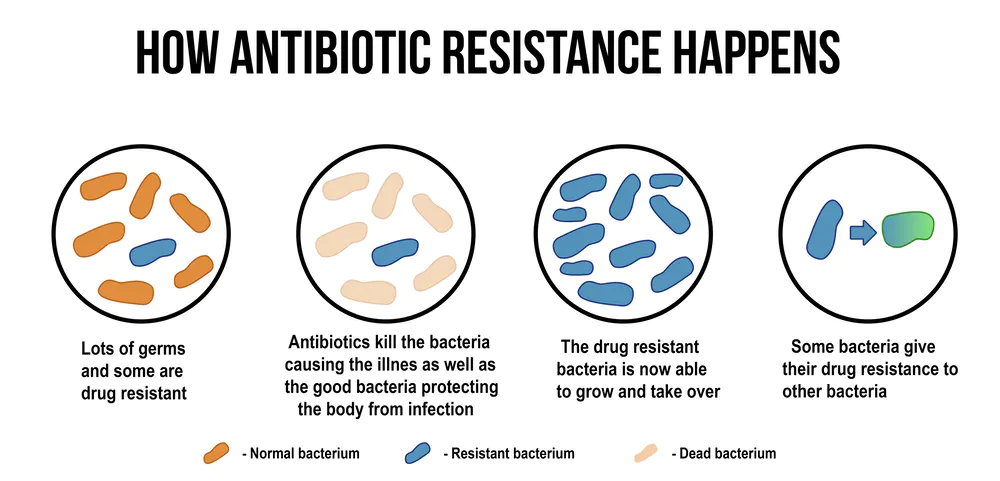
Causes for Antimicrobial Resistance
- Overuse: The excessive and inappropriate use of antibiotics in humans and animals is a major driver of antimicrobial resistance.
- Self-Medication: Self-prescription without proper medical guidance contributes to the misuse of antibiotics.
- Antibiotics Consumption in Food-Animals: Use of antibiotics as growth promoters in food animals and poultry is a common practice and later it evolves in the food chain.
- Poor Sanitation: The large proportion of sewage is disposed of untreated into receiving water bodies, leading to gross contamination of rivers with antibiotic residues, antibiotic-resistant organisms.
Measures Taken against Antimicrobial Resistance in India
- National Action Plan on Antimicrobial Resistance (NAP-AMR): It has a focus on the One Health approach & was launched with the aim of involving various stakeholders ministries/departments.
- AMR Surveillance Network: Indian Council of Medical Research (ICMR) established the AMR surveillance and research network (AMRSN) to generate evidence and capture trends and patterns of drug resistant infections in the country.
- FSSAI has set certain guidelines limiting the antibiotics in food products such as fish and honey.
- National Health Policy, 2017: It terms antimicrobial resistance as one of the key healthcare issues and prioritizes the development of guidelines regarding antibiotic use and check on restricting the growth of antibiotics.
- National Antibiotic Consumption Network (NAC-NET): The network sites compile data on antibiotic consumption in their respective health facilities and send it to National Centre for Disease Control (NCDC).
Source: IE
Previous article
Stable India-China ties will help build ‘multi-polar Asia’: EAM
Next article
Plastic Currency in India
