


Syllabus: GS3/Internal Security
In News
- The Union Government is going to launch a Smart Border Project to strengthen India’s borders with Pakistan and Bangladesh using advanced technologies such as drones, radars, and modern surveillance cameras.
Border Management
- Border management is the process through which a country controls and manages its borders to ensure both security and smooth movement of authorised people and goods.
- It involves preventing illegal crossings and threats while facilitating legitimate trade and travel with minimal disruption.
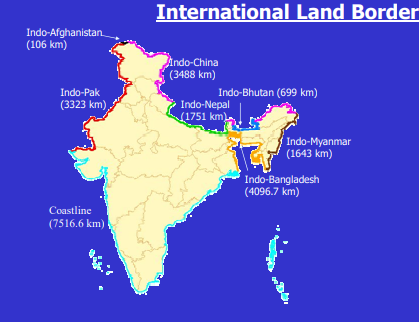
Note: The length of India’s coastline of 7516.6 km has been re-assessed to 11098.81 km by National Hydrographic Office (NHO) in coordination with Survey of India (SoI) as per the latest terms of references provided by National Security Council Secretariat (NSCS).
Importance of Border Management
- National Security: India shares a 15,106 km land border with seven countries—Pakistan, China, Bangladesh, Nepal, Bhutan, Myanmar, and Afghanistan.
- Protecting these borders is essential to prevent infiltration, terrorism, and illegal migration, ensuring national security and stability.
- Economic Development: Border roads, tunnels, and connectivity projects enable trade, tourism, and reverse migration, turning “remote” villages into “first villages.”
- Strategic Stability: Effective border management strengthens India’s deterrence posture against adversaries and supports rapid military mobilization.
- Community Integration: Development of border villages fosters national unity and reduces alienation among frontier populations.
Challenges
- Porous Borders: Borders, especially along Bangladesh ,Nepal and Myanmar , create security challenges by enabling smuggling, illegal migration, and human trafficking due to easier cross-border movement.
- Difficult Terrain: Himalayas, deserts, and dense forests hinder surveillance and infrastructure development.
- Cross-Border Terrorism: Persistent infiltration attempts along the India-Pakistan border.
- Technological :Technology gaps in border security highlight the need for wider use of AI, UAVs (drones), and smart fencing to effectively tackle emerging and evolving threats.
- Socio-Economic Vulnerabilities: Border villages often lack healthcare, education, and livelihood opportunities, making them susceptible to exploitation.
- Coordination Issues: Multiple agencies sometimes face overlap and coordination challenges.
Steps Taken by India
- Border Infrastructure and Management (BIM) Scheme : It is a Central Sector programme (2021–26) with an outlay of ₹13,020 crore aimed at strengthening India’s international borders.
- It focuses on improving border security through infrastructure development such as fencing, roads, floodlights, Border Out Posts, helipads, and foot tracks, along with using technology in areas where physical fencing is not feasible.
- Comprehensive Integrated Border Management System (CIBMS) : It is designed to improve real-time situational awareness and enable quick response along the India-Pakistan and India-Bangladesh borders.
- It integrates manpower, sensors, networks, intelligence, and command-and-control systems to strengthen border surveillance and manage
- Border Area Development Programme (BADP) : It aims to improve the living conditions of people in border areas within 10 km of India’s international borders by providing essential infrastructure like health, education, roads, water, sanitation, and livelihood facilities through coordinated government schemes.
- Role of BRO: The Border Roads Organisation(BRO) constructs and maintains strategic roads, bridges, tunnels and airfields in border and inaccessible regions to meet both military and civilian needs.
- It has built over 64,100 kms of roads, 1,179 bridges, 07 tunnels and 22 airfields across India’s border areas and in friendly neighbouring countries.
- The BSF’s jurisdiction has been extended from 15 kilometres to 50 kilometres and decisions related to land allocation in West Bengal have also been finalised
- Digital Connectivity: The government is expanding digital connectivity in rural and remote areas through projects like BharatNet, funded by Digital Bharat Nidhi, to provide broadband to all Gram Panchayats.
- It is also upgrading networks under the Amended BharatNet Program and extending connectivity to remaining villages.
- Digital governance platforms with offline, multilingual, and accessible features are being used to reduce the digital divide and ensure last-mile service delivery.
- Vibrant Villages Programme : The Government has launched the Vibrant Villages Programme-I (VVP-I) in 2023 for the comprehensive development of 662 villages in border blocks along the northern frontier across states like Arunachal Pradesh, Himachal Pradesh, Sikkim, Uttarakhand, and Ladakh.
- Vibrant Villages Programme-II (VVP-II) was approved in 2025 to cover 1,954 villages in other international border areas across 15 States and 2 Union Territories, focusing on overall socio-economic development of border communities.
Conclusion and Way Forward
- India’s border management is evolving into a holistic system combining technology, infrastructure, and community development.
- Therefore there is a need for expanding AI and satellite-based surveillance, improving border village development in health, education, and livelihoods
- The focus should be on strengthening coordination among security forces and state agencies, promoting smart and self-reliant border villages, enhancing regional cooperation with neighboring countries, and building resilience against hybrid cyber-physical threats.
- The Smart Border initiative is expected to create an integrated, technology-driven security grid within a year.
Source : IE
Previous article
Cyber Warfare and the Challenge to International Law
Next article
75th anniversary of the Korean War
