


South Zone Council
Syllabus: GS2/Polity and Governance
Context
- The 31st Southern Zonal Council meeting was held in Mahabalipuram, Tamil Nadu.
About
- Zonal Councils are statutory bodies established under the States Reorganisation Act, 1956, to promote cooperation and coordination on issues involving two or more States or between the Centre and States.
- The Union Home Minister is the Chairman of the Zonal Councils, while the Chief Minister of one of the member States serves as Vice-Chairman on a rotational basis.
- Zonal Councils are advisory bodies. A Standing Committee comprising Chief Secretaries of member States also examines issues before they are placed before the Zonal Council. Unresolved matters can subsequently be taken up by the full Council.
Historical Background
- The idea of Zonal Councils was proposed by Prime Minister Jawaharlal Nehru in 1956 and five Zonal Councils were established. These are:
- The Northern Zonal Council, comprising the States of Haryana, Himachal Pradesh, Jammu & Kashmir, Punjab, Rajasthan, National Capital Territory of Delhi and Union Territory of Chandigarh;
- The Central Zonal Council, comprising the States of Chhattisgarh, Uttarakhand, Uttar Pradesh and Madhya Pradesh;
- The Eastern Zonal Council, comprising the States of Bihar, Jharkhand, Orissa, Sikkim and West Bengal;
- The Western Zonal Council, comprising the States of Goa, Gujarat, Maharashtra and the Union Territories of Daman & Diu and Dadra & Nagar Haveli;
- The Southern Zonal Council, comprising the States of Andhra Pradesh, Karnataka, Kerala, Tamil Nadu and the Union Territory of Puducherry.
- North Eastern Council: The North Eastern States i.e. (i) Assam (ii) Arunachal Pradesh (iii) Manipur (iv) Tripura (v) Mizoram (vi) Meghalaya and (vii) Nagaland are not included in the Zonal Councils and their special problems are looked after by the North Eastern Council, set up under the North Eastern Council Act, 1972.
- The State of Sikkim has also been included in the North Eastern Council vide North Eastern Council (Amendment) Act, 2002 notified in 2002.
Source: AIR
Pradhan Mantri Janjatiya Vikas Mission (PMJVM)
Syllabus: GS2/Government Initiatives
Context
- The Pradhan Mantri Janjatiya Vikas Mission (PMJVM) is unlocking India’s tribal forest economy.
About PMJVM
- Launched in 2021-22, PMJVM is a Central Sector Scheme of the Ministry of Tribal Affairs.
- The scheme is implemented through Tribal Co-operative Marketing Development Federation of India (TRIFED) and State Implementing Agencies.
- It seeks to enhance livelihood opportunities for tribal communities by promoting value addition, entrepreneurship and market linkages for tribal products.
- It also provides Minimum Support Price (MSP) for identified Minor Forest Produce (MFP) through direct procurement from tribal gatherers.
Source: PIB
Core Sector Growth Slows
Syllabus: GS3/Economy
Context
- Economic activity in India’s core industrial sectors saw growth slow to 5.4% in July 2026 from 6% in June.
About
- This was driven by a significant slowdown in the fertilisers, iron ore, and steel sectors, accompanied by a continued contraction in the natural gas and crude oil sectors.
- Nine core industries are Coal, Crude Oil, Natural Gas, Petroleum Refinery Products, Fertilizers, Steel, Cement, Iron ore and Electricity.
- Index of Core Industries (ICI): It is a production volume index to provide an advance indication on production performance of industries of ‘core’ nature before the release of Index of Industrial Production (IIP) by the Central Statistics Office.
- The Index is compiled and released by Office of the Economic Adviser (OEA), Department of Industrial Policy & Promotion (DIPP), Ministry of Commerce & Industry.
Source: TH
District Collectors in 8 States Empowered to Grant Citizenship under CAA
Syllabus: GS2/Polity and Governance
Context
- The Union Ministry of Home Affairs (MHA) has transferred the processing of pending citizenship applications under the Citizenship Amendment Act (CAA) to District Collectors in eight States and Union Territories (UTs).
- District Collectors in Gujarat, Rajasthan, Punjab, West Bengal, Assam, Tripura, Jammu and Kashmir, and Ladakh have been authorised.
About
- It amended the Citizenship Amendment Act, 1955, making two key changes to facilitate citizenship to undocumented migrants belonging to six non-Muslim communities — Hindu, Sikh, Buddhist, Jain, Parsi or Christian from Afghanistan, Bangladesh and Pakistan, who entered India on or before December 31, 2014.
- It reduced the period to qualify for citizenship from the existing requirement of continuous stay of 11 years to continuous stay of five years.
- However, Pakistani Hindus were anyway eligible for citizenship under Section 5 and Section 6 (1) of the Citizenship Act, 1955. The CAA only helped fast track the application process.
- The Rules grant the final authority to accord citizenship to an empowered committee headed by the Director, Census Operations, while the scrutiny of applications filed online on the portal was done by a district level committee (DLC) headed by Department of Post officials.
- On successful verification of documents, the DLCs administered the oath of allegiance to the applicants.
Source: TH
Expansion of NAMASTE Scheme
Syllabus:GS2/Governance
In News
- The government is considering extending the National Action for Mechanised Sanitation Ecosystem (NAMASTE) initiative from urban to rural areas for mechanisation of sanitation operations and death during hazardous cleaning for the years 2026-27 to 2030-31.
About NAMASTE Scheme
- The Ministry of Social Justice and Empowerment in convergence with the Ministry of Housing and Urban Affairs have launched NAMASTE scheme in 2023 to ensure safety and dignity of sanitation workers.
- The focus is on prevention of hazardous cleaning and promotion of safe cleaning practices through trained and certified sanitation workers.
- Under the NAMASTE Scheme, sanitation workers are being identified, profiled and provided with a range of benefits including Personal Protective Equipment (PPE), health insurance, Ayushman Bharat coverage, occupational safety training etc.
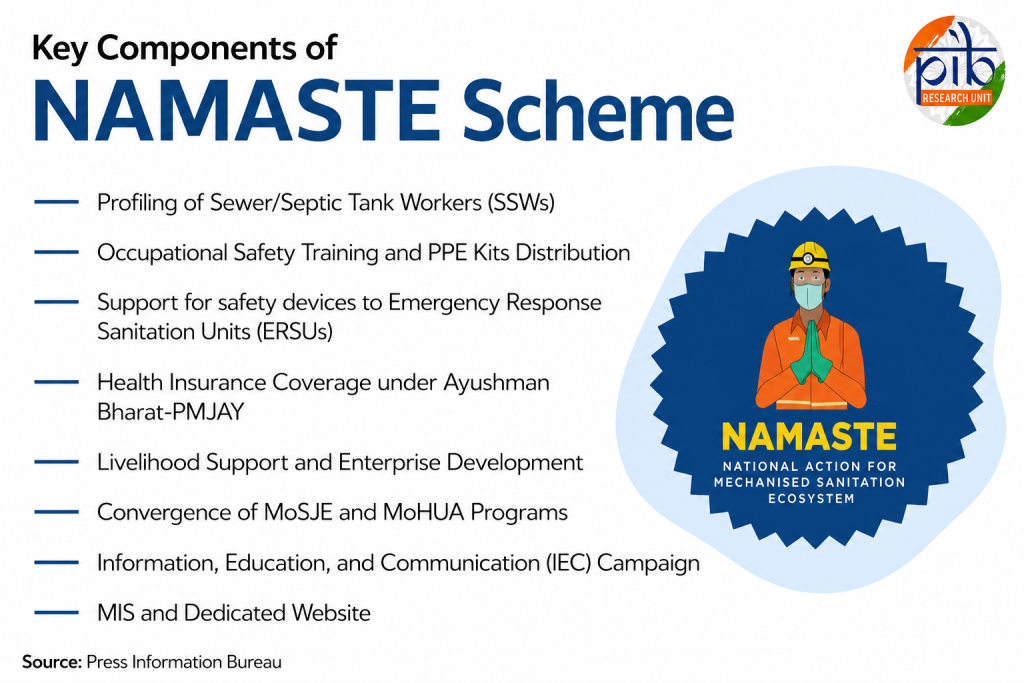
- It helps manual scavengers and septic tank workers (SSWs) to set up their own sanitation-related projects by providing capital subsidies of up to 50% of the total project cost, and aid in setting up emergency response sanitation units in urban local bodies.
Source :TH
GISAT-1A
Syllabus: GS3/Science and Tech
In News
- The Indian Space Research Organisation (ISRO is preparing to launch GISAT-1A Satellite.
GISAT-1A (Geo Imaging Satellite )
- It is also referred to as EOS-05 under the new nomenclature .
- It is a replacement satellite for the 2021-launched GISAT-1 (or EOS-03), which missed the orbit after the final propulsive segment of the rocket failed to ignite.
- It is scheduled to launch aboard the Geosynchronous Satellite Launch Vehicle (GSLV).
- The mission will be Isro’s first launch since the PSLV-C62/EOS-N1 mission failed in January 2026.
- Purpose : GISAT-1A is designed for high-frequency imaging of large areas of the Indian landmass.
- Its applications include monitoring natural disasters, agriculture, forestry and other changes on the ground.
- The satellite has a planned 10-year mission life.
Source :IE
Satkosia Tiger Reserve
Syllabus: GS3/Environment
Context
- The Odisha government has formed a high-level inquiry committee to look into the displacement of villages from the Satkosia Tiger Reserve (STR) amid allegations that the villagers were forcibly evicted.
About Satkosia Tiger Reserve
- Location: Odisha, at the meeting point of the Deccan Peninsula and the Eastern Ghats.
- Established: In 2007 under Project Tiger.
- Area: The reserve includes the Satkosia Gorge Wildlife Sanctuary and Baisipalli Wildlife Sanctuary, which together span an area of around 1,000 sq km.
- The Mahanadi River flows through the reserve and forms the spectacular Satkosia Gorge.
- Flora: Mixture of deciduous forests including Sal (Shorea robusta) and riverine forest.
Source: TH
Previous article
Government Notifies New Indigenisation List
Next article
Resistance against Ken-Betwa Link Project
