


Syllabus: GS1/Geography
Context
- The world’s largest iceberg, A23a, has disappeared after nearly four decades.
About
- Once covering an area almost twice the size of London and weighing nearly one trillion tonnes, its final fragments have broken apart and melted, becoming too small to be detected by satellites.
- A23a originally calved from Antarctica’s Filchner-Ronne Ice Shelf in 1986 and remained grounded on the seafloor for decades before beginning to drift in recent years. Its breakup was influenced by the interaction of ocean currents, warmer waters, wave action and meltwater processes.
- This climatic event provides an opportunity to understand the changing Antarctic cryosphere and its wider implications for global climate systems.
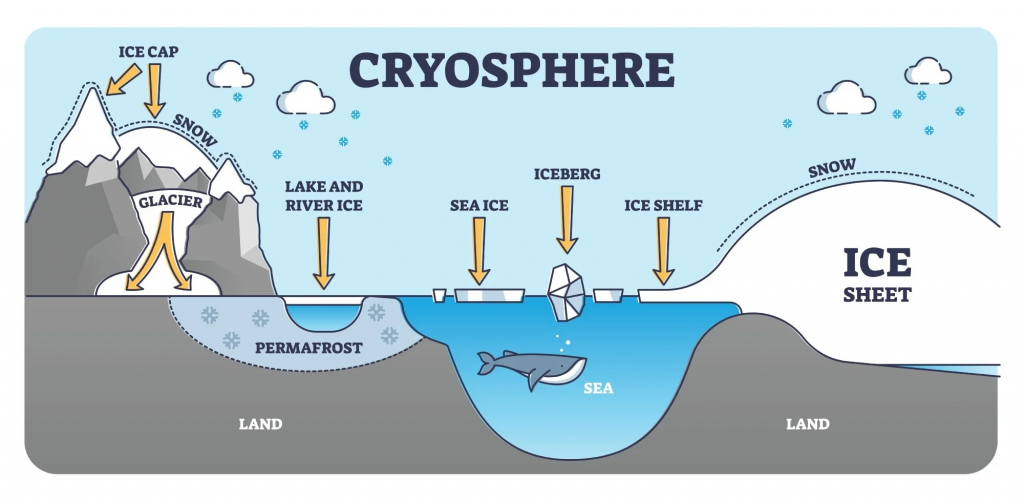
What is the Cryosphere?
- The cryosphere refers to all parts of the earth where water exists in solid form like ice sheets, glaciers, icebergs, and Permafrost.
- And, the Antarctic cryosphere is particularly important because Antarctica contains the world’s largest ice sheet. The ice sheet covers nearly 14 million square kilometres of size and contains enough ice to raise global mean sea level by approximately 58 metres if it were to melt completely.
What are the factors driving changes in the antarctic cryosphere?
- Rising ocean temperatures: Warm ocean water can reach the underside of ice shelves and cause basal melting. This is particularly important because ice-shelf melting from below may occur even when surface air temperatures remain extremely low.
- Atmospheric warming: Higher air temperatures can increase:
- Surface melting
- Formation of meltwater ponds
- Hydrofracturing
- Ice-shelf weakening
- Changing ocean currents and winds: Ocean currents transport heat towards ice shelves and glaciers. Changes in winds can also alter the movement of warm water beneath floating ice shelves.
- Iceberg calving and wave action: Calving is a natural process, but warmer waters, weakening ice structures and wave action can influence the rate at which icebergs break apart. The case of A23a illustrates how an iceberg can remain grounded for decades and later undergo rapid movement and fragmentation due to changing oceanic and physical conditions.
- Changes in snowfall and precipitation: The Antarctic ice sheet gains mass primarily through snowfall and loses it through: Iceberg calving, Surface melting and Ice discharge into the ocean. Thus, the net change depends on the balance between accumulation and loss.
Impacts of Changes in the Antarctic Cryosphere
- Changes in Ocean Circulation: Large quantities of freshwater entering the ocean can alter: Ocean salinity, Water density, Deep-water formation, and Global ocean circulation.
- Antarctic Bottom Water is an important component of the global ocean circulation system. Changes in Antarctic freshwater and ice processes can therefore have consequences beyond the polar region.
- Marine Ecosystems: Changes in sea ice can affect: Krill, Penguins, Seals, Whales and Other marine organisms. For example, changes in the distribution and accessibility of prey under sea ice can affect the feeding behaviour and survival strategies of penguins.
- Ice-Albedo Feedback: Snow and ice reflect a significant proportion of incoming solar radiation. When ice and snow cover decline:
- Less ice → lower albedo → more solar energy absorbed → further warming. This creates a positive feedback loop that can accelerate warming.
- Threat to Coastal Regions: Rising sea levels can increase coastal flooding, shoreline erosion, saltwater intrusion, and damage to coastal infrastructure. For India, sea-level rise poses risks to densely populated coastal regions, including parts of Mumbai, Kolkata and the Sundarbans.
India’s Initiatives Related to Antarctica and Polar Research
- Indian Antarctic Programme: It began in 1981, has completed 40 scientific expeditions and built three permanent research base stations in Antarctica. Dakshin Gangotri (1983), Maitri (1988) and Bharati (2012). Currently, Maitri and Bharati are fully operational.
- National Centre for Polar and Ocean Research: It is an autonomous institute under the Ministry of Earth Sciences which manages the entire Indian Antarctic programme. It is based in Goa.
Conclusion
- The disappearance of A23a should not, by itself, be treated as direct proof of climate change, since iceberg calving and melting are also natural processes. However, it provides a useful case study for understanding the dynamic nature of the Antarctic cryosphere.
- The key concern is not simply whether an individual iceberg disappears, but how the combined changes in ice sheets, glaciers, ice shelves and sea ice affect the global climate system.
- Thus, the Antarctic cryosphere is not merely a frozen region at the southern end of the world. It is a critical component of the global climate system, influencing sea levels, ocean circulation, ecosystems and the future of vulnerable coastal regions.
Source: DTE
Previous article
News In Short 21-07-2026
Next article
One Year of National Cooperation Policy
