


Syllabus: GS3/Economy
Context
- The Directorate of Enforcement (ED) has launched a money-laundering investigation into an alleged $35 million cryptocurrency over-the-counter (OTC) trading scam.
Money Laundering
- Money laundering disguises financial assets while protecting the illegal activity that produced them.
- The prevention of money laundering has become an international effort that includes terrorist funding among its targets.
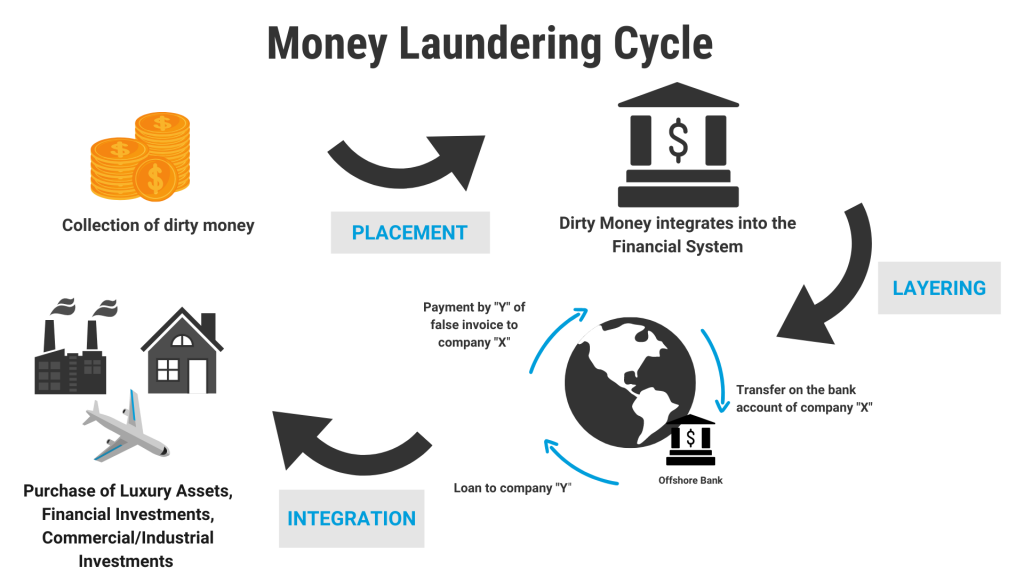
- 3 Stages of Money Laundering:
How Does Money Laundering Impact?
- Impact on Economy: Money laundering undermines the integrity of the financial system by introducing unaccounted and illegal funds into formal channels.
- This can lead to distortions in interest rates, exchange rates, and capital markets.
- It also discourages foreign direct investment (FDI), as investors perceive higher risks in economies affected by weak financial transparency.
- Impact on Public Welfare: Money laundering results in significant loss of tax revenue for the government, increasing fiscal pressure and reducing funds available for public welfare programs.
- Corruption supported by illicit funds erodes public trust in democratic institutions and governance.
- Illicit money often flows into sectors such as real estate, causing artificial inflation of asset prices and making housing unaffordable for genuine buyers.
- Role in Crime and Corruption: Laundered money fuels organized crime, drug trafficking, terrorism financing, and large-scale corruption.
- It enables criminal networks to expand and operate with greater financial strength.
Emerging Challenges
- Digital Banking: With the rise of online banking, digital payment platforms, and peer-to-peer transactions, it has become harder to spot illegal financial activity.
- As financial services become faster and more interconnected, identifying suspicious behavior requires monitoring patterns across multiple channels rather than individual transactions.
- Cryptocurrencies: Cryptocurrencies are not completely anonymous, but they can offer more privacy than regular payment systems.
- Because of this, regulators have increased oversight and reporting rules for digital asset service providers to prevent misuse while still allowing legal innovation.
The Prevention of Money-Laundering Act (PMLA)
- It was enacted under Article 253 of the Constitution in 2002 to prevent money laundering and provide for the confiscation of property derived from or involved in money laundering.
- It came into force from 2005, and it was further amended in 2009 and in 2012.
- The offence under the PMLA mainly involves money laundering obtained through criminal activities (e.g., drug trafficking, terrorism, corruption).
About Directorate of Enforcement (ED)
- Established: It was established in 1956 with the formation of an ‘Enforcement Unit’ under the aegis of the Department of Economic Affairs and handles Exchange Control Laws violations under Foreign Exchange Regulation Act, 1947 (FERA 1947).
- A year later, the Enforcement Unit was renamed the Enforcement Directorate.
- It is a multi-disciplinary organization mandated with investigation of the offence of money laundering and violations of foreign exchange laws.
The statutory functions of the Directorate include enforcement of following Acts:
- The Prevention of Money Laundering Act, 2002 (PMLA): It is a criminal law enacted to prevent money, ED has been given the responsibility to enforce the provisions of the PMLA.
- The Foreign Exchange Management Act, 1999 (FEMA): It is a civil law enacted to consolidate and amend the laws relating to facilitate external trade and payments.
- The Fugitive Economic Offenders Act, 2018 (FEOA): This law was enacted to deter economic offenders from evading the process of Indian law by remaining outside the jurisdiction of Indian courts.
Conclusion
- India has taken significant steps to combat money laundering through the Prevention of Money Laundering Act (PMLA), 2002, and the work of enforcement agencies such as the Enforcement Directorate.
- Despite these efforts, challenges remain, including complex financial structures, cross-border transactions, lengthy legal processes, and relatively low conviction rates.
- Strengthening investigation mechanisms, improving coordination among agencies, and enhancing judicial efficiency are crucial to addressing these gaps.
Source: TH
Previous article
One Year of National Cooperation Policy
Next article
Updation of the ICI Index
