


Syllabus: GS1/ Geography, Energy Resources
In News
- India has commissioned its first and deepest geothermal wells at Puga Valley of Ladakh, a major milestone in the country’s clean energy transition.
Geothermal energy
- It refers to the heat and electricity produced by using the heat from the interior of the Earth.
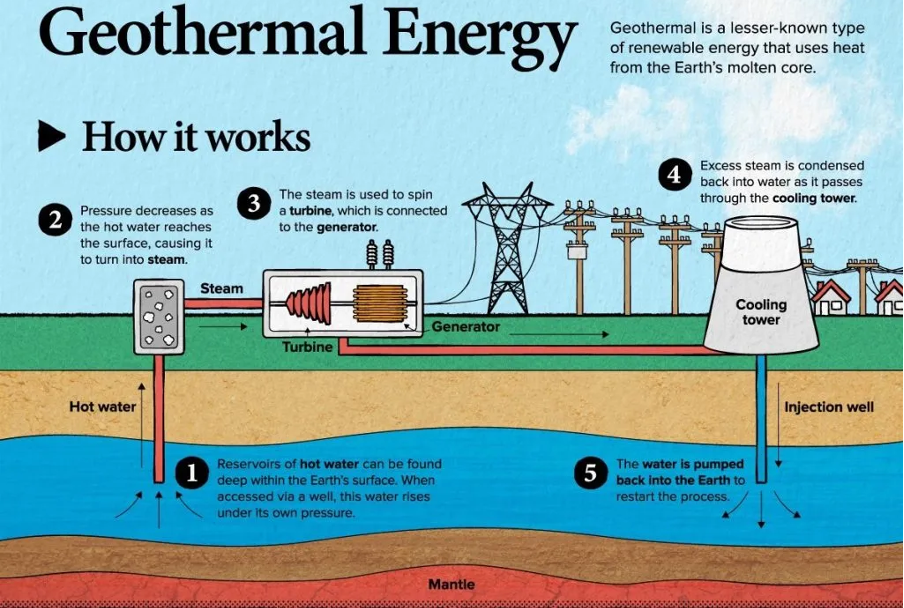
- It exists because the Earth grows progressively hotter with increasing depth. Where the geothermal gradient is high, high temperatures are found at shallow depths.
- Due to the high temperature, the groundwater in such areas absorbs heat from the rocks and becomes hot, which turns into steam. This steam is used to drive turbines and generate electricity.
- It is a site-specific renewable source of energy specifically suitable for catering to the energy needs of remote/interior localities.
Advantages
- Environmentally friendly: Geothermal energy is a clean energy source and has a very low carbon footprint.
- Reliable Renewable Source: It is a constant and reliable renewable energy source.
- High Efficiency: The geothermal systems provide efficient energy conversion.
- Flexible Design: Geothermal plants can be designed to many site conditions.
- Low Maintenance Cost – Usually these systems require very little maintenance.
- Heat Storage: Pumps can store heat for later use, offering more flexibility.
Disadvantages/Issues of Geothermal Energy
- Greenhouse Gas Emissions: Some greenhouse gases are emitted during the extraction process.
- Resource Depletion: Geothermal resources can be depleted over time.
- Cooling of the Extraction Site : After prolonged use the particular site used for extraction may cool.
- Technological Challenges: Using magma as a source of heat poses considerable technical challenges.
- High Capital Costs: The upfront capital investment for geothermal plants can be significant.
- Water Pollution: Some plants require large amounts of water and can be responsible for water pollution.
- Proximity to Volcanic Activity : Geothermal sources are often found near volcanic activity, which can threaten the operation of the plant.
- Hard to find reservoirs. Geothermal reservoirs are hard to find. Geothermal systems can also be hard to implement in large cities
Potential In India
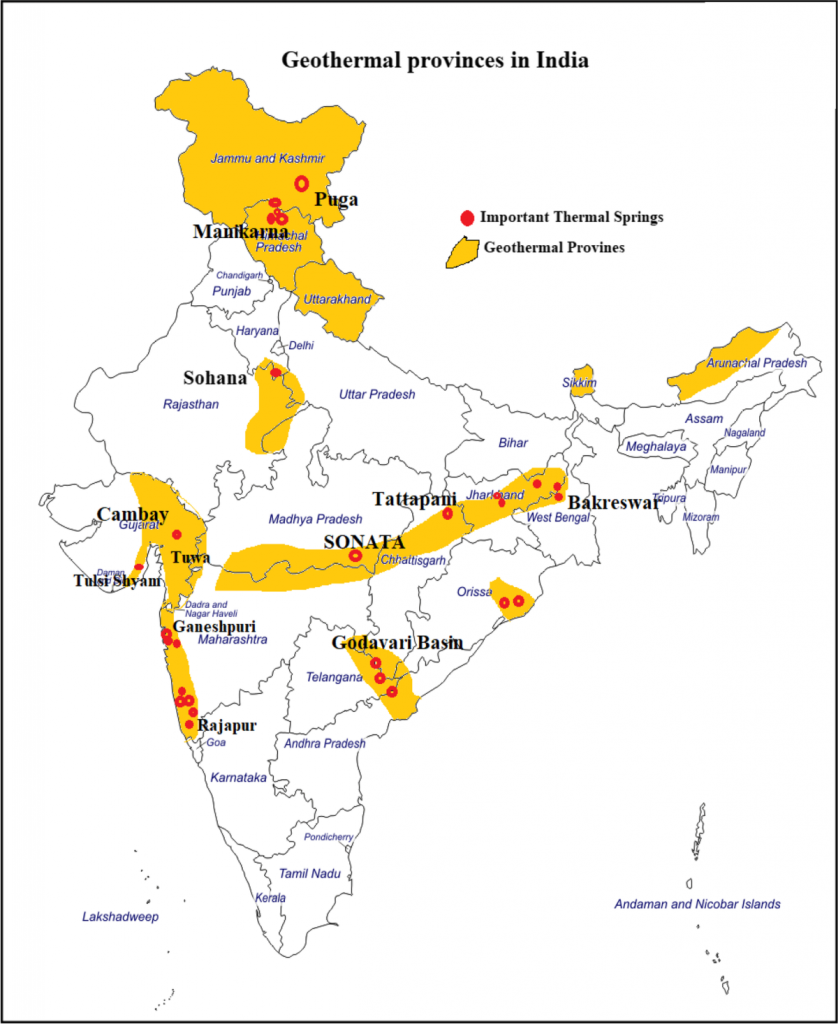
- India has 381 identified hot springs with temperature ranging from 35°C to 89°C with considerable geothermal energy potential.
- The Geological Survey of India (GSI) has estimated the geothermal potential of the country at 10.6 GW distributed over 10 geothermal provinces.
- These include Himalayan Geothermal Province, Cambay Graben and Andaman & Nicobar Islands.
- The global geothermal power capacity is still below 17 GW, with the US, Indonesia and the Philippines in the lead.
- The Indian market is predicted to grow to 4.2 GW by 2035 and almost 100 GW by 2045.
- In Ladakh, The ONGC Energy Centre has developed two 1,000-metre-deep wells to support India’s first 1 MW pilot geothermal power project.
Governments Steps
- The Ministry of New and Renewable Energy (MNRE) has released the National Policy on Geothermal Energy 2025 to facilitate the exploration and development of untapped geothermal energy resources.
- The policy aims to establish geothermal energy as one of the major pillars of India’s renewable energy landscape, reinforcing the commitment to achieve the 2070 Net Zero Goal, and ensuring energy security.
- 100% financial support by MNRE to government/non-profit research organizations and up to 70% to industry, startups etc.
- Renewable Energy Technology Action Platform under US – India Strategic Clean Energy Partnership.
Suggestions
- There is a need to develop exploratory risk fund mechanisms with government backing to offset the risk of failure in early stage drilling by private developers.
- There is a need for Investment in Enhanced Geothermal Systems (EGS) and closed loop technologies to access deep hot-dry-rock systems outside of natural aquifers.
- There is a need for Designing high-temperature, hard-rock drilling rigs for deep Himalayan granite and complex metamorphic formations.
- There is a need to accelerate non-power thermal applications, such as district space heating and cold-chain infrastructure in border areas, to stimulate local economies in extreme climates.
Source :IE
Previous article
News In Short 20-07-2026
Next article
Defections Affect Moral Sanctity of Democracy
