


Syllabus: GS3/ Energy
Context
- India’s power sector has transitioned from a deficit-driven system to a more reliable and capacity-sufficient system due to sustained investments, policy reforms, and institutional strengthening over the past decade.
Key Achievements of Power Sector
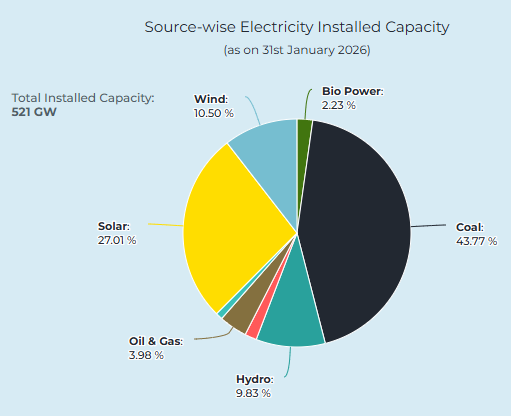
- India’s installed power capacity reached 520.51 GW as of January 2026, with the power shortage declining from 4.2% in FY14 to 0.03% till December 2025.
- Per capita electricity consumption increased to 1,460 kilowatt-hours in 2024–25, reflecting rising energy access and economic activity.
- DISCOMs recorded a profit of ₹2,701 crore in FY25, reversing earlier financial losses.
- Aggregate Technical and Commercial (AT&C) losses, which represent energy lost due to technical inefficiencies and commercial leakages, declined from 22.62 per cent in FY14 to 15.04 per cent in FY25.
Renewable Energy Transition
- India’s total renewable energy capacity reached 253.96 GW in November 2025, representing an increase of over 23% from 205.52 GW in 2024.
- Solar installed capacity reached 132.85 GW followed by Wind at around 53.99 GW.
- India’s Global Position:
- India ranks 3rd globally in solar power installed capacity.
- India ranks 4th in wind power installed capacity.
- India ranks 4th in total renewable energy installed capacity worldwide.
- The leading states in India for renewable energy capacity are Rajasthan, Gujarat, Tamil Nadu, and Karnataka.
- The country aims to achieve 500 GW of non-fossil fuel capacity by 2030 as part of its climate commitments.
Government Initiatives for Power Sector Growth
- Deen Dayal Upadhyaya Gram Jyoti Yojana (DDUGJY) strengthened rural electrification and feeder separation.
- Integrated Power Development Scheme (IPDS) improved urban distribution infrastructure and IT-enabled systems.
- Pradhan Mantri Sahaj Bijli Har Ghar Yojana (Saubhagya) Scheme ensured universal household electrification through last-mile connectivity.
- Revamped Distribution Sector Scheme (RDSS) aims to improve efficiency and financial sustainability of DISCOMs with an outlay of ₹3.03 lakh crore.
Policy and Regulatory Reforms
- The Electricity (Late Payment Surcharge and Related Matters) Rules, 2022, aim to tackle DISCOM cash flow issues by establishing a structured, time-bound mechanism for settling outstanding dues.
- Electricity (Amendment) Bill, 2026 seeks to promote cost-reflective tariffs, rationalise cross-subsidies, and enable market-based power procurement.
- The National Electricity Plan (2023–2032) provides a roadmap to meet projected peak demand of 458 GW by 2032 with large-scale investments.
Challenges
- Financial Stress in DISCOMs: Distribution companies (DISCOMs) continue to face financial stress due to high subsidy burdens imposed by state governments, especially for agriculture and domestic consumers.
- Operational inefficiencies such as power theft, poor billing, and low collection efficiency further increase losses.
- This weak financial position affects their ability to invest in infrastructure, pay generators on time, and ensure reliable supply.
- High Dependence on Coal: Despite growth in renewables, coal remains the dominant source of electricity generation in India. This leads to high carbon emissions, air pollution, and environmental degradation, affecting climate commitments.
- Intermittent Renewable Energy: Renewable energy sources are intermittent in nature and the variability creates challenges in maintaining grid stability and balancing supply with demand in real time.
- Need for Tariff Rationalisation: Electricity tariffs in India are not cost-reflective, as higher-paying industrial consumers subsidise agricultural and domestic users.
- This cross-subsidy structure leads to distorted pricing and reduces competitiveness of industries.
Way Ahead
- Accelerating the rollout of smart metering and digital billing systems will reduce AT&C losses, improve billing efficiency, and enhance transparency.
- Enhancing grid infrastructure, including transmission corridors and flexible generation capacity, is critical for managing rising demand and renewable integration.
- Promoting cost-reflective tariffs with targeted direct benefit transfers (DBT) will reduce cross-subsidies while protecting vulnerable consumers.
Source: PIB
Previous article
Levels and Trends in Child Mortality
Next article
National Vaccination Day
