


Syllabus: GS2/Health
Context
- The United Nations Inter-Agency Group for Child Mortality Estimation (UNIGME) Report 2025 was released recently.
Major Highlights
- Child Mortality: An estimated 4.9 million children died before turning 5 years old in 2024, including 2.3 million newborns.
- Newborn deaths account for nearly half of all under-five deaths, reflecting slower progress in preventing deaths around the time of birth.
- Most of these deaths were preventable with proven, low-cost interventions and access to quality healthcare.
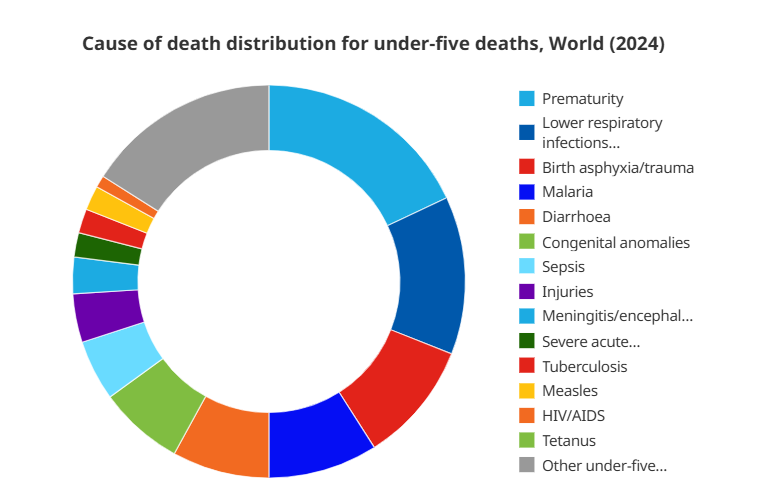
- Causes of Child Mortality:
- Among newborns, deaths are largely caused by prematurity, complications during labour, and neonatal infections.
- For children aged 1–59 months, pneumonia, diarrhoea and malaria remain leading killers, often intensified by malnutrition.
- For the first time, the report estimates deaths directly caused by severe acute malnutrition (SAM), finding that more than 100,000 children aged 1-59 months died from it in 2024.
- Progress Made So Far: Since 1990, the under-five mortality rate has fallen by about 60%, and neonatal mortality by 45%.
- Rate of Decline: Under-five deaths globally have fallen by more than half since 2000 however, since 2015, the pace of reduction in child mortality has slowed by more than 60%.
- The current rate of decline means that 27.3 million under five deaths are projected between 2025 and 2030.
- These deaths remain concentrated in the same regions: sub Saharan Africa and Southern Asia.
- India Specific Findings: India is among the countries demonstrating steady progress in reducing child mortality through sustained public health efforts.
- In 1990, India had an NMR of 57 per 1,000 lives, which fell to 17 in 2024.
- In 1990, the Under 5 Mortality Rate (U5MR) stood at 127 per 1,000 live births, while in 2024 it declined to 27.
- This sharp reduction is due to targeted public health interventions, improved institutional delivery systems, and expanded immunisation coverage.
- Recommendations:
- Political commitment from high-burden countries to mobilize domestic resources, and improve access to evidence-based, quality services that are affordable for all;
- focus on those at highest risk, especially mothers and children in sub-Saharan Africa and Southern Asia, and in conflict and fragile settings;
- strengthen accountability for existing commitments to reduce maternal, newborn, and child deaths, and
- invest in primary health care systems to prevent, diagnose and treat the leading causes of death in children.
United Nations Inter-Agency Group for Child Mortality Estimation (UNIGME)
- It was formed in 2004 to share data on child mortality, improve methods for child mortality estimation, and report on progress towards child survival goals.
- It is led by the United Nations Children’s Fund (UNICEF) and includes the World Health Organization (WHO), the World Bank Group and the United Nations Population Division of the Department of Economic and Social Affairs as full members.
Government Initiatives to Curb Child Mortality in India
- Janani Shishu Suraksha Karyakram (JSSK) entitles all pregnant women and sick infants (up to one year of age) delivering in public health institutions to have free and no-expense delivery, including cesarean section.
- It includes free drugs, consumables, free diet during the stay, free diagnostics, free transportation, and free blood transfusion if required.
- Pradhan Mantri Surakshit Matritva Abhiyan (PMSMA) provides pregnant women a fixed day, free of cost, assured and quality antenatal checkup by a Specialist/Medical Officer on the 9th day of every month.
- Village Health Sanitation and Nutrition Days (VHSNDs) are observed for the provision of maternal and child health services and for creating awareness on maternal and child care.
- Reproductive and Child Health (RCH) portal is a web-enabled tracking system for pregnant women and newborns to ensure seamless provision of regular and complete services to them.
- Mother and Child Protection (MCP) Cards and Safe Motherhood Booklet are distributed to pregnant women to educate them on diet, rest, danger signs of pregnancy, benefit schemes, and institutional deliveries.
- Mission Indradhanush: It was launched in 2014, aiming to achieve over 90% full immunisation coverage by strengthening routine immunisation services and targeting hard-to-reach populations.
- Full immunisation coverage has risen from 62% in 2015 to 98.4% in 2026.
- Rashtriya Bal Swasthya Karyakram (RBSK): Children from 0 to 18 years of age are screened for 32 health conditions (i.e. Diseases, Deficiencies, Defects, and Developmental delays) under RBSK to improve child survival.
- Nutrition Rehabilitation Centres (NRCs) are established at public health facilities where children with Severe Acute Malnutrition (SAM) and medical complications are admitted for treatment.
Do You Know?
- India has eradicated smallpox, polio and maternal & neonatal tetanus through vaccination, and continues to expand its immunisation programme — most recently launched HPV and indigenous Td vaccines in 2026.
- The UIP is one of the world’s largest immunisation programmes, reaching 2.9 crore pregnant women and 2.54 crore newborns every year, free of cost.
Source: TH
Previous article
Morality in Warfare
Next article
India’s Power Sector: Progress and Reforms
