


Rajasthan’s Property Bill
Syllabus: GS2/Polity
Context
- The Rajasthan Prohibition of Transfer of Immovable Property in Disturbed Areas Bill was passed by the Rajasthan Legislative Assembly.
- Rajasthan becomes the second state in India, after Gujarat, to implement such a bill.
About
- Aim: To regulate property transactions in areas that the government declares as “disturbed”.
- Under the proposed law, Section 3(1,2) states that the State government may declare any area within the State as a ‘disturbed area’ if it considers that communal violence, riots, or public disorder exist or are likely to occur.
- Once a locality is notified, any transfer of immovable property, including land, houses or commercial establishments, would require prior approval from the District Magistrate.
- Property transactions carried out without such permission would be treated as legally invalid.
- The law also provides penalties for property transfers carried out without the required permission.
- The legislation has sparked debate over its constitutional validity, potential misuse, and its broader social and economic implications.
Legal Question
- The right to property was removed as a fundamental right by the 44th Amendment to the Constitution in 1978.
- It remains protected under Article 300A, which states that no person can be deprived of property except by authority of law.
- The proposed legislation provides such authority by requiring government approval before property in notified “disturbed areas” can be transferred.
- The Bill has also drawn attention in relation to Article 14, which guarantees equality before the law.
- If the provisions disproportionately affect certain neighbourhoods or communities, the law could face scrutiny on grounds of arbitrary classification or discrimination.
Source: TH
Captive Power Generation
Syllabus: GS3/ Energy
In News
- The Electricity (Amendment) Rules, 2026, notified by India’s Ministry of Power, updated the Electricity Rules, 2005, to streamline regulations for captive generating plants (CGPs) and boost ease of doing business.
About Captive Power Plant
- A Captive Power Plant is a power plant set up primarily for its owner’s use, per the Electricity Act, 2003.
- It qualifies as captive if captive users hold over 26% ownership and consume more than 51% of generated electricity annually.
Significance
- CGPs help industries avoid grid supply shortages and price swings, supporting growth via reliable, on-site power often from sources like gas engines or renewables.
Source: TH
Nivation
Syllabus: GS3/Environment; Disaster Management
Context
- A new study by scientists from the Indian Space Research Organisation (ISRO) found the flash flood in Dharali village in Uttarakhand was triggered by the collapse of an ice patch in the nivation area of the Srikanta glacier.
About
- Nivation is defined as the erosion of the ground beneath and around a snow bank, primarily as a result of alternate freezing and thawing.
- This can form a nivation hollow, which gradually becomes deeper when snow repeatedly accumulates in the same place.
Nivation area of the Srikanta glacier
- It lies in the upper Bhagirathi river basin in Uttarkashi district of Uttarakhand.
- Srikanta Glacier is a small- to medium-sized valley glacier with a height of 6,133 m, around 9.8 km upstream of Dharali.
- The glacier has steep accumulation and ablation zones, seasonal snow cover, and extensive nivation areas.
Source: TH
Indigenous TAVR system for preclinical studies
Syllabus: GS3/Science and Tech
In News
- S3V Vascular Technologies Ltd. has launched an indigenous Balloon-Expandable TAVR system for preclinical studies
Transcatheter Aortic Valve Replacement (TAVR) system
- It is a transformative, minimally invasive therapy for patients with severe aortic stenosis—a condition where the aortic valve narrows, restricting blood flow.
- Traditional treatment requires open-heart surgery but TAVR allows clinicians to replace the valve via a catheter, significantly reducing recovery time for elderly or high-risk patients.
Present status
- Currently, TAVR remains inaccessible to many in emerging markets due to high costs.
- Imported valve replacement systems in India cost ₹13–23 lakh, limiting access, while the annual need for TAVR is around 50,000 compared to only 4,000 procedures performed.
Latest developments
- Transcatheter Aortic Valve Replacement (TAVR) system for preclinical studies offering a minimally invasive alternative to open-heart surgery for severe aortic stenosis.
- The recent launch of indigenous Balloon-Expandable TAVR system for preclinical studies aims to lower costs with a high-quality, locally developed alternative, making advanced cardiac care more accessible nationwide.
Source :TH
Sangita Kalanidhi Award
Syllabus: Miscellaneous
Context
- Veena player Jayanthi Kumaresh has been announced the coveted Sangita Kalanidhi at the 100th Conference and Concerts of The Music Academy, Madras.
- Bharatanatyam dancer Narendra G will be conferred the Nritya Kalanidhi award.
About Sangita Kalanidhi Award
- Instituted in 1942 by The Music Academy, Madras.
- It is regarded as the highest honour in Carnatic music, often described as the “Nobel Prize of Carnatic music.”
- The award comprises a gold medal and a birudu patra (citation).
- Since 2005, recipients have also been honoured with the MS Subbulakshmi Award, instituted by The Hindu.
About the Music Academy, Madras
- The Music Academy, Madras originated as an offshoot of the All India Congress Session of 1927 held in Chennai (then Madras).
- It was established to promote and standardise Carnatic music traditions.
- The Academy organizes the annual Music and Dance Festival, one of the most prominent cultural events in the Carnatic tradition.
- The Academy also confers several awards, including the Sangita Kala Acharya, TTK Award, and Musicologist Award.
Source: TH
Jnanpith Award
Syllabus: Miscellaneous
Context
- Tamil poet and lyricist Vairamuthu has been selected for the Jnanpith Award for the year 2025.
About
- He is the third Tamil litterateur to receive the award after Akilan (1975) and Jayakanthan (2002), and the first to be honoured for Tamil poetry, while the earlier awardees were recognised for prose.
- He has written over 8,000 songs, won seven National Film Awards for lyrics, and earned the honorific “Kaviperarasu” (Emperor of Poets).
- The award, however, has been met with sharp criticism from some writers, artists and activists who point to sexual harassment allegations made against him during the #MeToo movement in India.
About Jnanpith Award (also spelled Gyanpeeth Award)
- Instituted in 1961 by the Bharatiya Jnanpith, it is India’s highest literary honour, awarded annually to an Indian author for outstanding contribution to literature.
- Bharatiya Jnanpith is a literary and research organization founded by Sahu Shanti Prasad Jain and Rama Jain.
- It is awarded for the work in 22 languages recognized by the Constitution of India and, from 2013, in the English language.
- The award carries a ₹11 lakh cash prize, citation, and a bronze statuette of Vagdevi (Saraswati).
- The first recipient was Malayalam writer G. Sankara Kurup in 1965 for Odakkuzhal.
Source: IE
Western Tragopan: King of Birds
Syllabus: GS3/Environment
Context
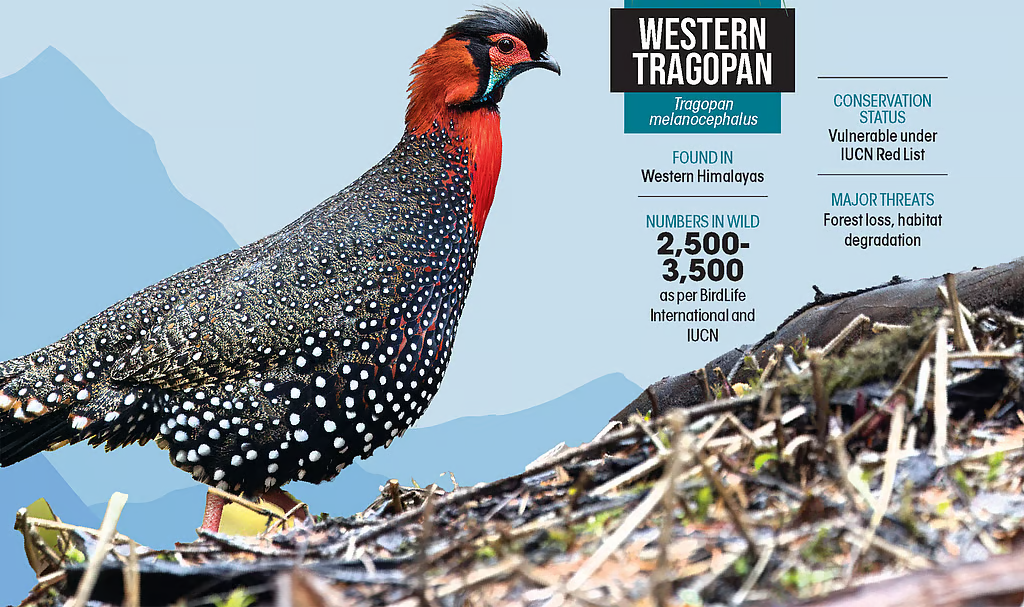
- The Western Tragopan, a rare Himalayan pheasant, faces increasing threats due to forest loss and human pressures.
About
- The Western Tragopan (Tragopan melanocephalus), also known as Jujurana or “king of birds,” is one of the rarest and most stunning pheasant species in the world.
- Habitat and Distribution: Found in temperate and subalpine forests at 2,400–3,600 m (occasionally down to 2,000 m in winter).
- From Swat Valley (Pakistan) across Kashmir and Himachal Pradesh to Uttarakhand.
- Diet: They are omnivores, feeding on berries, seeds, buds, shoots, and insects.
- Major Threats: Forest degradation, climate change, and human disturbances.
- Conservation Status: It is listed as Vulnerable by BirdLife International and the International Union for Conservation of Nature (IUCN).
Do you know?
- The bird is also the state bird of Himachal Pradesh, highlighting its cultural and ecological value.
Source: DTE
Previous article
India’s Expanding Data Centre Ecosystem
Next article
India to Begin Mapping Its Manuscript Heritage
