


Whip
Syllabus: GS2/Polity
Context
- The ruling political party has issued a three-line whip to all its MPs, urging them to remain present in their respective Houses during the extended Budget session of Parliament.
What is Whip?
- A whip refers to an order to members of a party in the House to abide by a certain direction of the party.
- Political parties issue whips to their MPs to either vote for or against the bill, depending on their party line.
- Once the whip is issued, the MPs from each party will necessarily have to obey the whip or else risk losing their seat in Parliament.
- The term is derived from the old British practice of “whipping in” lawmakers to follow the party line.
- It is not mentioned in the constitution but is considered a parliamentary convention.
- Parties appoint a senior member from among their House contingents to issue whips — this member is called a chief whip, and he/ she is assisted by additional whips.
Types of Whip
- There are three kinds.
- A one-line whip just informs members about a vote but permits them to abstain.
- A two-line whip asks them to be present but does not tell them how to vote.
- The three-line whip, largely the norm these days, directs members to be present and vote as per the party line.
Importance of a whip
- The whip maintains discipline, secure attendance of, and gives necessary information to, members of the party.
- It is a channel of communication between the political party and the members of the party in the legislature.
- They also serve the function of gauging the opinion of the members, and communicating it to party leaders.
Source: TH
Right to Vote in India
Syllabus: GS2/ Polity and Governance
Context
- The Supreme Court of India has reiterated that a person born in India has the right to remain on the electoral roll and to vote.
About
- The Supreme Court of India has held that the right to be included in the electoral roll and to vote is also a “sentimental right.”
- The observation came amid large-scale voter deletions during the Special Intensive Revision (SIR) of electoral rolls in West Bengal ahead of Assembly elections.
Right to Vote in India
- Article 326 of the Indian Constitution provides that every citizen of India, not less than 18 years of age is entitled to be registered as a voter for Elections to the House of the People and Legislative Assembly of every State on the basis of adult suffrage.
- However, voting is a statutory right, not a fundamental right (as held by the Supreme Court of India in various judgments).
- In the case of N.P. Ponnuswami v. Returning Officer (1952), the Supreme Court of India held that the right to vote and the right to contest elections are statutory rights.
- The SC in Kuldip Nayar v. Union of India (2006) reiterated that voting is a statutory right, though crucial for democracy.
Source: TH
India Rejects China’s Fictitious Naming of Places in Arunachal Pradesh
Syllabus: GS2/IR
In News
- India has strongly rejected China’s attempts to assign “fictitious names” to places it considers part of its territory, calling such actions “mischievous” and harmful to bilateral relations.
China’s actions
- China claims Arunachal Pradesh as “southern Tibet” (Zangnan) and has issued multiple lists of renamed locations since 2017, which India consistently rejects as invalid.
- China is creating administrative units such as He’an and Hekang counties in areas of Ladakh, including parts of Aksai Chin, which is a long-standing border dispute region.
- China has also reportedly created a new county, Cenling.
Cenling
- It is located near the Karakoram mountain range, which falls in the vicinity of Pakistan-occupied Kashmir (PoK) and Afghanistan’s Wakhan corridor.
He’an
- It included parts of the Aksai Chin plateau, which has been in focus because of the long-running India-China border issue.
India’s Response
- The Ministry of External Affairs (MEA) reiterated that regions like Arunachal Pradesh and other disputed areas are “integral and inalienable” parts of India.
- India views such moves in the broader context of border tensions and strategic concerns, including the China-Pakistan Economic Corridor (CPEC), which India opposes due to sovereignty issues over PoK.
Line of Actual Control (LAC)
- The LAC is the demarcation that separates Indian-controlled territory from Chinese-controlled territory.
- India considers the LAC to be 3,488 km long, while the Chinese consider it to be only around 2,000 km.
- It is divided into three sectors: the eastern sector which spans Arunachal Pradesh and Sikkim, the middle sector in Uttarakhand and Himachal Pradesh, and the western sector in Ladakh.
Source :TH
Project HIM SAROVAR
Syllabus: GS3/Infrastructure/Climate Change
Context
- Project Him Sarovar has been launched in Ladakh.
About
- Aim: The project aims at scientific snow harvesting and the creation of water bodies to address the pressing challenge of water scarcity in Ladakh.
- The project will build storage ponds to collect melting snow and glacial water.
- These ponds will support irrigation and rural water needs.
- The initiative also aims to develop a local model for climate-resilient water management.
- As valleys in Ladakh rely on snowfall and glaciers for their water needs, unpredictable weather changes are leading to water scarcity, severely affecting the livelihood of villagers.
- The project has received support from the Indian Army, ITBP, BRO, and local communities.
- Significance:
- This will help boost local livelihoods and agriculture in the region.
- It will address water scarcity, boost irrigation, and enhance climate resilience in region.
Source: ET
Transition Metals
Syllabus: GS3/ Science and Technology
Context
- Recent research published in Nature has demonstrated that aluminium can mimic certain catalytic properties of transition metals.
What are Transition Metals?
- Transition metals are elements located in the d-block of the periodic table and are characterised by partially filled d-orbitals.
- Examples: Palladium, Platinum, and Rhodium.
- Applications: These metals are widely used as catalysts due to their unique electronic configurations. Their catalytic properties significantly reduce reaction time and improve yield and efficiency.
- They play a vital role in petrochemical refining, polymer manufacturing, and agrochemical industries.
Key Properties of Transition Metals
- Transition metals exhibit variable oxidation states, which allow them to gain and lose electrons easily.
- They facilitate Redox Reaction processes, which are essential for catalytic activity.
- They form stable complexes with ligands, enabling controlled chemical transformations.
Significance for India
- Transition metals are rare and expensive. Aluminium is abundant, inexpensive, and widely available in India.
- Aluminium-based catalysts can reduce import dependence on critical transition metals.
Source: TH
CAFE-III Norms
Syllabus: GS3/Economy
Context
- The Corporate Average Fuel Efficiency (CAFE) III norms are proposed to be implemented from April 1, 2027, to March 31, 2032, with stricter fuel efficiency requirements for automobile manufacturers.
About CAFE Norms
- Corporate Average Fuel Efficiency or CAFE norms were first introduced in 2017 under the Energy Conservation Act, 2001, as part of India’s efforts to curb fossil fuel dependence and air pollution from road transport.
- Issued by the Bureau of Energy Efficiency (BEE), the fuel efficiency regulations apply to M1 category vehicles—passenger cars with seating for up to nine persons and a maximum weight of 3,500 kg.
- The regulations set limits on corporate average fuel consumption, measured in litres per 100 kilometres, based on the average weight of vehicles sold by an automaker during a financial year.
- Since fuel consumption and carbon dioxide (CO2) emissions are directly linked, the rules aim to reduce carbon intensity by pushing companies to improve the efficiency of their overall fleet.
- Phases of CAFE Norms:
- The first phase, implemented in 2017–18, capped average fuel consumption at 5.5 litres/100 km and emissions at <130 gm CO2/km.
- The second phase, in force since 2022–23, tightened this to 4.78 litres/100 km and <113 gm CO2/km.
- The third iteration, CAFE III (or CAFE 2027), proposes to reduce permissible fuel consumption to a range of 3.72–3.01 litres/100 km, with emissions expected to fall below 91.7 gm CO2/km.
Source: BS
National Agriculture Market (e-NAM)
Syllabus: GS3/Agriculture
Context
- The e-NAM portal reflects increasing market integration, with the number of connected mandis rising from 1,389 in 2024 to 1,656 as of March 2026, spanning 23 States and 4 Union Territories.
About National Agriculture Market (e-NAM)
- Pan-India electronic trading portal for agricultural commodities.
- Integrates APMC mandis into a unified national market.
- Operated by the Small Farmers Agribusiness Consortium (SFAC) under the Ministry of Agriculture.
- Objectives:
- ‘One Nation, One Market’ for agricultural produce;
- Better price discovery, transparency, and competition.
Key Features
- Online Trading Platform: Farmers can sell produce electronically across markets; and removes geographical barriers
- Quality Assaying: Scientific quality testing ensures fair pricing
- Transparent Bidding System: Reduces middlemen/cartelization; and promotes competitive price discovery
- Unified License: Traders can operate across multiple mandis
- Online Payment System: Direct payment to farmers reduces delays & exploitation
e-NAM Portal
- Single-Window Service: Commodity arrivals, quality assaying, bidding, payment, all on one platform.
- Unique Lot ID Tracking: Each lot tracked from gate entry to final sale via mobile.
- Live Price Dashboard: Real-time commodity prices, mandi arrivals, trade volumes, publicly accessible.
- 12-language Interface: Hindi, English, Gujarati, Marathi, Telugu, Bengali, Tamil, Odia and others.
- Secondary Sale Module: Enables resale of already-purchased lots within the platform.
- Inter-state Trade Facility: State Unified License enables traders to bid across State boundaries.
Atlantic Meridional Overturning Circulation (AMOC)
Syllabus: GS3/Environment
Context
- Recent scientific studies highlight that the weakening Atlantic Meridional Overturning Circulation (AMOC) could trigger major climatic disruptions.
What is AMOC?
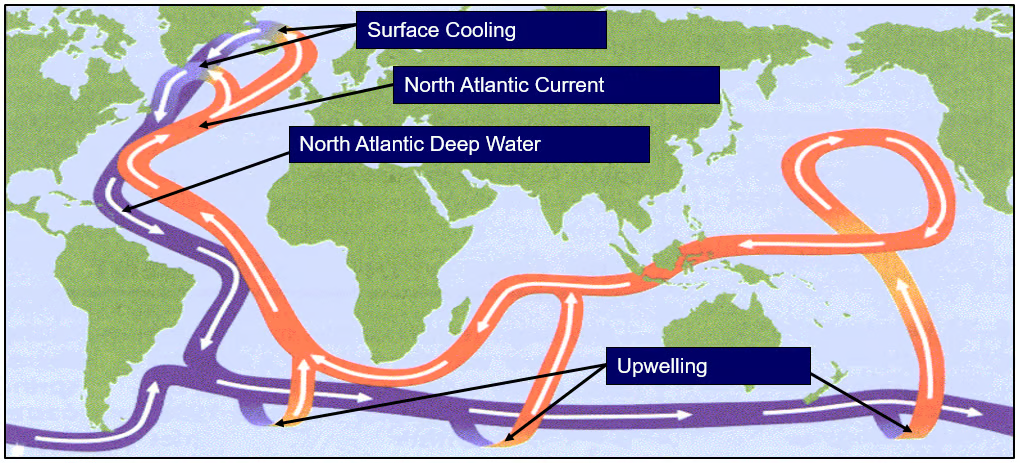
- The AMOC is a large system of ocean currents that transports heat:
- Warm, salty water flows northward near the surface (e.g., Gulf Stream)
- Cold, dense water sinks in the North Atlantic and flows southward at depth.
- It regulates global climate, keeps Europe warmer than comparable latitudes, and drives rainfall patterns in tropics.
- In the North Atlantic, water cools, becomes denser, and sinks. It then flows southward at depth, completing a circulation loop.
Importance
- Keeps Europe relatively warm despite high latitude.
- Influences Indian monsoon patterns.
- Regulates global climate and rainfall distribution.
- Supports marine ecosystems by nutrient circulation.
Evidence of Weakening
- Observational data (last 20 years) shows consistent decline in AMOC strength.
- Western Atlantic boundary contributes about 90% of weakening.
- Strongest decline observed at 16.5°N latitude.
Impacts of AMOC Collapse
- Carbon Cycle Disruption: Release of 47–83 gigatonnes of CO₂ into the atmosphere.
- The Southern Ocean shifts from carbon sink to carbon source, adding about 0.2°C global warming.
- Temperature Changes:
- Northern Hemisphere: Arctic cooling up to 7°C; reduced heat transport and sea-ice albedo feedback.
- Southern Hemisphere: Antarctic warming up to 6–10°C.
- Global Temperature Effect: Net global warming increase: 0.17–0.27°C.
- Oceanic and Atmospheric Changes: AMOC weakening disrupts monsoons, storm tracks, and marine ecosystems
- It can trigger cascading tipping points.
Previous article
EAM Addressed the 9th Indian Ocean Conference
Next article
India’s New Deportation Policy
