


Syllabus: GS3/ Agriculture
Context
- The Union Cabinet has approved a subsidy of ₹62,370.02 crore for fertilisers for the Rabi 2026–27 season, 64% higher than the previous year’s allocation of Rs 37,952 crore.
About
- Coverage: The subsidy applies to Phosphatic and Potassic (P&K) fertilisers, including Di-Ammonium Phosphate (DAP) and NPKS grades.
- Beneficiaries: Fertiliser manufacturers and importers receive the subsidy so that fertilisers remain available to farmers at affordable prices.
What are Fertilizers?
- Fertilizers are concentrated plant nutrients made from inorganic chemicals.
- Unlike organic manure, fertilizers contain nutrients in higher amounts and are applied in smaller quantities.
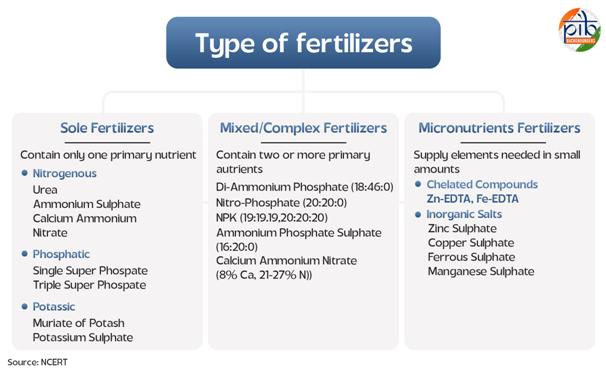
Mechanism of Subsidy
- Subsidy on Sale Price: The government provides financial support to fertilizer manufacturers or importers, lowering the price of fertilizers sold to farmers.
- Direct Benefit Transfer (DBT): In some cases, the subsidy is transferred directly to farmers through their bank accounts to cut out the middlemen and ensure transparency.
- Fixed Subsidy Rates: For urea, the subsidy is fixed per kilogram of the product, and for others like DAP, it is adjusted periodically based on market prices.
Nutrient-Based Subsidy (NBS) Scheme
- It was launched in 2010 by the Department of Fertilisers, Ministry of Chemicals and Fertilisers.
- Objective: To ensure the availability of P&K fertilisers to farmers at subsidised and affordable prices while promoting balanced nutrient application.
- Mechanism: The government provides a fixed subsidy per kilogram of nutrient (N, P, K and S) contained in notified fertilisers.
- Subsidy rates are revised periodically, generally twice a year, based on international prices and input costs.
- Fertiliser companies are free to determine the retail prices of P&K fertilisers, subject to government monitoring.
- Coverage: The scheme covers 28 grades of P&K fertilisers, including DAP, NPK and NPKS fertilisers.
Reasons for the Increase in Fertiliser Subsidy
- Rise in global fertiliser prices: International prices of DAP, urea, muriate of potash (MOP) and sulphur have increased, raising India’s fertiliser import costs.
- Geopolitical disruptions: The Russia–Ukraine conflict and the West Asia crisis have disrupted global fertiliser supply chains and increased input costs.
- Higher energy costs: Natural gas (including LNG) is a key feedstock for urea production. Rising gas prices increase domestic fertiliser manufacturing costs.
- Import dependence: India depends on imports for key fertilisers and raw materials such as phosphatic and potassic fertilisers, potash and sulphur, making domestic agriculture vulnerable to international price fluctuations.
Challenges Associated with Fertiliser Subsidies
- Soil degradation: Excessive fertiliser use reduces soil health along with affecting soil microorganisms and lower long-term agricultural productivity.
- Fiscal sustainability: International pricing raises the load on government subsidy and causes unpredictability in budgetary planning.
- Leakages and diversion: Fertilisers used for agriculture may be diverted for non-agricultural purposes.
Government’s Initiatives in the Fertilizer Sector
- The One Nation One Fertilizer scheme was introduced to bring uniformity in branding and ensure transparency in the Fertilizer sector.
- PM PRANAM scheme: PM Programme for Restoration, Awareness Generation, Nourishment and Amelioration of Mother – Earth (PMPRANAM) was launched to incentivize States/ Union Territories to promote alternate fertilizers and balanced use of chemical fertilizers.
- Sulfur Coated Urea (Urea Gold) was introduced to overcome the sulfur deficiency in the soil and reduce the input cost of the farmers.
- Nano Urea: It is a liquid fertilizer developed by IFFCO. It is an alternative to conventional urea.
Way Ahead
- There is a need to encourage farmers to adopt balanced nutrient management practices through awareness campaigns and training programmes.
- Information on soil health, crop nutrient need and harmful effects of overuse would assist farmers to make informed decisions on fertiliser application.
- Promotion of manufacture and use of alternative and eco-friendly fertilisers such as biofertilizers, green manure, compost etc. will lead to sustainable agricultural methods and reduced dependence on imports.
Source: MoneyControl
Previous article
News In Brief 11-11-2026
Next article
Supreme Court OBC Creamy Layer Ruling
