


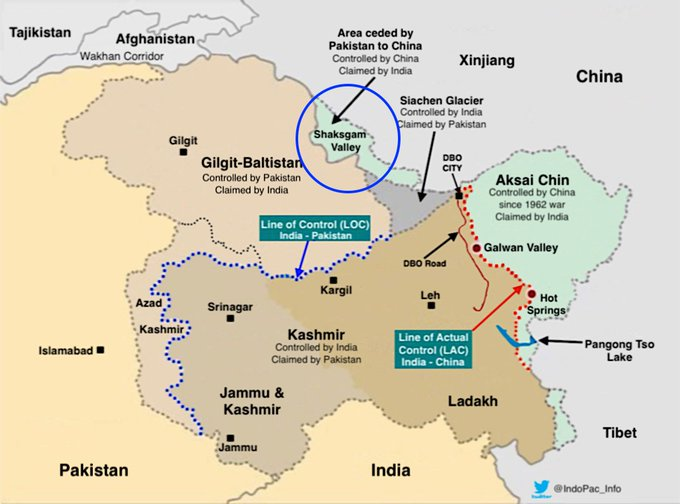
Shaksgam Valley
Syllabus: GS1/ Places In News
Context
- India has reiterated that Shaksgam Valley is part of its sovereign territory and rejected the 1963 China–Pakistan Boundary Agreement, calling it illegal and invalid.
- India also reaffirmed its opposition to the China–Pakistan Economic Corridor (CPEC) as it passes through Indian territory under illegal occupation.
About Shaksgam Valley
- Also known as the Trans-Karakoram Tract.
- Lies north of the Siachen Glacier, in the region of Ladakh.
- Historically part of the former princely state of Jammu and Kashmir.
- Currently under Chinese control, Pakistan illegally ceded Shaksgam Valley to China following the 1963 China–Pakistan Boundary Agreement.
Source: TOI
Water Vapor
Syllabus: GS1/Geography
Context
- As per the recent study, water vapour contributes more to atmospheric heating than aerosols, highlighting its dominant role in the regional climate system.
Key Points
- The radiative effect of water vapour is strongly modulated by aerosol presence, indicating a tight aerosol–water vapour coupling.
- Water vapor radiative effects (WVRE) is strongest in clean (low-aerosol) atmospheric conditions, both at the surface and within the atmosphere.
- The Indo-Gangetic Plain (IGP) is a global hotspot of aerosol loading due to:
- High population density;
- Industrial and vehicular emissions;
- Biomass burning and dust transport.
Water Vapour
- Water vapour is the most abundant greenhouse gas in the atmosphere.
- It is a condensable gas, easily changing from gas to liquid.
- Its concentration decreases with altitude and from the equator towards the poles.
- It can constitute up to 4% of air by volume in warm tropical regions.
- In cold, dry deserts and polar regions, it may be less than 1%.
Source: TH
Somnath Swabhiman Parv
Syllabus: GS1/History
In News
- Somnath Swabhiman Parv is being organised to commemorate the temple’s reopening.
The Somnath Swabhiman Parv
- It marks 1,000 years since the first recorded attack on Somnath Temple and 75 years since its reopening in 1951.
- The temple was rebuilt through the collective resolve of devotees like Devi Ahilya Bai Holkar.
- It is a four-day event which celebrates resilience, faith, and India’s civilisational continuity, featuring 72-hour Akhand Omkar chanting, devotional music, spiritual discourses, and cultural programs.
- It highlights Somnath as a symbol of revival and national pride rather than a remembrance of destruction.
| Somnath – The Somnath temple located in Prabhas Patan near Veraval in Saurashtra on the western coast of Gujarat, is believed to be the first among the twelve jyotirlinga shrines of Shiva – Somnath is revered as the first among the 12 Aadi Jyotirlingas of Lord Shiva. – The present temple complex comprises the Garbhagriha (sanctum sanctorum), Sabhamandap (assembly hall) and Nrityamandap (dance hall), rising majestically alongside the Arabian Sea. – Features: The temple is crowned by a 150-foot Shikhar, with a 10-tonne Kalash at its summit. The Dhwajdand (flagpole), standing 27-foot tall, marks the temple’s unwavering identity. a. The complex is adorned with 1,666 gold-plated Kalash and 14,200 Dhwajas, symbolising generations of devotion and craftsmanship. – Attacks: Over centuries, it was repeatedly destroyed and rebuilt, beginning with the first recorded attack by Mahmud of Ghazni in 1026, symbolising India’s enduring faith, identity, and civilisational pride. – Reconstruction: The present temple was reconstructed in Chaulukya style of Hindu temple architecture and completed in May 1951. The reconstruction was completed by Vallabhbhai Patel. |
Source :PIB
Weimar Triangle
Syllabus: GS2/ International Relation
In News
- India participated for the first time in the Weimar Triangle format, a significant diplomatic development.
About the Weimar Triangle
- It is a trilateral political and diplomatic grouping of France, Germany & Poland established in 1991 named after Weimar, where the three foreign ministers of these nations first met.
- It aims to build a united, secure, and resilient Europe & strengthen political, security, and economic cooperation among Western and Central European powers.
Why Does India’s Participation Matters?
- Reflects India–Europe strategic convergence, beyond bilateral ties.
- Indicates European support for India’s:
- Energy security needs
- Independent foreign policy decisions
- Expands India’s engagement with key European security platforms, even outside formal EU structures.
Source: TH
Ministry of Tourism completes 75 projects under Swadesh Darshan
Syllabus: GS2/ Governance
Context
- The Ministry of Tourism Completes 75 Projects under Swadesh Darshan Scheme.
About
- The Ministry of Tourism launched the Swadesh Darshan Scheme in 2015 for the development of theme-based tourist circuits.
- The scheme adopts an integrated approach to tourism development, focusing on infrastructure creation, destination management, and visitor experience.
- A total of 76 projects have been sanctioned for a total amount of Rs. 5290.33 Crore under the scheme.
- Theme-Based Tourist Circuits: It identifies various thematic circuits based on specific themes such as;
- Spiritual circuits (e.g., Char Dham Yatra, Buddhist circuit)
- Cultural circuits (e.g., North East Circuit, Tribal Circuit)
- Heritage circuits
- Wildlife circuits
- Coastal circuits
- The scheme has now been revamped as Swadesh Darshan 2.0 with the objective to develop sustainable and responsible destinations.
Source: PIB
Samagra Shiksha 3.0
Syllabus: GS2/Education
Context
- The Union Minister for Education chaired a consultation meeting with the stakeholders on Samagra Shiksha 3.0, titled ‘Reimagining Samagra Shiksha’.
About
- The meeting aimed to develop a strategic, consultative, and implementable roadmap for Samagra Shiksha 3.0 through collaborative deliberations with States, UTs, and sectoral stakeholders.
- The discussions focused on emerging challenges, best practices, and priority interventions required to strengthen governance, infrastructure, teacher training, and student entitlements in the next phase of the scheme.
Samagra Shiksha
- Launch: It was launched in the Union Budget, 2018-19.
- Aim: To treat school education holistically without segmentation from pre-nursery to Class 12.
- It subsumes the three erstwhile Schemes of Sarva Shiksha Abhiyan (SSA), Rashtriya Madhyamik Shiksha Abhiyan (RMSA) and Teacher Education (TE).
- The main outcomes of the Scheme are envisaged as Universal Access, Equity and Quality, promoting Vocationalisation of Education and strengthening of Teacher Education Institutions (TEIs).
- The Scheme is implemented as a Centrally Sponsored Scheme under the Ministry of Education.
Source: TH
Creator’s Corner
Syllabus: GS2/Governance
In News
- Prasar Bharati launched “Creator’s Corner” on DD News to spotlight Digital Talent.
“Creator’s Corner”
- It is a new segment on DD News aimed at providing a national platform to emerging digital content creators from across India.
- It would empower creators from small towns and linguistic communities who are producing, editing and distributing content independently.
- It will feature content on a wide range of themes including News and Current Affairs, Culture, Travel, Cuisine, Art and Literature, Music and Dance, Health and Wellness, Education, Science and Technology, inspiring stories, Environment and Sustainable Development, and Entertainment.
Significance
- It aligns with the Centre’s push to recognise and mainstream the country’s growing creator economy.
- It seeks to build a vibrant, responsible and inclusive ecosystem that recognises creators as full-fledged content producers.
- It aims to promote the digital economy by encouraging the creation of quality content and expanding its reach through a partnership between Prasar Bharati and individual content creators.
9th Apex-level Narco Coordination Centre (NCORD) Meeting
Syllabus: GS3/ Internal Security
In News
- The Home Minister chaired the 9th apex-level Narco Coordination Centre (NCORD) meeting in New Delhi and reviewed the collective national effort to combat the drug menace in the country.
About NCORD
- NCORD serves as India’s key coordination mechanism for combating drug trafficking and abuse through enhanced collaboration between central and state agencies.
- Established in 2016 and restructured in 2019 under the Ministry of Home Affairs, it enforces the NDPS Act, 1985, via a structured four-tier system (Apex Level Committee, Executive Level Committee, State Level Committees & District Level Committees)
Key Initiatives
- NCORD Portal: By Narcotics Control Bureau (NCB) acts as a knowledge management system for intelligence sharing and monitoring.
- MANAS Helpline (1933): 24×7 toll-free service for drug-related information and support.
- NIDAAN Database: Tracks arrested narco-offenders to disrupt networks.
Source: PIB
National IED Data Management System of NSG
Syllabus: GS3/Internal Security
In News
- The Home Minister launched the National IED Data Management System (NIDMS), marking a significant step towards strengthening the country’s counter-IED and internal security architecture.
National IED Data Management System (NIDMS)
- It is developed by the National Security Guard (NSG).
- It is a secure national digital platform through which accurate and organized analysis of bomb explosion-related incidents across the country can be conducted.
- It is aimed at enabling the systematic collection, collation and dissemination of data related to Improvised Explosive Devices (IED).
- It will enable ATS units, the police, and the CAPFs across the country to access and use a wide range of data available online. He added that the system will function as a two-way platform.
Source :Air
Copper
Syllabus: GS3/ Economy/ Science & Technology
Context
- Global copper demand is projected to rise nearly 50% by 2040, driven by artificial intelligence, clean-energy transition and rising defence expenditure.
About Copper
- Copper (Cu) is a reddish-orange, soft and highly malleable metal with atomic number 29, known for its exceptional electrical and thermal conductivity.
- These properties make it vital for electrical wiring, power transmission, plumbing and electronic applications.
- Copper is also a key component of important alloys such as brass (copper–zinc) and bronze (copper–tin), which enhance strength and corrosion resistance.
- India has significant copper ore resources primarily in Rajasthan’s Khetri belt, Madhya Pradesh’s Malanjkhand , and Jharkhand’s Singhbhum belt.
Source: FP
