


Syllabus: GS3/Science & Technology
Context
- The 2026 Nobel Prize in Chemistry has brought global attention to chirality and homochirality, highlighting how chemical reactions can selectively produce one mirror-image form of a molecule.
About Nobel Prize in Chemistry & Its 2026 Recipient
- The Nobel Prize in Chemistry, established under Alfred Nobel’s will, recognises discoveries or improvements of greatest benefit to humankind in chemistry.
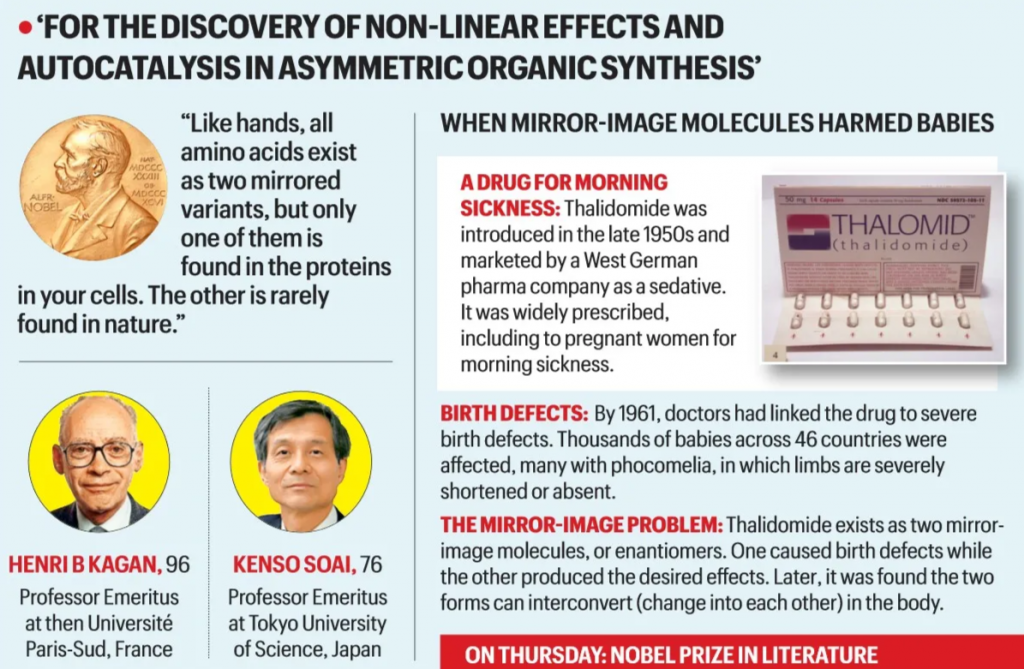
- In 2026, Henri B. Kagan and Kenso Soai were recognised for work explaining how chemical reactions can generate and amplify one enantiomer over its mirror image.
- Their work connects fundamental stereochemistry with the chemistry of life and has important applications in pharmaceuticals, agriculture, flavours and fragrances.
About Chirality
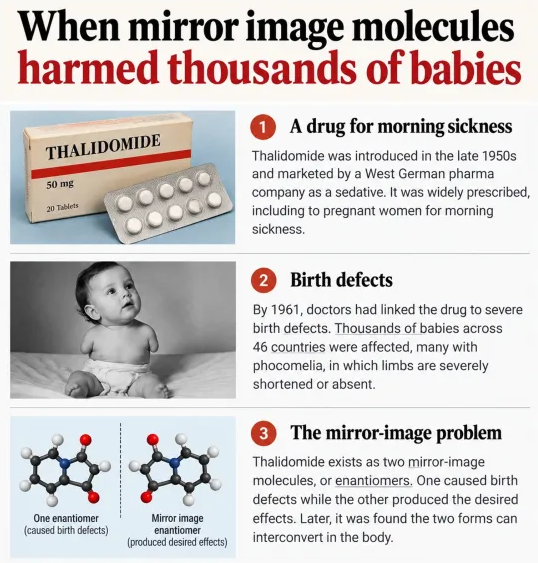
- It refers to the property of an object or molecule that cannot be superimposed on its mirror image, analogous to the left and right hands.
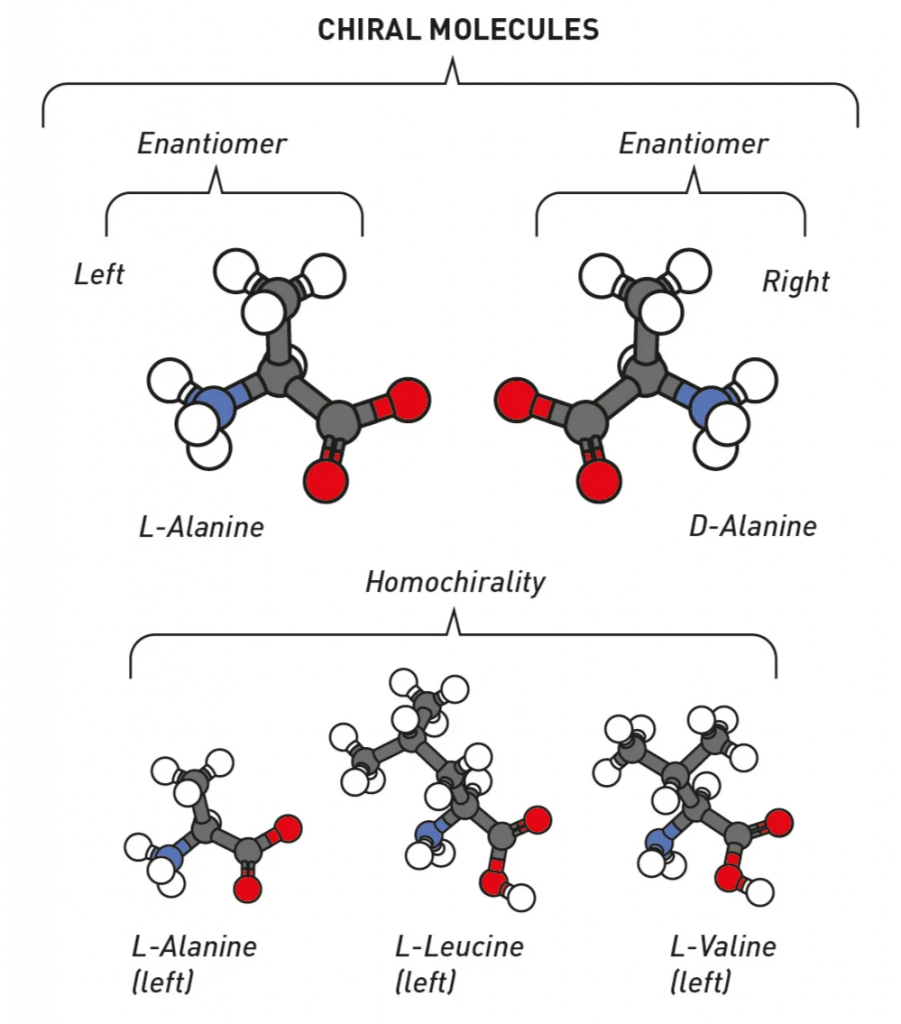
- The two mirror-image molecules are called enantiomers.
- Although enantiomers have the same atoms and connectivity, their three-dimensional arrangements differ.
- This distinction is crucial in biology because living systems exhibit homochirality, a strong preference for one enantiomer.
- For example, proteins predominantly use L-amino acids, while biological sugars predominantly occur in the D-configuration.
- The persistence of this molecular ‘handedness’ has been a major question concerning the origin of life.
From Asymmetric Catalysis to Enantioselectivity
- Ordinary synthesis of a chiral compound generally produces both enantiomers in nearly equal quantities, known as a racemic mixture.
- In the 1980s, Kagan demonstrated nonlinear effects in asymmetric catalysis i.e. a catalyst possessing only modest enantiomeric excess could produce a product with a disproportionately greater enantiomeric excess.
- Thus, the relationship between catalyst chirality and product selectivity was nonlinear rather than proportional.
- It laid the foundation for modern asymmetric synthesis, in which chemical reactions are deliberately designed to favour one enantiomer.
Soai Reaction: Self-Replication of Chirality
- Kenso Soai took the concept further through asymmetric autocatalysis. In an autocatalytic reaction, the product itself promotes the formation of more products.
- In the Soai reaction, a small initial imbalance in chirality can be amplified because the chiral product acts as an asymmetric catalyst for its own formation.
- It creates a form of self-replication of molecular handedness.
- The reaction can produce an exceptionally high enantiomeric excess, demonstrating that powerful chiral amplification is possible outside biological systems.
Significance for Origin of Life
- Kagan and Soai’s work does not solve the origin-of-life problem. It does, however, demonstrate that homochirality need not be exclusive to biological systems.
- Their findings provide a plausible chemical mechanism through which a tiny initial asymmetry could be amplified into a dominant molecular handedness, offering insights into theories of prebiotic chemistry and the emergence of biological homochirality.
Pharmaceutical and Industrial Applications
- Chirality is critically important in pharmaceuticals because different enantiomers can interact differently with biological receptors.
- One may be therapeutically useful, while another may be less effective or even harmful.
- Earlier, manufacturers often produced racemic mixtures and subsequently separated the desired enantiomer, increasing cost, waste and technical complexity.
- Asymmetric synthesis enables preferential production of the desired enantiomer at the reaction stage itself.
- The principle is consequently valuable not only for medicines but also for agrochemicals, pesticides, flavours and fragrances.
Previous article
News In Short 07-10-2026
