


Syllabus: GS3/Environment/Energy
Context
- Iceland is confident about the opportunities emerging in India’s evolving geothermal energy landscape and believes regulatory challenges can be overcome.
About
- Iceland pointed to potential opportunities for deploying its Carbfix technology, which converts captured carbon dioxide into stone.
- Iceland is also venturing into the “next-generation geothermal utilisation”. The technology involves drilling deeper into the earth, potentially increasing the productivity of each borehole by about ten times.
- Iceland generates around 70% of its electricity from hydropower and the remaining 30% from geothermal sources.
- India, meanwhile, has an estimated geothermal potential of about 10.6 GW.
Geothermal Energy
- Geothermal energy is a type of renewable energy that comes from the heat stored within the Earth.
- This heat is produced by the natural decay of radioactive materials and by the heat that’s left over from the planet’s formation.
Ways to Harness Geothermal Energy
- Geothermal Power Plants: These use steam from heated water reservoirs beneath the Earth’s surface to drive turbines connected to electricity generators. There are three main types:
- Dry Steam Plants: Directly use steam from a geothermal reservoir to turn the turbines.
- Flash Steam Plants: Pull high-pressure hot water into lower-pressure tanks to create steam.
- Binary Cycle Plants: Transfer heat from geothermal hot water to another liquid with a lower boiling point, which vaporizes and drives the turbine.
- Geothermal Heat Pumps: These systems use the Earth’s constant temperature to heat and cool buildings. In winter, they bring heat from the ground into buildings, and in summer, they transfer heat from buildings back into the ground.
- Direct Use Applications: Geothermal energy can also be used directly for heating buildings, growing plants in greenhouses, drying crops, and even in some industrial processes.
- Drawbacks: It can have some environmental impacts, such as land subsidence and the potential for induced seismicity (earthquakes triggered by human activity).
- Geothermal resources are often location-specific, which means they are most effective in regions with significant geothermal activity, such as Iceland.
Carbfix
- Carbfix is a carbon capture, utilisation and storage technology that mineralises carbon dioxide by turning it into stone.
- In practical terms, the process traps captured emissions permanently underground, creating a storage pathway that is designed to be durable rather than temporary.
- The technology could be particularly useful for sectors such as cement and steel in India.
Carbon Capture, Storage and Utilisation (CCUS)
- CCUS refers to a set of technologies that capture carbon dioxide emissions from industrial processes or power plants and either reuse them or store them safely underground, helping reduce the amount of climate-warming gases released into the atmosphere.
- In practice, this involves capturing CO₂ at the source, transporting it via pipelines or other means, and then either using it in industrial applications or storing it deep underground to prevent its release into the atmosphere.
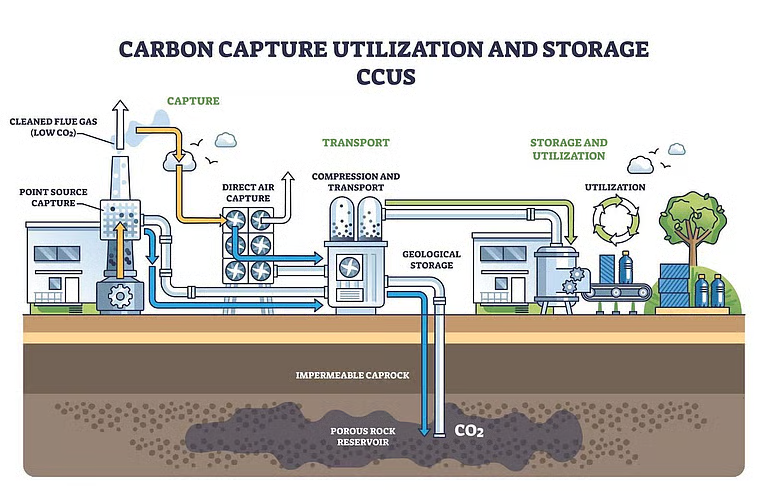
- Status in India: India is still largely at the R&D, pilot and demonstration stage of dedicated CCUS deployment.
- Existing carbon capture is particularly associated with processes such as urea production, while pilot projects have also been undertaken in sectors such as steel and oil refining.
- The first of its kind R&D Roadmap to Enable India’s Net Zero Targets through Carbon Capture, Utilization and Storage (CCUS) was launched in 2025. It proposes a three-phase R&D strategy for developing CCUS technologies in India.
- First, near-term efforts focus on scaling up and deploying existing, proven carbon capture and storage technologies across industrial sectors.
- Second, mid-term work prioritises the demonstration and validation of next-generation capture, utilisation and storage solutions that improve performance and cost efficiency.
- Third, long-term investments support fundamental research into breakthrough concepts and disruptive innovations that could transform CCUS capabilities and reduce costs over time.
Why is CCUS Important for India?
- Decarbonising hard-to-abate sectors: Steel, cement, chemicals, fertilisers and refineries have significant process-related emissions that are difficult to eliminate through electrification alone.
- Supports Net Zero 2070: CCUS can complement renewable energy, energy efficiency and electrification in India’s pathway towards net-zero emissions by 2070.
- Enables low-carbon products: Captured CO₂ can potentially become an industrial feedstock, creating economic value alongside emission reduction.
- Supports coal-transition technologies: CCUS can potentially facilitate low-carbon hydrogen and coal gasification while reducing associated emissions.
- Large storage potential: NITI Aayog’s assessment identifies substantial potential in saline aquifers, basaltic formations, enhanced oil recovery and enhanced coal-bed methane recovery.
What the partnership could mean for India?
- Diversifying Clean Energy: The conversation comes at a time when India is trying to diversify its clean-energy toolkit.
- Solar and wind remain the headline sectors, but policymakers and industry are increasingly looking at technologies that can provide firm power, industrial heat and emissions reduction for sectors that are harder to decarbonise.
- Carbon mineralisation could become more attractive if India’s industrial emitters seek long-duration storage options that go beyond conventional capture-and-compression models.
- Geothermal may not be a mass-market solution across India, but it could be relevant in specific regions, industrial zones and applications where underground heat resources are viable.
Conclusion
- Rather than offering a generic clean-energy partnership, Iceland is targeting areas where it has a specific comparative advantage: geothermal regulation, deeper drilling methods and carbon mineralisation.
- For India, the opportunity lies in whether these niche technologies can be adapted to a much larger and more complex energy system.
- If the collaboration advances, it could add another layer to India’s decarbonisation strategy, especially in industrial sectors that need solutions beyond conventional renewables.
Source: TH
Previous article
Illegal Herbicide-tolerant Bt Cotton Expands Across India
