


Silk Road
Syllabus: GS1/History
Context
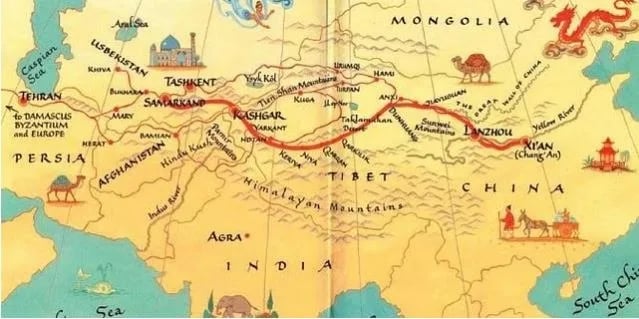
- Contrary to the name, the Silk Road was a network of multiple land and maritime trade routes connecting parts of east, central, south, and west Asia.
Ancient Silk Road
- The Silk Road became important from around the second century BC, when China’s Han dynasty expanded west and established contacts with Central Asian states.
- Because Chinese silk was a prized commodity then, the network was called the Silk Road.
- It was a network of trade routes connecting China and the Far East with the Middle East and Europe.
- Silk was transported from east to west throughout the year except for harsh winters which brought back gold and silver coins and other precious goods in exchange.
- Since it offered well-traveled roads, the Silk Road also became the routes that technologies, religions, artistic styles, languages, and natural philosophy took to spread across Eurasia.
- The Silk Road routes remained in use until A.D. 1453, until the Ottoman Empire boycotted trade with China and closed them.
Source: TH
Retreating Monsoon
Syllabus: GS1/Geography
In News
- Monsoon retreat triggering thunderstorms and heavy rain across India.
Retreating Monsoon or Northeast monsoon
- The Retreating Monsoon refers to the withdrawal of the Southwest Monsoon from India, generally during October–November.
- It marks the transition from the rainy season to the winter season.
- During this period, the Northeast Monsoon becomes important, particularly over southern and southeastern India.
- The northeast monsoon mainly affects five meteorological divisions—Tamil Nadu, Kerala, Coastal Andhra Pradesh, Rayalaseema and South Interior Karnataka—and contributes about 11% of India’s annual rainfall, compared with around 75% from the southwest monsoon.
- Rainfall in northern and Gangetic regions during November–December is largely caused by Western Disturbances, not the northeast monsoon.
- Kerala receives some secondary rainfall during October–November.
Source :DTE
Integrated Transport & Logistics Authority (ITLA)
Syllabus: GS2/Governance
Context
- The Union Cabinet approved the setting up of a Special Purpose Vehicle (SPV), namely, Integrated Transport & Logistics Authority (ITLA).
About Integrated Transport and Logistics Authority (ITLA)
- It is a national apex institution established as a Special Purpose Vehicle (SPV) to promote integrated and multimodal transport planning, big-data analytics, technical appraisal of projects, and policy support across freight and transit sectors.
- It is modelled on integrated transport planning institutions in countries such as Japan, the United States, South Korea, China and Australia.
Key Roles and Responsibilities of ITLA
- Long-Term National Transport Master Plan: The authority will prepare a comprehensive National Transport Master Plan with a planning horizon of 10 years or more.
- It will cover roads, railways, ports and shipping, civil aviation, inland waterways, coastal shipping, urban mobility and logistics.
- Integrated Planning Framework: It will evaluate short-term sectoral plans with a horizon of around five years and annual plans of transport Ministries.
- Technical Appraisal of Major Projects: ITLA will undertake technical appraisal of Government of India infrastructure projects costing ₹500 crore or more.
- Monitoring and Impact Assessment: It will monitor transport and infrastructure projects costing above ₹500 crore and provide a coordinated mechanism for issue resolution.
- National Transport Data Repository (NTDR): The authority will develop a unified transport data repository by integrating relevant transport and logistics datasets from multiple sources.
- Logistics Policy Support: It will advise and assist in the review and updating of the National Logistics Policy (2022).
- Research and Innovation: It will promote research & innovations in transport and logistics sectors.
Source: AIR
India and Japan Launch Operational Manual for the Joint Crediting Mechanism
Syllabus: GS2/ IR, GS3/ Environment
Context
- India and Japan launched the Operational Manual for the India-Japan Joint Crediting Mechanism (JCM) in New Delhi.
About
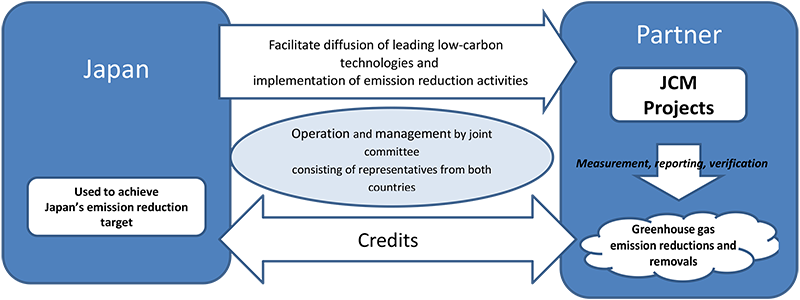
- The Joint Crediting Mechanism aims to promote the deployment of advanced low-carbon technologies, mobilise climate finance, facilitate technology cooperation and support high-integrity emission reductions and removals in India.
- The JCM contributes to the achievement of both countries’ Nationally Determined Contributions (NDCs) by evaluating Japan’s contributions in a quantitative manner and acquiring the part of credit.
- It marks a significant milestone in operationalising bilateral cooperation between India and Japan under Article 6.2 of the Paris Agreement.
Source: DD News
India’s First-Ever Household Travel Survey
Syllabus: GS3/ Economy
Context
- The National Statistics Office (NSO) of the Ministry of Statistics and Programme Implementation has conducted the first-ever all-India survey on household travel between July 2025 and June 2026.
About
- The survey captures key aspects of domestic travel, including:
- Purpose of travel: Employment, education, social engagements, cultural and leisure activities, tourism, domestic work, caregiving and other purposes.
- Mode of transport: Modes of transportation used by different demographic groups for undertaking trips.
- Travel duration and distance: Average time taken and distances travelled during trips.
Findings of the Survey
- Two-wheelers are the predominant mode of transport for commuting to fixed workplaces, accounting for 42.6 per cent of workers.
- Buses and railways facilitate 73.5 percent of overnight travel followed by cars at 15.1 percent and two wheelers at 8.8 percent.
- Gender Gap in Workforce Travel: 61.9% of male workers undertake daily work trips (>1 km) compared to 41.9% of female workers nationwide.
- The average monthly expenditure on commuting to a fixed workplace is ₹785 per worker.
- Urban workers spend substantially more, at ₹1,044 a month, compared with ₹612 for rural workers.
- Male workers spend an average of ₹835 on their commute each month, against ₹533 for female workers.
Source: AIR
Indian Navy’s first indigenous fleet support ship ‘Surya’
Syllabus: GS3/Defence
Context
- Defence Minister Rajnath Singh launched ‘Surya’, the Indian Navy’s first indigenously built Fleet Support Ship (FSS-1), in Visakhapatnam.
About
- Designed and built by Hindustan Shipyard Limited (HSL), Surya is the first of five Fleet Support Ships being built for the Indian Navy.
- With a displacement of about 43,500 tonnes and a top speed of 20 knots, the vessel is designed to provide logistical support to warships during prolonged operations at sea.
- It can carry large quantities of fuel and fresh water, along with ammunition, spare parts and provisions.
- It also features a helicopter deck capable of supporting multi-role operations and self-defence systems.
- Surya will help enhance the Navy’s operational endurance and reach, supporting India’s sustained maritime presence across the Indian Ocean Region (IOR).
Source: TH
Previous article
India’s Aerospace Sovereignty
Next article
News In Short 07-10-2026
