



India Nominates Sarnath for UNESCO World Heritage Status
Syllabus: GS1/ History and Culture
Context
- India has submitted a dossier titled “Ancient Buddhist Site, Sarnath” to the UNESCO World Heritage Centre for the 2025–26 nomination cycle.
About Sarnath
- Location: It is situated near Varanasi, Uttar Pradesh.
- Historical Significance: In Sarnath Gautama Buddha delivered his first sermon, known as the Dhammachakkappavattana Sutta (Setting in Motion the Wheel of Dharma), after attaining enlightenment.
- This event marks the beginning of the Buddhist Sangha (monastic community).
- Cultural Importance: Sarnath is one of the four most sacred Buddhist pilgrimage sites, alongside Bodh Gaya, Lumbini, and Kushinagar, and served as a major centre for Buddhist learning and dissemination, closely linked to ancient transnational pilgrimage routes and cultural exchanges.
- It reflects the interplay of Mauryan, Kushan, and Gupta architectural styles.
Key Monuments and Structures at Sarnath
- Dhamek Stupa: Built in 500 CE to commemorate Buddha’s first sermon.
- Ashokan Pillar: Erected by Emperor Ashoka with an edict; originally topped with the Lion Capital, now India’s national emblem.
- Chaukhandi Stupa: Commemorates the spot where Buddha met his first disciples.
- Mulagandha Kuti Vihar: Modern temple built by the Mahabodhi Society, housing frescoes depicting Buddha’s life.
- Sarnath Archaeological Museum: Houses important artefacts, including the original Lion Capital of Ashoka.
Source: DC
Pariksha Pe Charcha 2025 Conferred With Guinness World Record
Syllabus: GS2/ Governance
Context
- The Prime Minister’s flagship initiative Pariksha Pe Charcha (PPC) has set a Guinness World Record for the “Most people registered on a Citizen Engagement Platform in one month”, with over 3.53 crore registrations on the MyGov platform during its 8th edition in 2025.
About Pariksha Pe Charcha (PPC)
- Launched in 2018, PPC is an annual event where Prime Minister Narendra Modi interacts with students, teachers, and parents ahead of the board examinations.
- It is organised by the Ministry of Education in collaboration with MyGov, the citizen engagement platform of the Government of India.
- The program is part of the broader movement under the ‘Exam Warriors’ initiative, aiming to reduce exam stress and promote holistic education.
Source: AIR
Russia withdrew From Intermediate-Range Nuclear Forces (INF) Treaty
Syllabus :GS2/IR
In News
- Russia has officially withdrawn from the Intermediate-Range Nuclear Forces (INF) Treaty.
The Intermediate-Range Nuclear Forces Treaty (INF)
- The INF Treaty was signed in December 1987 by the United States and the former Soviet Union, and entered into force on 1 June 1988.
- It required both countries to eliminate their ground-launched ballistic and cruise missiles that could travel between 500 and 5,500 kilometres by an implementation deadline of 1 June 1991.
- It was crucial to Euro-Atlantic security for decades and It eliminated a whole category of nuclear weapons that threatened Europe in the 1980s.
| Do you know? – Russia specifically pointed to the US deployment of a Typhon missile system in the Philippines and missile drills in Australia as destabilizing moves. – The US had already left the treaty in 2019, accusing Russia of violations, which Russia denied, claiming the US was instead developing prohibited missile systems. – This latest step reflects rising tensions between Russia and the US, especially following President Trump’s announcement of deploying two nuclear submarines. |
Source :Air
PAN 2.0 Project
Syllabus: GS3/ Economy
In News
- The income tax department has selected mid-sized information technology firm LTIMindtree Ltd for the PAN 2.0 Project.
About PAN 2.0 Project
- The “PAN 2.0 Project” is a major e-governance initiative by the Income Tax Department of India, launched to modernize and enhance the Permanent Account Number (PAN) system. The project was approved by the Cabinet Committee on Economic Affairs (CCEA) on November 25, 2024.
- The project’s main goal is to consolidate all PAN and Tax Deduction and Collection Account Number (TAN) related services—which are currently spread across multiple portals like the e-Filing Portal, UTIITSL, and Protean e-Gov—into a single, unified online platform.
- PAN 2.0 is designed to be a completely paperless, technology-driven system for all services, including new PAN allotments, updates, and corrections.
- The project will create a “PAN Data Vault System” to safeguard sensitive taxpayer information and will introduce advanced security measures, including a dynamic QR code on PAN cards.
Source: LM
Central Nod to Increase CISF Strength
Syllabus :GS3/Security Agencies
In News
- The Union Ministry of Home Affairs (MHA) has approved the recruitment of 58,000 additional personnel for the Central Industrial Security Force (CISF), anticipating future industrial hubs in areas now affected by Left Wing Extremism (LWE).
The Central Industrial Security Force (CISF)
- It is an armed force of the Union established under the CISF Act, 1968.
- Initially formed in 1969 with 3,129 personnel, its strength has grown to 1.88 lakh as of April 1, 2025.
- The CISF includes 74 other formations, such as 12 reserve battalions and 8 training institutes.
- CISF is the only force with a customized and dedicated fire wing.
Mandate
- CISF’s mandate covers the security of premises, staff, property, and establishments.
- It secures strategic and vital infrastructure, including the Department of Space, Department of Atomic Energy, airports, Delhi Metro, ports, historical monuments, and sectors like petroleum, natural gas, electricity, coal, steel, and mining.
- It also protects some private sector units, key government buildings in Delhi, and VIPs under Z+, Z, X, and Y categories.
Source :TH
SC Allows Pollution Boards to Recover Environmental Damages
Syllabus :GS3/Environment
In News
- The Supreme Court ruled that Pollution Control Boards can impose environmental compensation.
Background of Case
- The Delhi Pollution Control Committee (DPCC) had appealed a High Court ruling which stated that it lacked the authority to impose compensatory damages under Section 33A of the Water Act, 1974, and Section 31A of the Air Act, 1981.
- The High Court held that such damages amounted to a penalty, and therefore, could only be imposed through the specific procedures outlined in Chapters VII and VI of the respective Acts.
Supreme Courts recent observations
- The Supreme Court has ruled that Pollution Control Boards are legally empowered to impose environmental compensation and seek bank guarantees from polluters as preventive (ex-ante) measures under Sections 33A of the Water Act and 31A of the Air Act.
- It emphasized that these actions are remedial, not punitive, and must be exercised fairly, transparently, and not arbitrarily.
- The Court clarified that such compensation is distinct from penalties like fines or imprisonment under other chapters of the Acts.
- The ruling invoked the “polluter pays” principle, stating that actual environmental damage is not required to impose compensation—the potential for harm is sufficient.
| Central Pollution Control Board (CPCB) – It is a statutory organisation, was constituted in September, 1974 under the Water (Prevention and Control of Pollution) Act, 1974. – Further, CPCB was entrusted with the powers and functions under the Air (Prevention and Control of Pollution) Act, 1981. – It serves as a field formation and also provides technical services to the Ministry of Environment and Forests of the provisions of the Environment (Protection) Act, 1986. – Principal Functions of the CPCB is to promote cleanliness of streams and wells in different areas of the States by prevention, control and abatement of water pollution, and – to improve the quality of air and to prevent, control or abate air pollution in the country. – CPCB is the State Board for all the Union Territories and it has delegated all its powers and functions in respect of NCT of Delhi to Delhi Pollution Control Committee. |
Source :TH
Asian Giant Tortoise
Syllabus: GS3/Species in News
Context
- Asian giant tortoise, the largest tortoise in mainland Asia, has been reintroduced into the Zeliang Community Reserve in Nagaland.
About
- Asian giant tortoises are also known as the small elephants of the forests.
- They help in seed dispersal and forest regeneration, apart from scavenging to keep the forest floor clean.
- Habitat: Tropical and subtropical mountainous evergreen forests.
- Distribution: Found in Northeast India (especially Arunachal Pradesh, Nagaland, Assam).
- Also present in Myanmar, Thailand, Malaysia, Bangladesh, Indonesia.
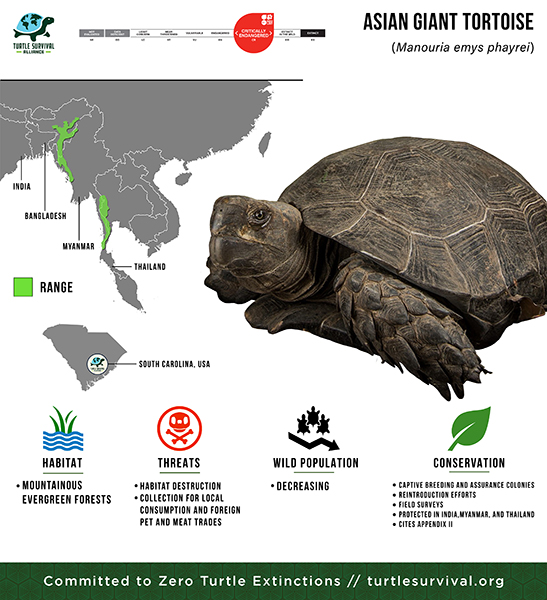
- Threats:
- Habitat destruction;
- Collection for local consumption;
- Collection for pet and food trades.
- Conservation Efforts:
- Captive breeding and assurance colonies;
- Reintroduction efforts;
- Field surveys.
- IUCN Status: Critically Endangered.
Source: TH
Rhisotope Project
Syllabus: GS3/Conservation
Context
- A South African university launched an anti-poaching campaign with a unique approach – injecting radioactive isotopes into rhino horns.
About
- Rhisotope Project: University of the Witwatersrand, supported by the International Atomic Energy Agency (IAEA), formally launched the Rhisotope Project.
- Five rhinos were administered radioactive isotope injections in the Waterberg Biosphere Reserve, South Africa.
- Need: South Africa, home to the world’s largest rhino population, had lost over 10,000 rhinos to poaching over the last decade.
- Method: The radioactive isotopes or radioisotopes are the unstable form of an element that emits radiation to transform into a more stable form.
- The radiation can be traced, and typically causes changes in the substance it falls upon.
- Rhino horns are tagged with low-dose radioactive isotopes through a non-invasive method, making them easily detectable by radiation monitors at borders, ports, and airports.
- Significance: The method is harmless for the rhinos and allows customs agents to detect trafficked horns.
Source: IE
Agnishodh
Syllabus: GS3/Defence
Context
- The Indian Army has collaborated with the Indian Institute of Technology (IIT) Madras to establish ‘Agnishodh’, the Indian Army Research Cell (IARC) on the IIT Madras campus.
About
- The initiative is part of the Indian Army’s broader transformation framework, guided by the Five Pillars of Transformation articulated by the Chief of the Army Staff (COAS).
- The Five Pillars of Transformation encompasses technology absorption, structural changes, human resource development and increasing cohesion between the three services.
- Agnishodh specifically advances one of the pillars, Modernisation and Technology Infusion.
- The new research centre will collaborate with IIT Madras Research Park and entities like the Advanced Manufacturing Technology Development Centre (AMTDC) focusing on converting lab-scale innovations into deployable technologies.
- It will also help upskill military personnel in emerging domains, including additive manufacturing, cybersecurity, quantum computing, wireless communication, and unmanned aerial systems.
Source: AIR
Previous article
Missing Link in India’s Battery Waste Management
