



Syllabus: GS3/ Economy
Context
- India has become the world’s fifth-largest aviation market, handling 211 million passengers in 2024, as per the latest World Air Transport Statistics (WATS) released by the International Air Transport Association (IATA).
Key Findings of the Report
- According to IATA, India saw a growth of 11.1 per cent compared to 2023, ahead of Japan, which handled 205 million passengers.
- The US remains the world’s biggest aviation market with 876 million passengers in 2024, growing 5.2 percent year-on-year.
- China was the second-biggest passenger market, with 741 million passengers, a growth of 18.7 per cent compared to 2023.
- While the UK was at the 3rd spot with 261 million passengers, Spain stood at the 4th position with 241 million.
- The figures include all international and domestic passengers departing or arriving in each country.
- Airport Pair Ranking:
- Asia-Pacific dominated the busiest airport-pair rankings.
- Jeju–Seoul (South Korea) was the busiest route globally with 13.2 million passengers.
- Mumbai–Delhi ranked 7th globally with 5.9 million passengers.
Key Pillars of Aviation Transformation
- Legislative Reforms for Systemic Change:
- Protection of Interest in Aircraft Objects Bill, 2025 aligns India’s aircraft leasing system with the Cape Town Convention, reducing leasing costs and improving investor confidence.
- Bharatiya Vayuyan Adhiniyam, 2024: Replaces the colonial-era Aircraft Act, 1934. It encourages Make in India, simplifies licensing, and aligns regulations with global standards like the Chicago Convention and ICAO norms.
- Infrastructure Expansion and Capacity Building:
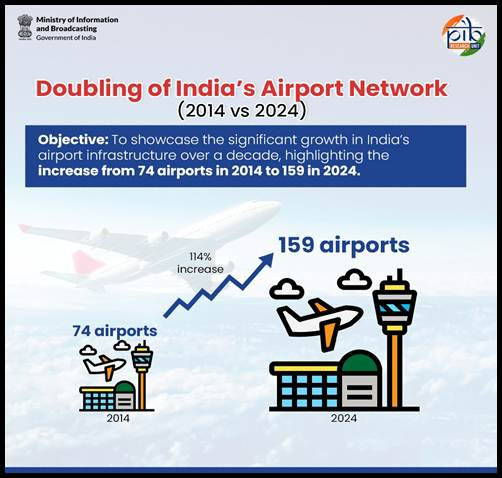
- Terminal Upgrades: Foundation laid for new terminals at Varanasi, Agra, Darbhanga, and Bagdogra.
- Greenfield Airports: 12 operationalised since 2014 (e.g., Shirdi, Mopa, Shivamogga), with Navi Mumbai and Noida (Jewar) to be operational by early 2025–26.
- CAPEX Investment: ₹91,000 crore allocated under National Infrastructure Pipeline (NIP); ₹82,600 crore spent by Nov 2024.
Government Initiatives to Support Aviation Sector
- UDAN Scheme: Enhances regional air connectivity by making air travel affordable for common citizens.
- National Civil Aviation Policy (NCAP): Promotes MRO, airport development, and aircraft leasing in India.
- Green Airports Policy: Encourages use of renewable energy, waste reduction, and carbon-neutral targets.
- Development of Noida International Airport and expansion of existing metro and non-metro airports.
- Aircraft Leasing and Financing Ecosystem: GIFT City is being promoted as a global aircraft leasing hub.
What are the Challenges?
- Infrastructure bottlenecks: Many major airports are operating at or near capacity, while infrastructure in Tier-2 and Tier-3 cities remains underdeveloped.
- High cost of Aviation Turbine Fuel (ATF): Aviation fuel is heavily taxed in India, making airline operations costlier compared to global standards.
- Regulatory complexities: Multiple layers of regulation and lack of coordination between central and state authorities hamper ease of doing business in the aviation sector.
- Environmental concerns: Rapid expansion of air traffic raises issues of carbon emissions, noise pollution, and ecological impact, demanding greener alternatives.
- Shortage of skilled workforce: The sector faces a growing gap in the availability of trained pilots, engineers, and aviation professionals.
Way Forward
- Fuel Pricing Reform: Rationalise Aviation Turbine Fuel (ATF) taxes across states to make air travel cost-effective.
- Sustainability Focus: Encourage Sustainable Aviation Fuel (SAF), electric aircraft technology, and carbon offsetting mechanisms.
- Skilling and Training: Expand aviation skill development programs through institutions like the National Aviation University.
- International Hub Strategy: Develop select Indian airports into full-service international hubs competing with Dubai, Doha, and Singapore.
Source: AIR
Previous article
Environmental, Social, and Governance (ESG)
Next article
Missing Link in India’s Battery Waste Management
