


El Niño
Syllabus: GS1/Geography
Context
- El Niño is set to intensify to exceptional levels in the coming months and persist into early 2027, the World Meteorological Organization (WMO) has warned, raising the risk of extreme heat, droughts and floods across the globe.
About
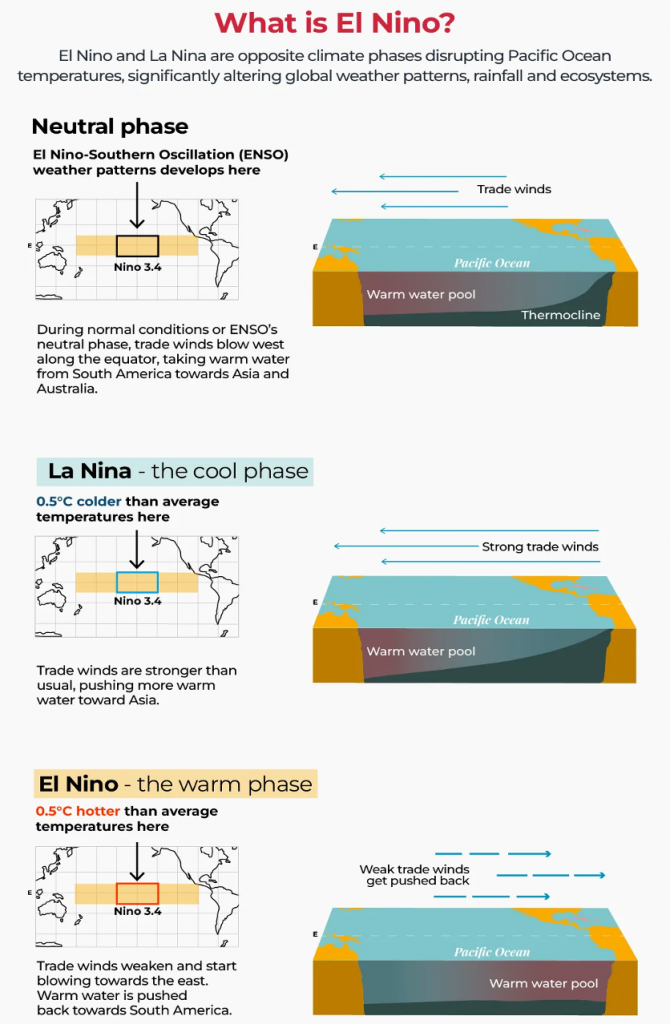
Source: Al Jazeera
Bar Council of India (BCI)
Syllabus: GS2/Judiciary
Context
- The Supreme Court held that the Bar Council of India (BCI) has no statutory power to regulate the conduct of law students before their enrolment as advocates.
Background
- The controversy arose at NALSAR University of Law, Hyderabad, after students objected to the proposed participation of Chief Justice of India Surya Kant as the chief guest at the university’s convocation, following his oral remarks in court comparing youths to “parasites” and “cockroaches.”
- In response, the BCI issued notifications directing State Bar Councils to withhold the enrolment of NALSAR’s 2026 graduates as advocates. The directives were later withdrawn.
Bar Council of India (BCI)
- About:
- The BCI is a statutory body established under the section 4 of Advocates Act 1961 that regulates the legal practice and legal education in India.
- Its members are elected from amongst the lawyers in India and as such represents the Indian bar.
- Structure:
- It consists of members elected from each state bar council, and the Attorney General of India and the Solicitor General of India who are ex officio members.
- The council elects its own chairman and vice-chairman for a period of two years from among its members.
- Functions:
- Prescribes standards of professional conduct and etiquette for advocates.
- Lays down standards of legal education.
- Grants recognition to universities for degree in law.
- Safeguard the rights, privileges and interests of advocates.
- Promote and support law reform.
- Deal with and dispose of any matter which may be referred by a State Bar Council.
- Organise and provide legal aid to the poor.
- Recognise foreign qualifications in law obtained outside India for admission as an advocate.
Source: AIR
Nancy Grace Roman Space Telescope
Syllabus: GS3/ S&T
In News
- NASA launched the Nancy Grace Roman Space Telescope on a SpaceX rocket, named after the “mother of Hubble” who pioneered space based astronomy.
Key Technical Features
- Vantage point: Operates from Lagrange Point 2, about 1.2 million km from Earth, where combined solar and Earth gravity offers stability and unobstructed cosmic view. James Webb also functions from this zone.
- Instruments onboard:
- Wide Field Instrument: A 300 megapixel infrared camera covering the sky area 1.5 times the Moon’s apparent size, processing images 1,000 times faster than Hubble.
- Coronagraph: Masks bright starlight to detect faint reflected light from orbiting planets, similar to protective shields used to view the Sun’s corona.
Significance
- Dark matter and dark energy research: Ordinary matter constitutes merely 5% of the universe, while dark matter (27%) and dark energy (68%) remain poorly understood. The telescope will conduct the most detailed dark matter mapping yet, especially during early star formation phases.
- Gravitational lensing studies: By measuring how gravity bends light across vast distances, it will construct a three dimensional map of galaxy distribution across the cosmos.
- Exoplanet discovery: With over 6,000 exoplanets already identified, Roman’s wide scanning capability could substantially expand this catalogue, advancing the search for life beyond Earth.
Source: IE
Thorium-based Fuel For Nuclear Reactor
Syllabus: GS3/Science and Technology
In News
- Nuclear scientist Anil Kakodkar has advocated introducing thorium-based fuel into the country’s indigenous pressurised heavy water reactor (PHWR) fleet alongside the ongoing three-stage nuclear programme.
Thorium (chemical symbol Th)
- It is a naturally occurring radioactive metal found at trace levels in soil, rocks, water, plants and animals.
- It is solid under normal conditions. There are natural and man-made forms of thorium, all of which are radioactive.
- In general, naturally occurring thorium exists as Th-232, Th-230 or Th-228.
India’s Three-Stage Nuclear Power Program
- India has modest uranium deposits but one of the largest thorium reserves in the world.
- The Department of Atomic Energy has, therefore, formulated a three-stage nuclear power program based on a closed nuclear fuel cycle for optimum utilisation of the available resources.
- The aim is to increase the domestic supply of fissile material gradually, and to ensure energy independence over the long term.
- Stage 1: Pressurised Heavy Water Reactors (PHWR): The PHWRs use natural uranium as fuel to produce power. The spent fuel from these reactors yields plutonium, which is the main input for the following stage.
- Stage 2: Fast Breeder Reactors (FBR): The fuel is Plutonium from Stage 1.
- This fuel powers Fast Breeder Reactors, which produce more fuel than they consume. The Kalpakkam PFBR represents India’s entry into this stage. These reactors will be used to generate U-233 from thorium, leading to Stage 3.
- Stage 3: Thorium Fuelled Reactors: This stage will use India’s huge thorium supplies in a big way, with the Uranium-233 generated in Stage 2 as fuel.
- Thorium is a virtually limitless source of energy, and this stage is the key to India’s long-term energy security.
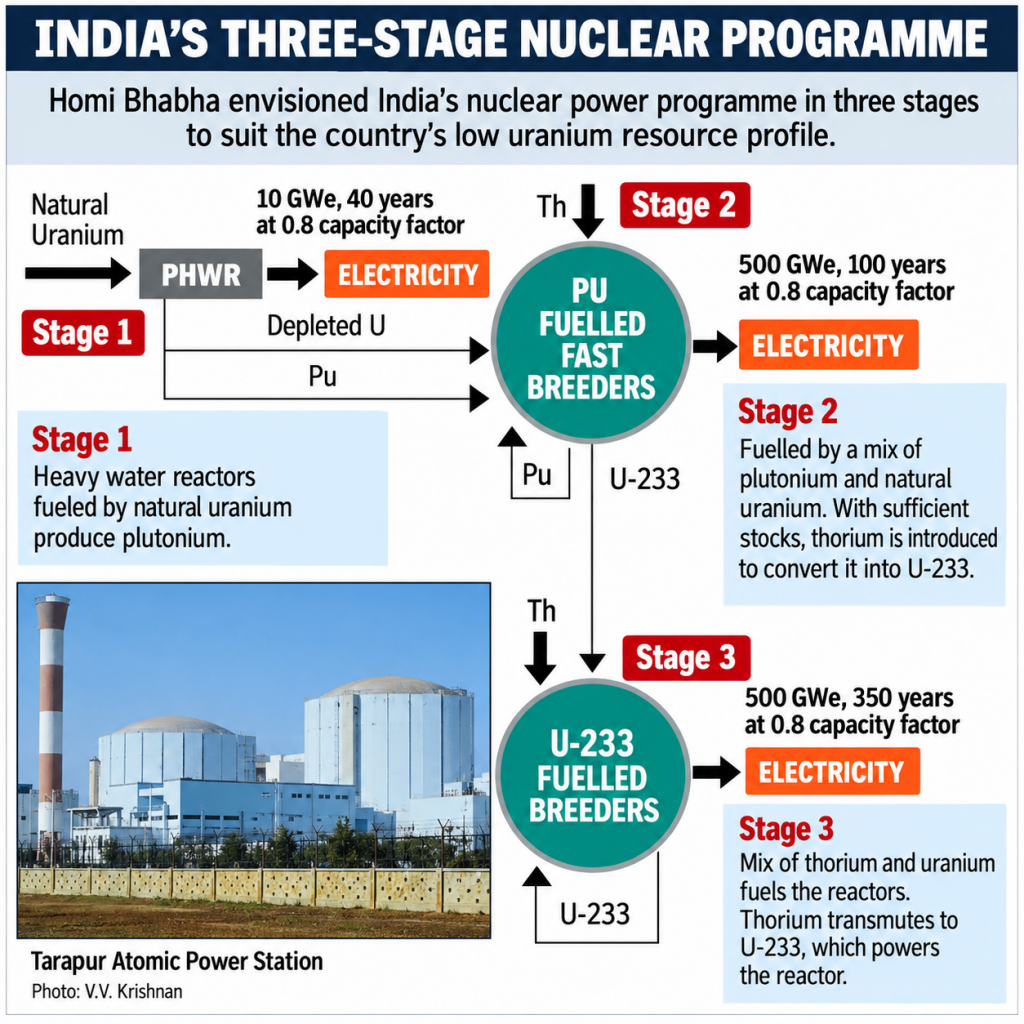
Source: IE
Pichavaram Mangroves
Syllabus: GS3/ Environment
Context
- In a recent study, the Pichavaram mangrove ecosystem was estimated to have a Total Economic Value (TEV) of ₹2,485.38 crore.
What Are Mangroves?
- A mangrove is a salt-tolerant plant community found in tropical and subtropical intertidal regions.
- These ecosystems thrive in high-rainfall areas (1,000–3,000 mm) with temperatures ranging from 26°C to 35°C.
- Mangrove species are adapted to survive in waterlogged soils, high salinity, and frequent tidal surges.
- Mangroves in India: As per the India State of Forest Report 2023 (ISFR-2023), India’s total mangrove cover stands at 4,991.68 sq. km, constituting 0.15% of the nation’s geographical area.
- West Bengal holds the largest share of the country’s mangrove forests, accounting for 42.45% of the total cover, followed by Gujarat (23.32%) and the Andaman & Nicobar Islands (12.19%).
Ecological and Economic Importance of Mangroves
- Climate Regulation: Act as vital blue carbon sinks, absorbing and storing large amounts of carbon dioxide and helping mitigate climate change.
- Mangrove vegetation stores an average of 79.449 tonnes of carbon per hectare. This is equivalent to approximately 291.33 tonnes of CO₂ per hectare.
- Livelihood Generation: Mangroves account for less than 1 per cent of the cover of global tropical forests; providing critical ecosystem goods and services to the estimated 2.4 billion people living within 100 km of the coast.
- Coastal Protection: Mangroves provide protection against storms, erosion, and flooding; serve as sources of food and timber; improve water quality; and sequester carbon.
- Biodiversity Hotspots: Mangrove forests also provide natural habitat for over 1,533 different species, including nursery habitats for many commercially important fish, and are beneficial to the health of adjacent ecosystems such as coral reefs and seagrass meadows.
Pichavaram Mangrove Forest
- Spread over 1,478.64 hectares, Pichavaram Mangrove Forest is one of India’s largest and best-preserved mangrove ecosystems, situated between the Vellar and Coleroon estuaries in Tamil Nadu’s Cuddalore district.
Previous article
‘Raksha’ Framework For Defence Diplomacy
Next article
Geothermal Energy
