


Syllabus: GS2/Governance; GS3/Economy
In News
- The Ministry of Finance, in its Monthly Economic Review has cautioned that several Indian states with high revenue deficits and heavy debt burdens will struggle to handle fiscal shocks.
Do you know?
- Revenue deficit: It occurs when a government’s regular spending (like salaries, pensions, subsidies, and interest payments) is higher than its regular income from taxes and fees.
- Revenue-surplus: Itimplies that states are able to meet their revenue expenditure—salaries, pensions, subsidies—through their own receipts, reducing reliance on borrowings for day-to-day spending, thereby improving fiscal sustainability.
Fiscal stress
- It refers to a situation where there is a persistent or temporary mismatch between government revenues and expenditures, forcing policymakers to adjust spending, raise revenue, or increase borrowing.
Causes of Fiscal Stress
- Structural Factors: Narrow tax base, uneven GST collections, and dependence on indirect taxes.
- Rising subsidies (food, fertilizer, fuel) and welfare commitments.
- Debt Burden: High borrowing and interest payments crowd out development spending.
- Economic Shocks: Pandemic-related expenditure, global commodity price volatility, and climate-related disasters.
- Compliance Gaps: Tax evasion, weak enforcement, and underperformance in capital expenditure.
Impacts
- Rising debt burden: Fiscal stress increases debt, raises interest burden, and reduces development spending, risking credit rating downgrades.
- Reduced fiscal space: Fiscal stress reduces government flexibility and limits investment in infrastructure and social sectors.
- Macroeconomic instability: Heavy government borrowing raises interest rates, restricting private sector investment.
- Weak social and development outcomes: Fiscal stress can limit spending on health, education, and welfare, potentially increasing inequality across regions.
- Inter-generational burden: Higher borrowing shifts repayment to future generations, raising long-term debt sustainability risks, especially if growth slows.
Data on fiscal position of states
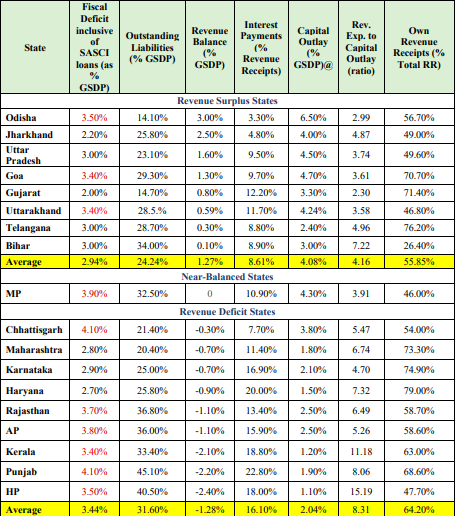
- Revenue surplus vs deficit states
- Revenue-surplus states: Jharkhand, Uttar Pradesh, Telangana (among others)
- Able to fund regular expenses (salaries, pensions, subsidies) from own revenue.
- Eight Indian states—Gujarat, Jharkhand, Uttar Pradesh, Telangana, Odisha, Uttarakhand, Bihar, and Goa—have kept their fiscal deficit at or below 3% of GSDP.
- This aligns with the Finance Commission’s recommended benchmark for fiscal discipline.
- The 16th Finance Commission (2026–31), chaired by Arvind Panagariya, also recommends a 3% fiscal deficit cap for states.
- This aligns with the Finance Commission’s recommended benchmark for fiscal discipline.
- Revenue-deficit states: Punjab, Kerala, West Bengal, Andhra Pradesh, Rajasthan, Himachal Pradesh
- Struggle due to high committed spending like pensions and interest payments.
- Revenue-surplus states: Jharkhand, Uttar Pradesh, Telangana (among others)
- Debt levels across states: Punjab is the most indebted (45.1% of GSDP), followed by Himachal Pradesh (40.5%), Rajasthan, and Andhra Pradesh(36%).
- Odisha and Gujarat have relatively low debt, indicating stronger fiscal health.
Repercussions
- Revenue-surplus states are in a relatively stronger fiscal position because lower interest payments free up resources for higher capital spending.
- Revenue-deficit states face tighter constraints since a larger share of their revenue goes toward debt servicing—often exceeding 15% of total revenue receipts—and they also carry higher outstanding debt.
- States that combine revenue deficits with high debt levels have limited flexibility to respond to economic or fiscal shocks.
- They are often forced to cut or restructure spending, or seek additional financial support from the Centre.
- However, this can create tension, as such demands arise while the Centre itself is focused on fiscal consolidation.
Conclusion and Way Forward
- High state-level debt (around 35–45% of GSDP in some cases) significantly contributes to India’s overall public debt burden. States that are unable to maintain a “golden rule” of zero revenue deficit face higher vulnerability to fiscal stress, especially during periods of rising expenditure.
- Maintaining fiscal discipline is therefore essential for long-term macroeconomic stability and effective shock management.
- Fiscal consolidation efforts must be pursued jointly by both the Centre and the States.
- India’s fiscal stress reflects the balance between welfare commitments and fiscal prudence. While the Centre has followed a credible consolidation path, state finances remain a key concern.
- Sustainable fiscal health requires discipline, transparency, and stronger cooperative federalism.
Source :TH.
Previous article
GST Collections Rise to a Record of ₹2.43 Lakh Crore in April
