


Syllabus: GS2/ Polity and Governance
Context
- In Union of India v. J. Sekar (2026), the Supreme Court held that every bench of the Adjudicating Authority under the Prevention of Money Laundering Act (PMLA), 2002, must include at least one judicial member while relating to the confirmation of property attachment.
Prevention of Money Laundering Act (PMLA) 2002
- It was enacted by Parliament of India under Article 253 of Constitution in 2002 to prevent money laundering and provide for the confiscation of property derived from or involved in money laundering.
- PMLA and the Rules notified there under came into force with effect from 2005, and it was further amended in 2009 and in 2012.
- Key provisions of the Act:
- Proceeds of Crime [Section 2(1)(u)]: It covers any property derived or obtained, directly or indirectly, from criminal activity related to a scheduled offence, including the value of such property.
- Provisional Attachment [Section 5]: An authorised officer can provisionally attach property suspected to be proceeds of crime for a period of up to 180 days, subject to statutory conditions.
- Adjudication [Section 8]: After a complaint is filed, the Adjudicating Authority issues a show-cause notice, gives the person concerned an opportunity to be heard, and considers the material/evidence to decide whether the property is involved in money laundering and whether to confirm the attachment.
- Confiscation [Sections 8(5) and 8(6)]: Upon conclusion of the trial, the Special Court may order confiscation of property involved in money laundering to the Central Government, depending on the outcome of the proceedings.
Supreme Court’s Directions
- Single-member Bench permitted: The Adjudicating Authority can function through a single-member Bench, provided the member conducting final adjudication is a judicial member.
- Show-cause notice: Participation of a judicial member is not mandatory for issuing a show-cause notice under Section 8(1).
- Chairperson’s appointment: The Court clarified that the Chairperson need not necessarily be a judicial member.
What is Money Laundering?
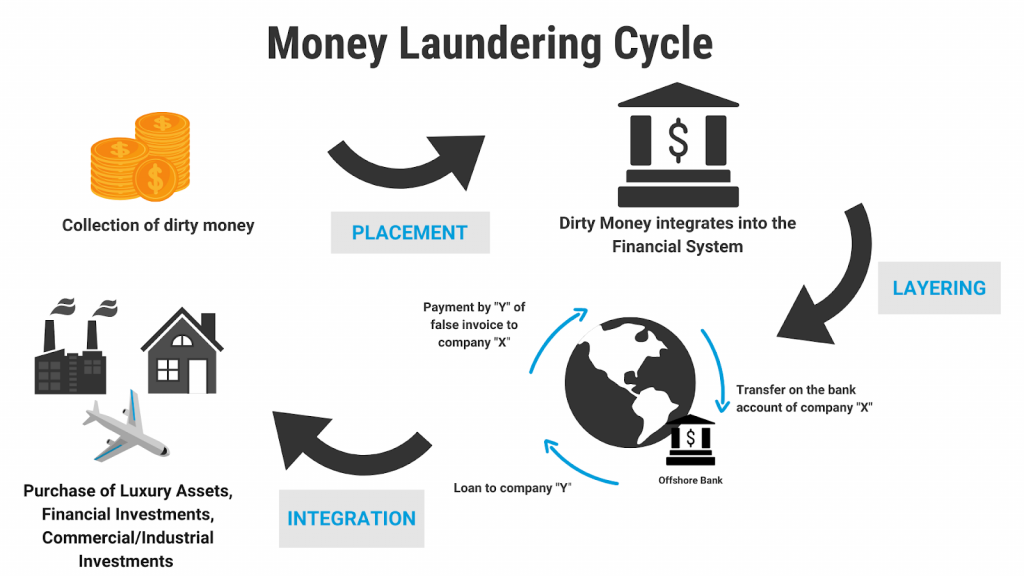
- Money laundering is the illegal process of making large amounts of money generated by criminal activity, such as drug trafficking or terrorist funding, appear to have come from a legitimate source.
- In terrorism financing the funds were used to procure arms and ammunition and for training the cadres of the violent extremist organization, among other purposes.
- The money from the criminal activity is considered dirty, and the process “launders” it to make it look clean.
Impact of Money Laundering
- Reduces Tax Revenue: As illicit funds are hidden from authorities, governments suffer significant losses in tax collection, weakening their ability to fund public services.
- Creates Asset Bubbles: Laundered money is often invested in real estate, gold, or luxury goods, leading to artificial inflation and economic disparities.
- Hampers Investment: Uncertainty and lack of transparency caused by money laundering deter foreign and domestic investment.
- Supports Criminal Networks: Money laundering sustains organized crime, including drug trafficking, terrorism, and human trafficking.
- International Repercussions: Countries perceived to have weak anti-money laundering measures face sanctions or restrictions from global bodies such as the Financial Action Task Force (FATF), affecting international relations and trade.
Measures taken by India to combat money laundering
- GST E-Invoices and E-Bills: Promotes transparency in the supply chain.
- Indian Cyber Crime Coordination Centre: Strengthens cybercrime enforcement.
- Central KYC Records Registry (CKYCR): Repository for KYC data and customer records.
- Investigative Agencies: The National Investigation Agency (NIA) and Enforcement Directorate (ED) effectively conducted probes.
- Financial Intelligence Unit-India (FIU-IND): The FIU-IND is the central national agency responsible for receiving, processing, analyzing, and disseminating information relating to suspicious financial transactions.
- It serves as the nodal agency for coordinating action against money laundering and related offenses.
- International cooperation: India cooperates through the Financial Action Task Force (FATF), the Asia/Pacific Group on Money Laundering (APG) and mechanisms for information exchange, mutual legal assistance and asset recovery across jurisdictions.
Previous article
Ambedkar’s Idea of Conscience in Democracy
Next article
Global Maritime Trade Set to Stall in 2026
