


Bab el-Mandeb Strait
Syllabus: GS1/Places In News
In News
- Yemeni government forces announced their withdrawal from areas near the Bab el-Mandeb Strait, ending a six-week counteroffensive against the Iran-aligned Houthis.
Bab el-Mandeb Strait
- Bab el-Mandeb translates to “Gate of Tears” in Arabic.
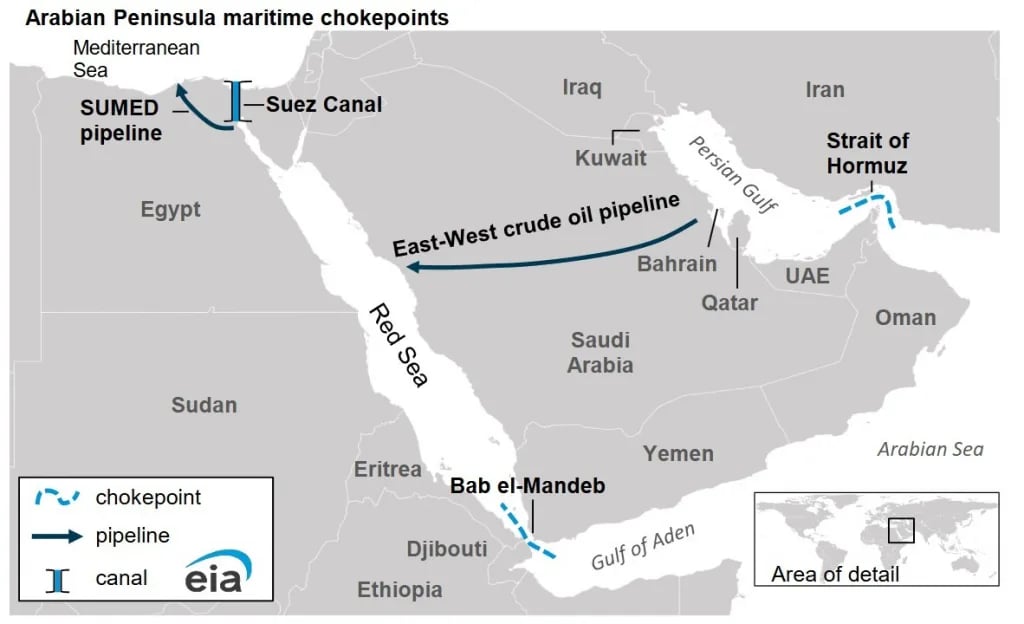
- It is a narrow waterway and a major global chokepoint that connects the Red Sea to the Gulf of Aden.
- It sits between Yemen on one side and Djibouti and Eritrea, in the Horn of Africa, on the other.
- At its narrowest point, the Strait is just 29 km wide, with just two channels for inbound and outbound traffic.
- The strait is located at the mouth of the Red Sea, which leads to the Suez Canal — the gateway to Europe.
Importance
- The Strait is one of the world’s most important shipping and energy passages.
- Around 12% of global trade usually passes through it.
- In 2024 alone, about 4.1 billion barrels of oil and petroleum products passed through the Strait, roughly 5% of the global total.
Source: TH
India-Bangladesh Ganga Water Treaty
Syllabus: GS2/International Relations
Context
- With the Ganga Water Treaty set to expire on 12 December 2026, a former Chairman of Bangladesh’s National River Conservation Commission has suggested a three-to-five-year extension to allow more time for renegotiations.
About the Ganga Water Treaty
- Also known as the Farakka Treaty, it was signed on 12 December 1996 between then Indian Prime Minister H.D. Deve Gowda and Bangladesh Prime Minister Sheikh Hasina.
- It governs the sharing of Ganga waters at the Farakka Barrage. During the lean period (11 March–11 May), 35,000 cusecs of water are allocated alternately to each country for 10-day periods, subject to water availability.
- The Farakka Barrage, built on the Bhagirathi River in West Bengal, was constructed to improve the navigability of the Kolkata Port by diverting water into the Hooghly River.
- Article XII provides that the treaty is renewable by mutual consent after the completion of its 30-year term.
Significance
- Before the treaty, Bangladesh faced uncertainty over Ganga water supplies during 1988–1996. The treaty established a predictable framework for water sharing between the two countries.
Source: TH
Central Government Health Scheme (CGHS)
Syllabus: GS2/Governance
Context
- A shortage of doctors, inadequate wellness centres and a rising beneficiary load under the Central Government Health Scheme (CGHS) have made access to healthcare difficult for thousands of beneficiaries, particularly retired Central Government employees in Keralam.
About the Central Government Health Scheme (CGHS)
- Launched in 1954, CGHS is a contributory healthcare scheme under the Ministry of Health and Family Welfare (MoHFW).
- It provides comprehensive healthcare facilities to serving and retired Central Government employees and their dependent family members.
- The scheme covers both outpatient (OPD) and inpatient care, including:
- Consultation with CGHS Medical Officers and specialists.
- Supply of medicines and diagnostic investigations.
- Hospitalisation and specialist treatment at government and empanelled private hospitals.
- Serving employees contribute through monthly salary deductions. Pensioners can opt for a monthly contribution or a one-time lifetime subscription.
- Central Government employees residing in cities not covered by CGHS are entitled to medical facilities under the Central Services (Medical Attendance) Rules.
Source: TH
Lakhpati Didi Initiative
Syllabus: GS3/Economy
In News
- The Lakhpati Didi Initiative represents an approach to rural livelihood development centred on women.
About Lakhpati Didi Initiative
- Lakhpati Didi is an SHG member whose household earns at least ₹1 lakh annually. The benchmark considers total household income rather than individual earnings.
- Income from eligible farm and non-farm activities contributes towards this target.
- It is calculated after expenses and should remain sustainable across agricultural seasons or business cycles.
- The initiative was announced on 5 August 2023.
- It initially targeted two crore women from Self-Help Group (SHG) households. The target was subsequently increased to three crore in February 2024.
- The initiative aims to create six crore Lakhpati Didis by March 2029. This target was envisioned in February 2026.
Features
- It organizes women from poor rural households into SHGs.
- These groups promote regular savings and collective financial activities.
- They also connect members with banks, credit, training and markets.
- It builds on the institutional network of the Deendayal Antyodaya Yojana-National Rural Livelihoods Mission (DAY-NRLM).
- The government launched DAY-NRLM in June 2011.
- It seeks to move rural women beyond subsistence-based activities.
- Its approach combines livelihood diversification, financial inclusion, skill development and enterprise support.
Source:PIB
Exercise ‘MITRA SHAKTI 2026’
Syllabus: GS3/ Defence
Context
- An Indian Defence Forces contingent departed for Sri Lanka to participate in the 12th edition of the India–Sri Lanka joint military exercise ‘MITRA SHAKTI 2026’.
About
- The Exercise ‘Mitra Shakthi’ is an annual Combined Training Exercise conducted jointly by the Sri Lanka Army and the Indian Army since the year 2012.
- The last edition was conducted in Karnataka (India) in November 2025.
- The exercise aims to enhance joint military capability of both armies to undertake Counter Terrorism operations in a semi-urban environment under a United Nations mandate.
Source: PIB
Previous article
Fall in Out-of-Pocket Expenditure (OOPE) in Healthcare in India
Next article
News In Brief 16-11-2026
