


Syllabus: GS3/ Agriculture/ Environment
Syllabus
- India is the world’s biggest exporter of rice, but its rising reliance on water-guzzling rice farming is raising questions about the long-term sustainability of farm exports.
India’s Rice Production and Export Performance
- India produced an estimated 154.02 million tonnes of rice in 2025–26.
- Major producing states: Uttar Pradesh, Telangana, West Bengal, Punjab, Chhattisgarh, Odisha, Madhya Pradesh, Bihar, Andhra Pradesh and Tamil Nadu.
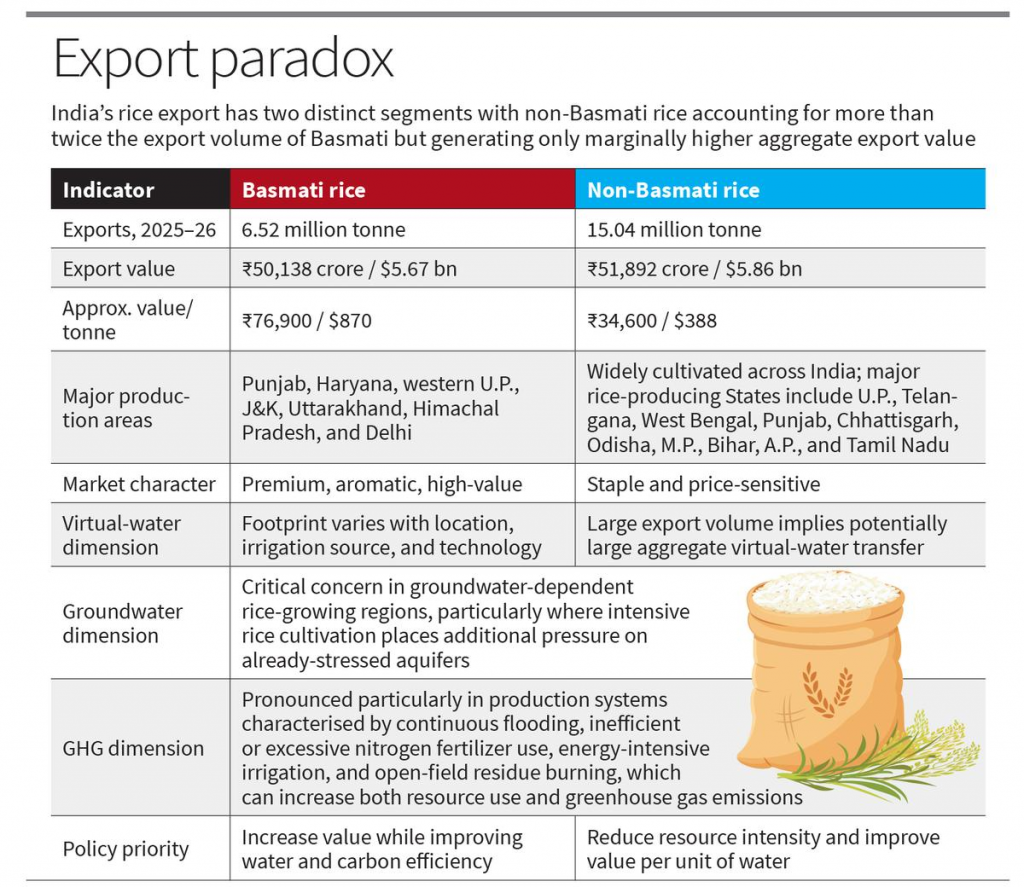
- Rice exports increased from 17.73 million tonnes in 2020-21 to 21.57 million tonnes in 2025-26, while export value rose from $8.82 billion to $11.54 billion.
- Global position: India has remained the world’s largest rice exporter since 2012, accounting for around 30–35% of global rice exports in recent years.
Challenges in Sustainable Rice Economy
- Groundwater depletion: Rice cultivation in Punjab, Haryana and western Uttar Pradesh heavily depends on groundwater extraction, mainly through energy-intensive tube wells.
- Assured procurement and Minimum Support Price (MSP) operations have encouraged paddy cultivation in regions where agro-climatic conditions and water availability may not favour it.
- Excessive groundwater extraction has resulted in declining water tables, increasing irrigation costs and pressure on long-term agricultural sustainability.
- Virtual Water Trade: Virtual water is the water consumed during the production of goods and services that is indirectly transferred through their trade.
- Rice exports therefore involve the export of water embedded in the crop.
- Greenhouse Gas Emissions: Microbial decomposition of organic materials under anaerobic conditions in flooded paddy fields leads to methane emissions.
- Regional Imbalance: Paddy cultivation has expanded in some water-stressed regions due to assured procurement and established agricultural infrastructure.
Sustainable Methods for Rice Production
- Alternate Wetting and Drying (AWD): An intermittent irrigation technique in which paddy fields are periodically drained and reflooded.
- It saves up to 30% irrigation water use and reduces methane emission by 43-48% under favourable situations.
- Direct Seeded Rice (DSR): Instead of producing nursery seedlings and transplanting them into puddled fields, rice seeds are immediately sown in dry or wet fields.
- Micro-irrigation is the application of water near the crop root zone by drip or sprinkler systems to reduce water losses through evaporation and runoff.
- Integrated Nutrient Management: Balanced application of chemical fertilisers along with organic sources such as farmyard manure and green manure, supported by soil testing and Leaf Colour Charts.
- Laser Land Levelling: It is the use of laser-guided equipment to create a uniformly levelled agricultural field to ensure uniform distribution of irrigation water.
- It can reduce irrigation time by 20–30%.
Concluding remarks
- India’s rice export competitiveness needs to be supported by sustainable resource management.
- A transition from volume-based production towards value-based, water-efficient and climate-resilient agriculture is essential.
Source: TH
Previous article
UNGA Resolution on Global Moratorium on Death Penalty
