


Pradhan Mantri Viksit Gram Swaraj Yojana (PM-VGSY)
Syllabus: GS2/Polity & Governance
Context
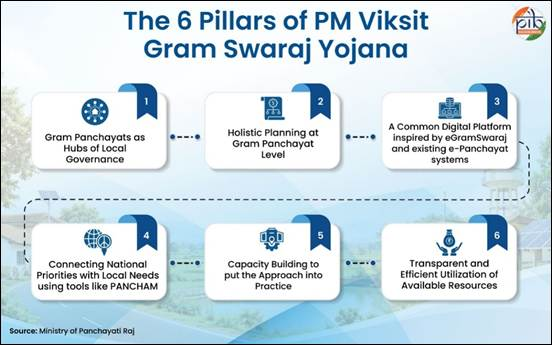
- The Union Cabinet approved the Pradhan Mantri Viksit Gram Swaraj Yojana (PM-VGSY) to strengthen grassroots governance and rural development across the country.
About PM-VGSY
- Type: Centrally Sponsored Scheme.
- Ministry: Ministry of Panchayati Raj.
- Implementation Period: The scheme will be implemented from 2026–27 to 2030–31, in line with the Sixteenth Finance Commission period, with a total outlay of Rs 7,395.55 crore.
- Coverage: An upgraded version of the Rashtriya Gram Swaraj Abhiyan, the scheme will cover all States and Union Territories, including traditional rural local government institutions in areas where Panchayats do not exist under Part IX of the Constitution.
- Beneficiaries: Around 32 lakh elected representatives, Panchayat functionaries and other stakeholders across more than 2.55 lakh Panchayats and traditional local bodies.
Source: TH
Illegal Food Colours
Syllabus: GS2/Health/ Governance
Context
- Uttar Pradesh’s Food Safety and Drug Administration (FSDA) has issued guidelines to stop street vendors from using banned industrial dyes in food.
What are food colours?
- Food colours are substances added to make food look brighter, more appealing or more consistent. They come in two kinds:
- Natural: From plants and minerals, such as beetroot, turmeric and paprika extract.
- Synthetic: Lab-made additives that are allowed only in certain food categories and within strict limits.
- Banned industrial dyes (illegal adulterants): Rhodamine-B, Metanil Yellow, Malachite Green, Sudan dyes (I-IV), Butter Yellow, Auramine and Orange II.
- Banned dyes belong in textiles, leather or paper, not in jalebi or chutney.
- Permitted synthetic colours (within limits): Tartrazine, Sunset Yellow FCF, Carmoisine, Ponceau 4R, Erythrosine, Brilliant Blue FCF, Fast Green FCF and Indigo Carmine.
Key Guidelines
- Prohibited Dyes: Non-permitted industrial dyes cannot be used in food.
- Permitted Artificial Colours: Under the Food Safety and Standards (Food Products Standards and Food Additives) Regulations, 2011, specified artificial colours are permitted in certain sweets and confectionery, cakes, pastries, biscuits, icing, some dairy products, processed fruits, beverages and savoury snacks.
- Accurate Measurement: Food businesses must use suitable digital weighing scales instead of estimating colour quantities using spoons or pinches.
- Record-Keeping: Businesses must procure colours from authorised sources, verify labels and supplier details, and retain purchase invoices and batch numbers for inspection.
The Legal Framework
- Food Safety and Standards Act, 2006: The main law that penalises making, selling or distributing adulterated food.
- FSS (Food Products Standards and Food Additives) Regulations, 2011: Lists which colours are allowed in which food categories, sets Good Manufacturing Practices and caps use generally at 100 mg/kg (up to 200 mg/kg in some canned fruits).
Source: IE
Salt Marshes
Syllabus: GS3/Environment
Context
- Gujarat is home to India’s largest coastal salt marshes, with smaller areas in Tamil Nadu, Andhra Pradesh, and Maharashtra.
Salt Marshes
- Salt marshes are coastal wetlands that are flooded and drained by salt water brought in by the tides.
- They are marshy because the soil may be composed of deep mud and peat.
- Peat is made of decomposing plant matter that is often several feet thick.
- They occur along sheltered coastlines, estuaries, bays and tidal flats.
- Formation: They develop when sediments accumulate in shallow coastal areas and support salt-tolerant vegetation.
Ecological Significance
- Coastal protection: Salt marsh vegetation reduces wave energy, traps sediments and helps prevent coastal erosion and flooding.
- Biodiversity conservation: They provide feeding, breeding and nursery habitats for fish, crustaceans, molluscs and migratory birds.
- Blue carbon sequestration: Salt marshes capture atmospheric carbon dioxide through plant growth and store carbon in waterlogged soils, where decomposition is often slow.
- Water purification: They trap sediments and help remove excess nutrients and certain pollutants from runoff before they enter coastal waters.
Source: TH
K9 Vajra
Syllabus: GS3/Defence
In News
- The Ministry of Defence granted in-principle approval for the procurement of more than 300 additional K9 Vajra-T self-propelled howitzers at an estimated cost of over ₹20,000 crore.
What is the K9 Vajra?
- The K9 Vajra-T howitzer is an Indian version of South Korea’s K9 Thunder.
- It is a 155 mm, 52-calibre tracked self-propelled howitzer manufactured under the ‘Make in India’ initiative by Larsen & Toubro (L&T) in Hazira, Gujarat, in partnership with Hanwha Aerospace, the Korean counterpart.
- A howitzer is an artillery gun that fires explosive shells over long distances, including at high angles to hit targets behind obstacles.
- It carries its gun on an armoured, tracked chassis.
- It helps the gun move with artillery formations, fire at enemy positions, and relocate quickly to reduce its exposure to retaliatory fire.
Specifications
- The system has a reported firing range of around 40 km, extendable to approximately 50 km with certain ammunition.
- It can travel at speeds of up to 67 km per hour on roads and houses a crew of five.
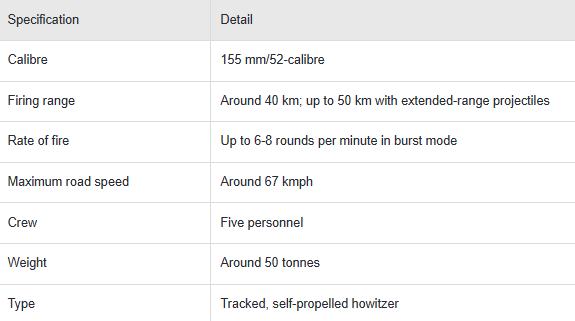
- It can fire three rounds in less than 15 seconds.
- Its all-welded steel hull protects the crew against shell fragments, landmines and small-arms fire.
- It can also turn within its own footprint using brake-torqueing, allowing it to maneuver in confined spaces.
Source: BS
Next article
News In Brief 29-10-2026
