


Syllabus: GS3/Science & Technology; Security
Context
- India’s satellite internet services were in the news following Starlink’s comments on regulatory clearances, pricing and security requirements, highlighting debates over capacity, competition and digital inclusion.
About Satellite Internet and Its Working
- Satellite internet provides internet connectivity through satellites communicating with ground terminals and gateways connected to terrestrial networks.
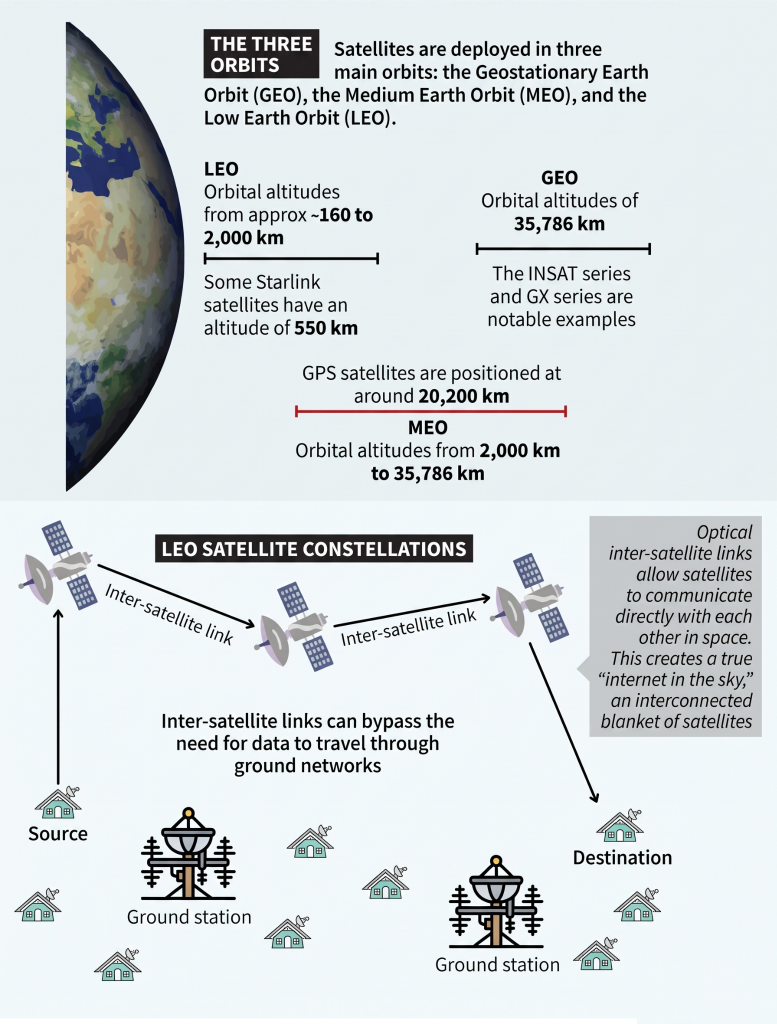
- Low Earth Orbit (LEO) satellites, generally operating hundreds of kilometres above Earth, offer lower latency than Geostationary Earth Orbit (GEO) satellites, which orbit approximately 35,786 km above the equator.
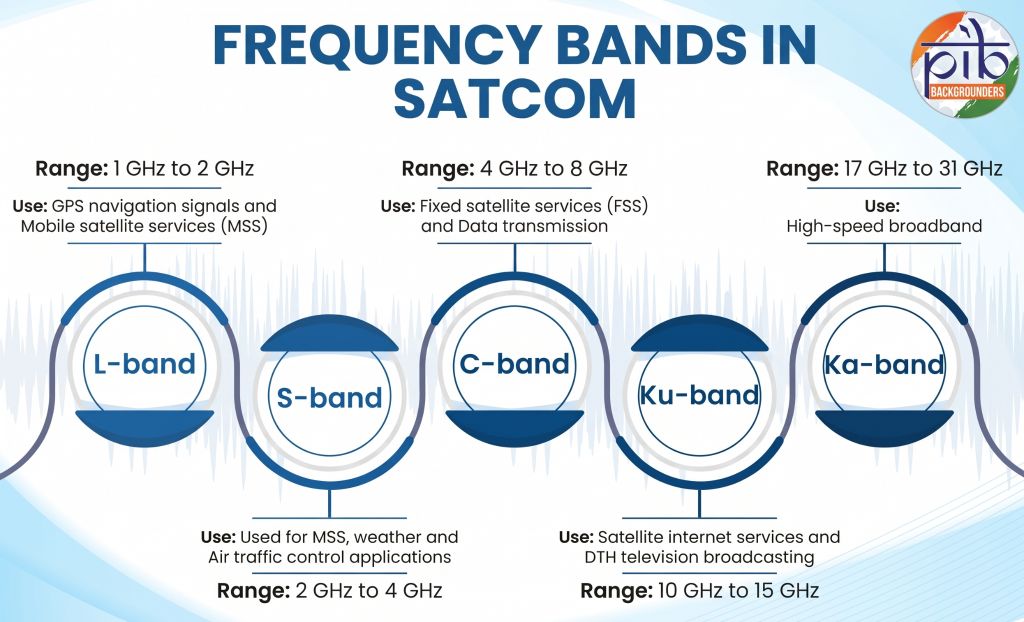
- However, satellite capacity depends on available spectrum, antenna design, frequency reuse and the number of users sharing a beam.
- How does it work?
- User terminal: A dish or antenna transmits and receives signals.
- Satellite constellation: Satellites relay data between users and ground stations.
- Gateway stations: These connect satellite networks to the wider internet.
Current Status as of October 2026: Global and India
- Global Scenario: Companies such as SpaceX’s Starlink, Eutelsat OneWeb and Amazon’s Project Kuiper are developing satellite broadband networks.
- Their applications extend from remote household connectivity to maritime communications, aviation, disaster response and defence.
- LEO constellations are particularly attractive because they reduce communication delays and can reach areas where terrestrial infrastructure is difficult to establish.
- India’s Position: India had 1,101.21 million broadband subscribers and an overall teledensity of 95.07% (August 2026, TRAI Report).
- India’s satellite communication market involves established providers such as Hughes Communications India and Nelco, alongside emerging LEO-based services.
Arguments Favouring Satellite Internet in India
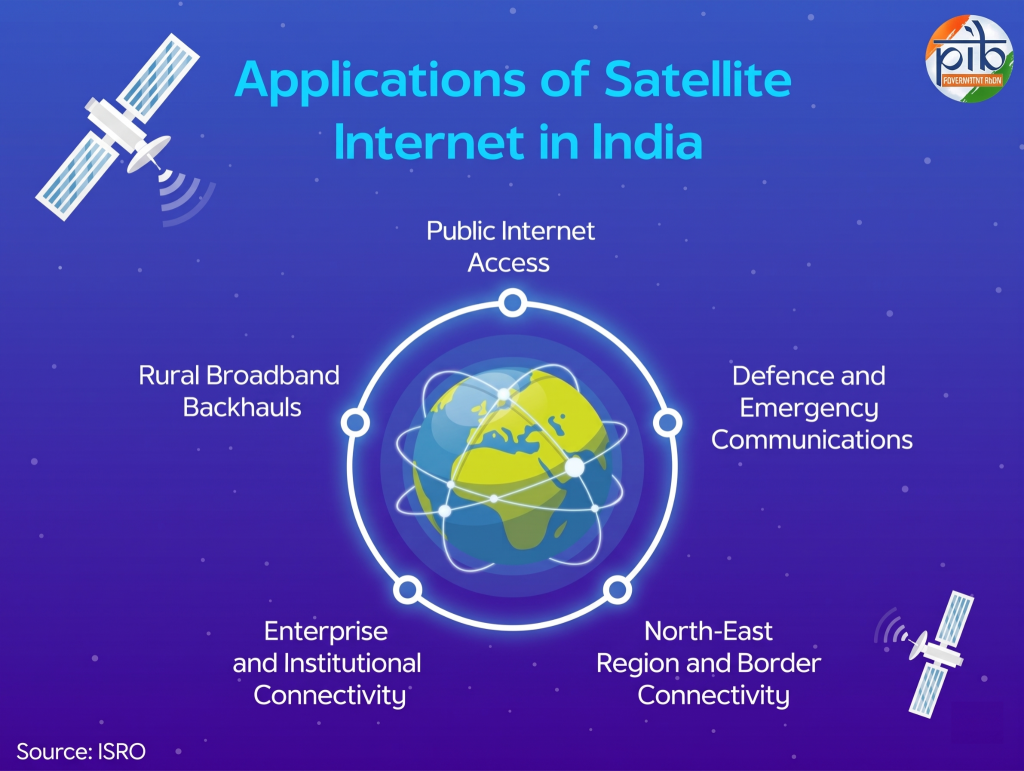
- Bridging Digital Divide: Satellite broadband can connect remote Himalayan settlements, islands, forest communities and sparsely populated regions where laying fibre is expensive or impractical.
- Rural internet penetration was still only 48.31 subscribers per 100 people.
- Disaster Management: Cyclones, floods and earthquakes can damage terrestrial communication networks. Satellite links can provide emergency connectivity for rescue teams, hospitals and disaster-response agencies.
- Strategic & Economic Benefits: Border outposts, ships, aircraft, mines and offshore installations require reliable connectivity beyond conventional network coverage.
- Satellite services can support defence communications, logistics, telemedicine, education and financial inclusion.
- Technological Competition: Entry by additional providers can improve service choices, encourage innovation and strengthen India’s participation in the global space economy.
Arguments Against Satellite Internet in India
- Limited Capacity and Spectrum Constraints: Radio spectrum is finite and internationally coordinated.
- Satellites cannot replicate the extensive spatial frequency reuse possible through dense terrestrial mobile networks.
- Affordability and Inequality: Satellite terminals and subscriptions can be expensive for low-income households. Where demand exceeds available capacity, prices and service quality may restrict access.
- Security and Digital Sovereignty: Foreign-controlled satellite infrastructure raises concerns about data protection, lawful interception, cybersecurity, network resilience and dependence on overseas providers.
- Spectrum Allocation and Fair Competition: Administrative assignment can facilitate satellite services that require coordinated spectrum access.
- Environmental and Orbital Concerns: Large constellations raise concerns about space debris, orbital congestion, astronomical interference and the long-term sustainability of outer space.
India’s Related Efforts and Initiatives
- BharatNet: Expands broadband infrastructure to rural areas through optical fibre and associated connectivity solutions.
- Digital Bharat Nidhi: Supports telecommunications access in underserved areas through eligible connectivity projects.
- Digital India: Promotes digital public services, digital literacy and wider internet access.
- IN-SPACe: Facilitates private-sector participation in India’s space ecosystem.
- Telecommunications Act, 2023: Provides the legal framework for telecommunications services and spectrum assignment.
- TRAI: Advises on regulatory and economic issues, including satellite communication service conditions.
- These initiatives should be viewed as complementary: satellite networks can extend connectivity, while terrestrial fibre remains essential for scalable, high-capacity broadband.
Way Forward
- Adopting Complementary Connectivity Strategy: Satellite internet should address locations where terrestrial networks are impractical, rather than substitute for fibre deployment.
- Improving Affordability Through Shared Access: Public support should prioritise community Wi-Fi hotspots, shared terminals, schools, health centres and mobile towers instead of indiscriminate subsidies for individual household terminals.
- Ensuring Transparent Spectrum Governance: Allocation and pricing should balance efficient resource utilisation, competition, service affordability and India’s international coordination obligations.
- Strengthening Security & Accountability: Licensing conditions should provide clear requirements for data protection, lawful access, cybersecurity, service continuity and domestic regulatory compliance.
- Upholding Digital Inclusion: The Supreme Court, in Anuradha Bhasin v. Union of India (2020), recognised that freedom of speech and expression, and the freedom to practise a profession through the internet, receive constitutional protection under Articles 19(1)(a) and 19(1)(g), respectively.
- The judgment did not declare internet access itself an independent fundamental right. Nevertheless, equitable and meaningful connectivity is essential to realising constitutional freedoms.
Conclusion
- Satellite internet is a strategic complement to India’s digital infrastructure, not a substitute for it. The objective should be to combine satellites’ geographical reach with fibre’s capacity, affordability and scalability.
- India’s digital future depends not merely on connecting more people, but on ensuring reliable, secure and affordable access for all.
| Daily Mains Practice Question [Q] Discuss the opportunities and limitations of satellite internet in bridging India’s digital divide. |
Previous article
WTO Reform: India’s Moment
Next article
Satellite Internet in India: Limits & Opportunities
