


Syllabus: GS3/ Environment
Context
- A study by the Centre for Research on Energy and Clean Air (CREA) found that Delhi’s average winter AQI worsened from 280 in 2022–23 to 295 in 2025–26, despite the implementation of the Graded Response Action Plan (GRAP).
Air Quality Index (AQI)
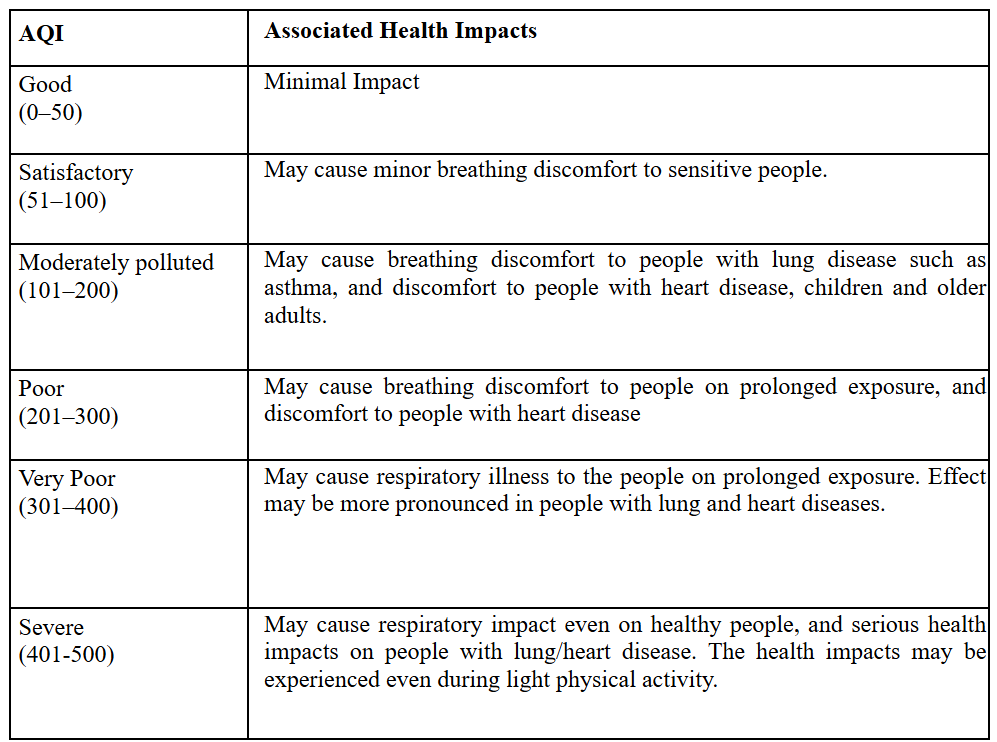
- The Air Quality Index (AQI) is a tool for effective dissemination of air quality information to people.
- There are six AQI categories, namely, Good, Satisfactory, Moderately polluted, Poor, Very Poor, and Severe.
- The proposed AQI will consider eight pollutants (PM10, PM2.5, NO2, SO2, CO, O3, NH3, and Pb) for which short-term (up to 24-hourly averaging period) National Ambient Air Quality Standards are prescribed.
Graded Response Action Plan (GRAP)
- GRAP is a framework implemented by the Commission for Air Quality Management (CAQM) to control air pollution in Delhi-NCR through progressively stricter measures based on AQI levels and forecasts.
| Stage | AQI category | Key measures |
| Stage I | Poor (201–300) | Dust-control measures, road mechanised sweeping and water sprinkling |
| Stage II | Very Poor (301–400) | Enhanced public transport, increased parking fees and intensified dust control |
| Stage III | Severe (401–450) | Restrictions on certain polluting vehicles and non-essential construction |
| Stage IV | Severe Plus (above 450) | Stricter vehicle controls and suspension of construction activities |
What’s Really Causing Delhi’s Air Quality Crisis?
- Delhi’s Topography: Delhi is surrounded by natural barriers on two sides, in the north, the Himalayas and on the southwest side, the Aravalli Hills block wind movement.
- As a result, polluted air cannot disperse and has nowhere to escape.
- Temperature Inversion (Urban Heat Island Effect): During winter, the air near the ground becomes cooler than the air above it.
- This inversion layer traps pollutants (such as particulate matter and gases) close to the surface, preventing their vertical dispersion into the upper atmosphere.
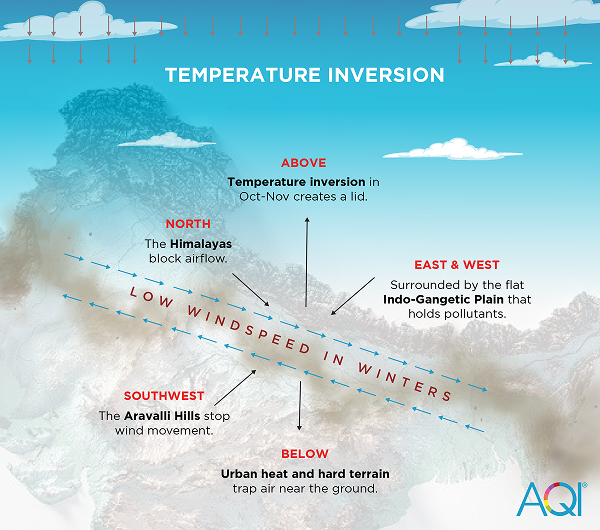
- Low Wind Speeds: Winds are generally weaker in winter, which reduces horizontal dispersion of pollutants, allowing them to accumulate in the lower atmosphere.
- Crop Residue Burning: Each year, post-harvest stubble burning in neighbouring states such as Punjab, Haryana, and western Uttar Pradesh releases large amounts of smoke and particulate matter.
- Dust and Urban Pollution Entrapment: Local emissions from vehicles and combustion sources are the most significant contributors.
- Urban dust and vehicular emissions linger longer in the atmosphere due to low boundary layer height in winter, compounding the pollution problem.
Steps Taken by the Government to Combat Air Pollution
- National Clean Air Programme (NCAP): Launched in 2019, NCAP is a comprehensive initiative aimed at reducing air pollution in identified cities and regions across India.
- The programme focuses on improving air quality monitoring, implementing stricter emission standards, and promoting public awareness.
- Bharat Stage VI (BS-VI) Emission Standards: The government implemented BS-VI emission standards for vehicles nationwide in 2020.
- Pradhan Mantri Ujjwala Yojana (PMUY): It aims to provide clean cooking fuel to households by promoting the use of liquefied petroleum gas (LPG) as an alternative to traditional biomass-based cooking methods.
- FAME (Faster Adoption and Manufacturing of Hybrid and Electric Vehicles) Scheme: The scheme promotes the adoption of electric and hybrid vehicles to reduce air pollution caused by vehicular emissions.
- Green Initiatives for Sustainable Habitat (GRIHA): Developed by TERI and the Ministry of New and Renewable Energy, it serves as India’s national rating system for green buildings.
- Waste Management Programs including the Swachh Bharat Abhiyan, aim to address solid waste issues and promote cleaner disposal methods.
- Commission for Air Quality Management: CAQM was constituted under the Commission for Air Quality Management in National Capital Region and Adjoining Areas Act, 2021.
- Objective: The Act provides for the constitution of a Commission for better coordination, research, identification, and resolution of problems related to air quality in the National Capital Region (NCR) and adjoining areas.
- Powers of the Commission include;
- Preparing codes and guidelines to prevent and control air pollution,
- Issuing directions on matters including inspections, or regulation which will be binding on the concerned person or authority.
- The Commission may impose and collect environmental compensation from farmers causing pollution by stubble burning prescribed by the central government.
- The Commission issues orders to combat air pollution in NCR under the Graded Response Action Plan (GRAP).
- In case of any conflict, the orders or directions of the Commission will prevail over the orders of the respective state governments, the Central Pollution Control Board (CPCB), state PCBs, and state-level statutory bodies.
Way Ahead
- Emission reduction at source: Prioritise sustained reductions in emissions from transport, industries, construction, waste burning and other major pollution sources, rather than relying primarily on emergency restrictions.
- Airshed-based approach: Ensure coordinated pollution-control measures across Delhi-NCR and neighbouring states, recognising that air pollution extends beyond administrative boundaries.
- Sector-specific interventions: Expand public transport, control road dust, enforce industrial emission standards and promote cleaner fuels and technologies.
- Evidence-based assessment: Regularly evaluate GRAP using emission trends, pollution-source data and weather conditions to distinguish the impact of restrictions from meteorological fluctuations.
Source: HT
Previous article
Immersive Technologies
Next article
News In Brief 29-10-2026
