


Syllabus: GS2/ Health
Context
- The Supreme Court said that economic policy could not take precedence over the lives of citizens, as it questioned the Union government about its approach to regulating the prices of essential medicines and medical products.
Background
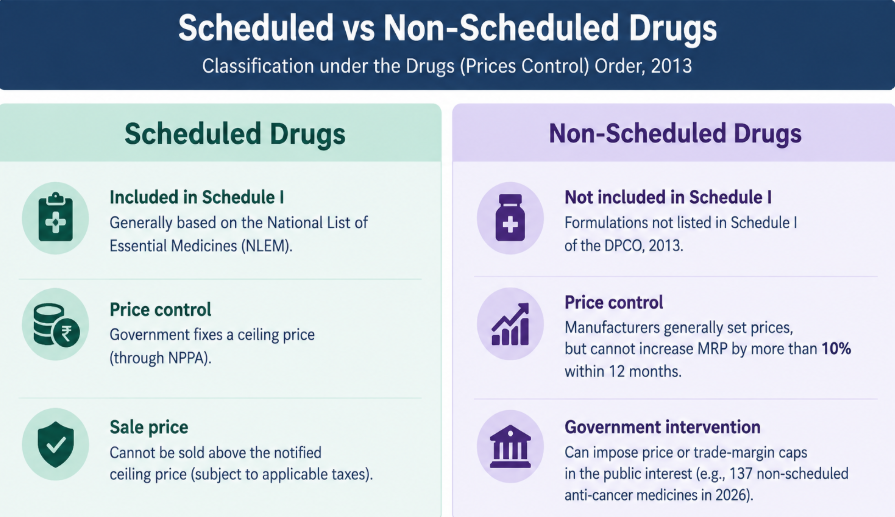
- The National Pharmaceutical Pricing Authority (NPPA), the government’s drug-price regulator, capped trade margins on 137 non-scheduled anti-cancer medicines at 30% of their maximum retail price (MRP).
- Trade margins are the difference between the price at which a medicine is purchased and the price at which it is sold by intermediaries such as distributors, retailers or hospitals.
Supreme Court’s Stand on Drug Price Control
- The court questioned the wide gap between the prices at which hospitals procure medicines and the prices charged to patients.
- It also raised concerns about the NPPA’s failure to adequately control excessive trade margins and why they were introduced for selected anti-cancer medicines and whether similar safeguards should extend to other essential medicines and medical consumables.
Existing Framework for Drug Price Regulation
- Drugs (Prices Control) Order (DPCO), 2013: Issued under the Essential Commodities Act, 1955, the DPCO empowers the government to regulate prices of scheduled formulations and monitor prices of non-scheduled medicines.
- The National Pharmaceutical Pricing Authority (NPPA) is responsible to fix and revise drug prices under the provisions of the Drugs (Prices Control) Order (DPCO), 2013, while monitoring compliance, ensuring the availability of essential medicines, and advising on pharmaceutical policy.
- National List of Essential Medicines (NLEM): Prepared by the Ministry of Health and Family Welfare, the NLEM identifies medicines that address priority healthcare needs.
- Inclusion of a medicine in the NLEM generally provides the basis for bringing its covered formulations under price control through the DPCO.
- Trade margin regulation and price monitoring: Under the DPCO, 2013, a notional retailer margin of 16% is incorporated into the calculation of ceiling prices for scheduled formulations.
- For non-scheduled medicines, manufacturers generally have pricing flexibility, but annual MRP increases are restricted to 10% over the preceding 12 months.
- The government may also, in the public interest, establish particular limitations on trade margins.
Significance of the Court’s Decision
- Right to Health: Affordable medicine flows from Article 21, backed by Article 47 on public health. Economic policy must be tested against this.
- Addresses financial hardship: Stricter regulation can reduce out-of-pocket expenditure and protect vulnerable households from catastrophic healthcare costs.
- Regulatory accountability: Highlights the need for the NPPA to act proactively against excessive markups and ensure timely recovery of overcharged amounts.
What are the Concerns?
- Impact on innovation and investment: The pharmaceutical industry argues that predictable returns are necessary to support research, innovation, quality manufacturing and investment.
- Uneven implementation: Differences in procurement practices, pricing transparency and enforcement across hospitals and states may limit the benefits of regulatory interventions.
Way Ahead
- Strengthen NPPA enforcement: Strengthen price surveillance and impose proportionate penalties for violations.
- Improve pricing transparency: Require hospitals and pharmacies to disclose medicine prices and provide itemised bills, enabling patients to compare prices and identify excessive charges.
- Expand affordable medicine access: Strengthen Jan Aushadhi Kendras, generic prescribing and the availability of essential medicines in public hospitals.
- Ensure regular review: Periodically update the NLEM and the list of medicines subject to price control, incorporating new therapies, disease burdens and affordability concerns.
Source: TH
Previous article
News In Brief 27-10-2026
