


WHO Releases First Global Guidelines on Child Obesity
Syllabus: GS2/Health
Context
- The World Health Organisation (WHO) has issued its first global guidelines for addressing obesity among children and adolescents.
Obesity
- It is a chronic, relapsing disease whose consequences can begin early in life. Overweight is a Body Mass Index (BMI) greater than or equal to 25; and obesity is a BMI greater than or equal to 30.
- Obesity can increase the risk of non-communicable diseases, including type 2 diabetes and cardiovascular disease.
- Children and adolescents living with obesity may also face mental health challenges, stigma, discrimination and bullying.
Status of Obesity
- Around 170 million children and adolescents aged 5-19 years were living with obesity in 2024.
- This includes approximately 70 million children aged 5-9 years and 100 million adolescents aged 10-19 years.
- The prevalence of obesity among 5-19-year-olds has quadrupled since 1990, rising from 2% to 8%.
Recommendations
- WHO recommends structured interventions covering diet, physical activity and behaviour change.
- It has also conditionally recommended digital health interventions, provided they are carried out under the supervision of a parent or caregiver.
- For children aged 0-9 years, the WHO does not recommend the use of weight-loss medicines, bariatric surgery or weight-loss devices for obesity treatment.
- For adolescents aged 10-19 years, approved medicines may be considered only when a supervised multimodal lifestyle programme has not delivered the desired results.
- Bariatric surgery may also be considered for adolescents with severe obesity, but only under strict conditions.
- Healthcare workers should address obesity and mental health conditions together, using inclusive and age-appropriate approaches that involve families.
Source: WHO
RBI to Allow Interoperability Among Account Aggregators
Syllabus: GS3/ Economy
Context
- The Reserve Bank of India (RBI) will enable interoperability among Non-Banking Finance Company Account Aggregators (NBFC-AAs), allowing individuals to access information on their financial assets through a single platform.
About
- The move will allow customers to link bank accounts with demat accounts and access consolidated financial information through their account aggregator.
- It will also enable Sebi-regulated depositories to include bank deposit information in their consolidated account statements (CAS).
About Account Aggregators
- An Account Aggregator (AA) is a type of Non-Banking Financial Company (NBFC-AA) regulated by the Reserve Bank of India (RBI).
- It is a consent-based financial data-sharing platform that enables individuals to securely access and share their financial information between participating financial institutions.
- The AA does not store the customer’s financial data; it facilitates its secure transfer between the relevant entities.
- Examples of licensed Account Aggregators (AAs):
- CAMS FinServ, A subsidiary of Computer Age Management Services (CAMS).
- OneMoney, operated by FinSec AA Solutions.
- Key Stakeholders:
- Financial Information Providers (FIPs): Banks, mutual fund companies, insurance companies, etc.
- Financial Information Users (FIUs): Lenders, wealth managers, insurers, etc.
- Account Aggregators (AAs): Licensed entities that facilitate data flow between FIPs and FIUs.
Source: TH
Living Planet Report, 2026
Syllabus: GS3/ Environment
Context
- The average size of monitored vertebrates — mammals, fish, birds and amphibians — populations declined 73% over 52 years between 1970 and 2022, according to the World Wide Fund for Nature (WWF) biennial Living Planet Report, 2026.
About
- The report is based on the data of Living Planet Index (LPI), produced by the Zoological Society of London (ZSL).
- The 2026 assessment covers 35,803 population trends across 5,790 vertebrate species.
Key Findings
- The decline was highest in freshwater ecosystems at 85%, followed by terrestrial ecosystems at 69% and marine ecosystems at 59%.
- Around half of the monitored populations were stable or increasing, showing that conservation interventions can reverse population declines.
- Threat: Habitat loss and degradation, overexploitation of resources, climate change, impact of invasive species, pollution and disease are some of the dominant drivers of changes across ecosystems and wildlife populations.
Source: IE
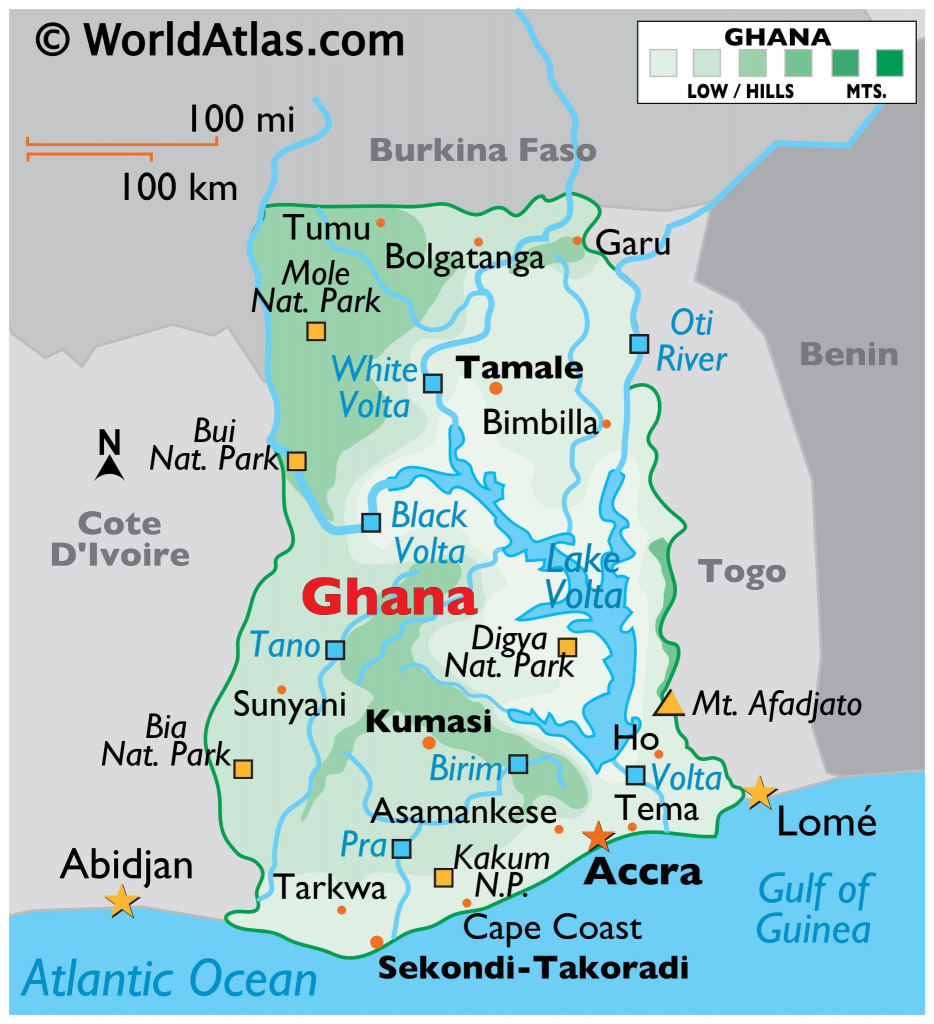
Ghana
Syllabus: GS1/ Places in News
Context
- India and Ghana have signed a five-year Memorandum of Understanding (MoU) to strengthen cooperation in agricultural research, education, technology transfer and commercialisation.
About Ghana (Accra)
- Ghana is a resource-rich country in West Africa and a unitary multiparty republic. It became independent from British rule on 6 March 1957, under Kwame Nkrumah, and played a major role in inspiring African decolonisation.
- It is located along the Gulf of Guinea on the Atlantic coast. It lies slightly north of the Equator and is crossed by the Prime Meridian.
- The country is largely drained by the Volta River system. Lake Volta, covering about 8,500 sq km, is one of the world’s largest artificial reservoirs and supports hydropower generation through the Akosombo Dam.
- Formerly known as the Gold Coast, Ghana is rich in gold, bauxite, manganese and diamonds, and also has offshore petroleum resources. It is a major cocoa producer and exporter.
- Seasonal movement of the ITCZ influences Ghana’s climate. Harmattan winds bring dry, dusty air from the Sahara, while southwesterly monsoon winds bring moisture from the Atlantic.
Source: PIB
Previous article
Character and Conduct as the Foundation of Moral Authority
Next article
News In Short 08-10-2026
