



Syllabus:GS2/IR/GS3/Economy
In News
The India-EFTA Trade and Economic Partnership Agreement (TEPA) between India and Iceland, Liechtenstein, Norway and Switzerland marked one year of its implementation.
Background
- European Free Trade Association (EFTA) is the intergovernmental organisation of Iceland, Liechtenstein, Norway and Switzerland.
- It was set up in 1960 by its then 7 Member States for the promotion of free trade and economic integration between its members.
- It is 1 important economic bloc out of the 3 (the other 2 – EU & UK) in Europe.
- It was set up in 1960 by its then 7 Member States for the promotion of free trade and economic integration between its members.
- India and EFTA signed a Trade and Economic Partnership Agreement (TEPA) in March 2024, and it entered into force on 1 October 2025 as India’s first FTA with four developed European countries.
India–European Free Trade Association (EFTA) Trade and Economic Partnership Agreement (TEPA)
- It is India’s first Free Trade Agreement with four developed European countries, Switzerland, Norway, Iceland, and Liechtenstein, and one of the most ambitious in scale and goal.
- It is a manifestation of a strategic congruence between India’s Atmanirbhar Bharat goal and EFTA’s quest for resilient, varied partnerships.
- It has 14 chapters and addresses key areas such as market access for goods, rules of origin, trade facilitation, trade remedies, sanitary and phytosanitary measures, technical barriers to trade, investment promotion, services, intellectual property rights, trade and sustainable development, and other legal and horizontal provisions.
Features
- Investment and Employment: EFTA aims to boost FDI in India by $100 billion in 15 years, including $50 billion in the first 10 years and another $50 billion in the next five years, and the creation of 1 million direct jobs.
- Operational since February 2025, the India-EFTA Desk facilitates investments, joint ventures and SME collaborations, especially in the renewable energy, life sciences, engineering and digital sectors.
- Market Access: EFTA has provided tariff discounts on 92.2% of tariff lines covering 99.6% of India’s exports. India has provided access on 82.7% of tariff lines which represent 95.3% of EFTA exports.
- Domestic safeguards: Sensitive sectors including dairy, soya, coal, pharmaceuticals, medical devices and some food goods will be protected by exclusions or progressive reductions in tariffs.
- The effective tariff on gold, which constitutes over 80% of India’s imports from EFTA, remains unchanged.
- Services and trained professionals: India has commitments in 105 service sub-sectors while EFTA countries have made wide commitments.
- The agreement enables digital services, commercial presence and temporary movement of trained professionals.
- Professional Mobility : Mutual Recognition Agreements are intended for professions such as nursing, chartered accountancy and architecture.
- IPR and innovation: TEPA enhances protection of intellectual property, but preserves India’s policy space for public health and affordable generic medications.
- Sustainable development: The pact encourages environmental protection, social advancement, transparency, simplified trade procedures and inclusive growth.
Importance
- Capital Inflow: India–EFTA Trade and Economic Partnership Agreement (TEPA) brings with it commitments of USD 100 billion in investments and the creation of 1 million direct jobs over the next 15 years
- It gives a dedicated push to foreign investment in India’s “Make in India” drive.
- Supply Chain Diversification: Indian firms are given reliable, duty-free access to sophisticated inputs (machines, precise instruments, and organic chemicals) and reduced reliance on single-source trade corridors.
- Technology Transfers: EFTA economies are specialised in sectors including precision engineering, pharmaceuticals, biotechnology, sophisticated manufacturing, clean technologies, and specialised industrial equipment. More investment and collaborative ventures could help in the transfer of technology and expertise.
- Professional Mobility Boosted: Mutual Recognition Agreements and reduced short-term residence rules lower barriers for Indian IT experts, engineers, accountants, and healthcare workers joining high-income European markets.
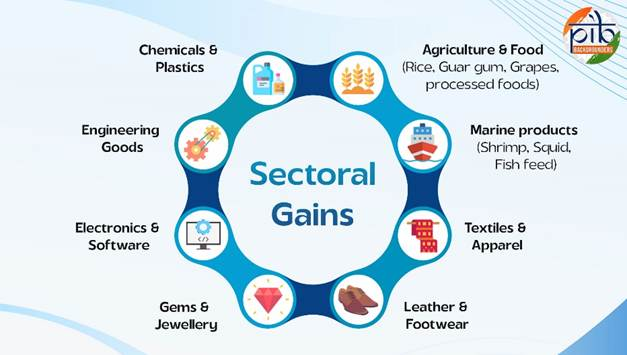
- Enhanced Competitiveness for Indian Products: Abolition of duties on Indian textiles, leather, chemical products, processed foods, and engineering goods boosts the pricing power of Indian products in higher-end European markets.
- Strategic Gateway to Europe: TEPA is a stepping stone for India’s continuing trade negotiations with major trading blocs, like the European Union and the UK.
Progress
- India’s goods exports to the EFTA fell 10.77 per cent to $1.75 billion in FY26, and the slide has deepened since TEPA took effect on October 1, 2025, with a 22.72 per cent drop to $461.64 million in April-June, the first quarter of FY27.
- The fall in exports to Switzerland, by far the largest market in the bloc, was sharper.
- Imports from the bloc rose 10.99 per cent to $24.9 billion in FY26 but fell 13.09 per cent to $2.93 billion in AprilJune 2026, mostly due to a fall in gold shipments
Challenges
- Non-Tariff Barriers (NTBs) : Stringent European sanitary, phytosanitary (SPS) and technical trade barriers (TBT) requirements continue to be a major compliance concern for Indian agricultural and processed food exporters.
- Limited use of preferences : Rules of origin, certificates, standards and documentation may prevent smaller exporters from taking full advantage of tariff advantages.
- EFTA’s demands for strong Intellectual Property Rights (IPR) and data protection need to be closely watched to ensure a balance between IPR and India’s generic medication ecosystem.
- Ground realities for Investment Target: The $100 billion investment target is a 15-year goal, and it will take continuous private investment, an enabling business environment, and robust project pipelines to achieve it.
- Economic asymmetry: India is very different in economic size from the four EFTA economies; benefits may be limited to a few high value-added sectors.
- Historically, India’s trade with EFTA (in particular Switzerland) has been dominated by gold and high-value imports.
- Domestic competitiveness: Indian producers may face tougher competition from imports and will need improvements in productivity, quality, technology, logistics, and standards compliance.
Conclusion
The India–EFTA Trade and Economic Partnership Agreement (TEPA) represents a historic milestone, establishing India’s first FTA with four developed European nations. It combines tariff liberalisation with US$100 billion investment, 1 million direct jobs over 15 years, services, technology transfer, professional mobility and sustainable development. It enhances India’s access to developed European markets and helps Make in India, Atmanirbhar Bharat, export diversification and global value-chain integration. Implementation is at an early stage, and its full impact has to be seen. Its success will depend on translating market access into exports, investment, technology and employment while tackling non-tariff obstacles, regulatory compliance and ease-of-doing-business difficulties.
| Mains Practice Question The India–EFTA Trade and Economic Partnership Agreement (TEPA) seeks to combine market access with a long-term investment and employment objective. Analyse its potential implications for India’s manufacturing sector, MSMEs, and integration into global value chains. |
Source: TH
