


Syllabus: GS3/Agriculture; Water Resources
Context
- As southwest monsoon withdraws recently, India’s reservoir storage remains below the decadal average, raising concerns over irrigation, drinking water and hydropower.
Key Highlights
- According to the Central Water Commission (CWC) live reservoir storage report dated September 24, 2026, water stored in 178 major reservoirs stands at about 70% of total capacity.
- It is below the 10-year average of 76.62% and the 79% storage recorded during the same period in 2025.
- India’s cumulative rainfall was 12% below normal.
- The monsoon accounts for more than 70% of India’s annual rainfall, making it crucial for replenishing reservoirs, groundwater and surface-water systems.
- The situation coincides with drought declarations in parts of Maharashtra and Karnataka.
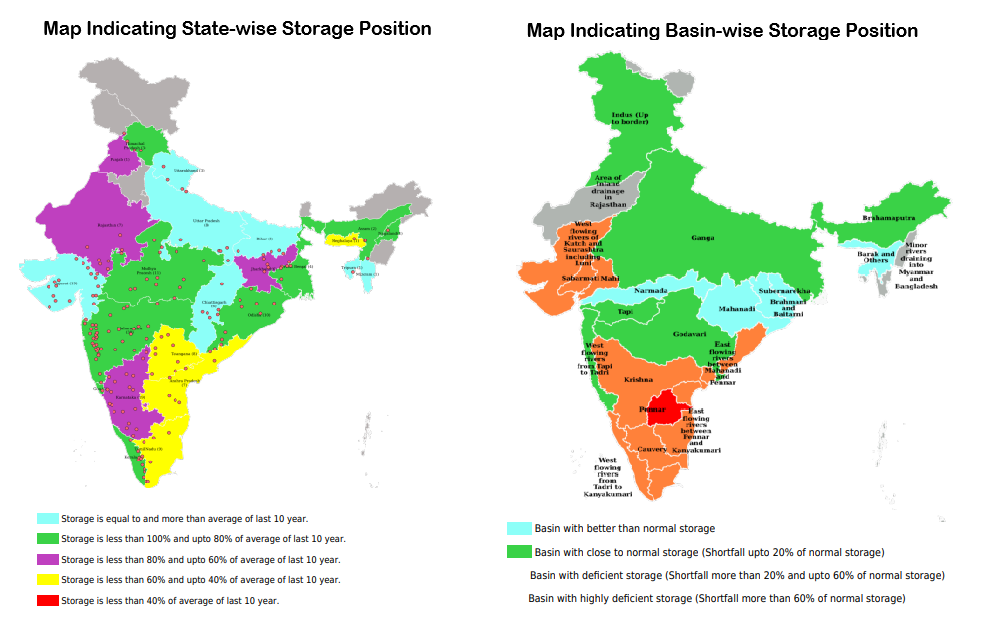
Regional Reservoir Status
- South India (Most Concerning): The southern region comprising Andhra Pradesh, Telangana, Karnataka, Kerala and Tamil Nadu has recorded the lowest reservoir storage.
- Current storage: 27.926 BCM (50% of capacity)
- Previous year: 87.25%
- Rainfall: 23% below normal as of September 28
- The sharp decline has implications for irrigation, drinking-water availability and hydropower generation.
- East and Northeast India: Across 31 reservoirs in Assam, Bihar, Jharkhand, Meghalaya, Mizoram, Nagaland, Odisha, Tripura and West Bengal:
- Storage: 16.157 BCM (73% of capacity)
- Seasonal rainfall deficit: around 25% in much of the region, except Odisha and some parts of West Bengal.
- Northern India: The 11 reservoirs in Himachal Pradesh, Punjab and Rajasthan show a substantial decline:
- 2026: 62% (12.431 BCM)
- 2025: 92.3%
- Western and Central India:
- Gujarat, Maharashtra and Goa: 32.664 BCM or 84.61%, compared with 95.79% in 2025.
- Chhattisgarh, Madhya Pradesh, Uttar Pradesh and Uttarakhand: 41.568 BCM or 85.55%, against 91.89% in 2025.
Monsoon Deficit and El Niño
- The southwest monsoon contributes over 70% of India’s annual rainfall and replenishes reservoirs, groundwater and other surface-water bodies.
- However, cumulative rainfall was 12% below normal.
- June recorded a deficit of 35.4%, August 16.3%, while July was around 1% above normal and September 1–28 recorded a 5% deficit.
- The strengthening El Niño, a periodic warming of the central and eastern tropical Pacific Ocean, has been associated with increased rainfall variability and prolonged dry spells.
- However, ENSO is not the sole determinant of Indian monsoon performance; regional atmospheric and oceanic factors also influence rainfall.
Implications for India
- Agriculture: Reduced irrigation availability and greater dependence on groundwater.
- Drinking water: Stress on urban and rural water supplies during the dry season.
- Hydropower: Lower reservoir levels can constrain electricity generation.
- Food security: Water shortages may affect crop yields and agricultural incomes.
- Inter-state water relations: Scarcity can intensify disputes over shared river waters.
- Drought vulnerability: Poor monsoon performance can translate into hydrological and agricultural drought even when annual rainfall deficits appear moderate.
Way Forward
- India needs to move from rainfall-dependent crisis management to integrated water-resource management. Priorities should include:
- Basin-level water budgeting and reservoir coordination.
- Expansion of rainwater harvesting and aquifer recharge.
- Micro-irrigation and water-efficient cropping patterns.
- Greater use of real-time reservoir and groundwater data.
- Drought-resilient agriculture and climate-informed crop planning.
- Rejuvenation of traditional water bodies and wetlands.
- Strengthening early-warning and anticipatory drought-management systems.
Central Water Commission (CWC)
- It is a premier technical organisation under the Department of Water Resources, River Development & Ganga Rejuvenation, Ministry of Jal Shakti, Government of India.
Key Facts
- Established: 1945, initially as the Central Waterways, Irrigation and Navigation Commission; it was renamed the Central Water Commission in 1951.
- Headquarters: New Delhi.
- Chairperson: Headed by a Chairman, who is also an ex-officio Secretary-level officer of the Government of India.
- Core Mandate: It provides technical support and advice to the Union Government and State Governments on water resources development and management.
- Major areas of work:
- Assessment of surface-water resources
- Planning and development of river basins
- Design and safety of dams and reservoirs
- Flood forecasting and hydrological monitoring
- Monitoring of reservoir storage
- Irrigation and hydropower-related water-resource projects
- Studies related to inter-State river and water-resource issues
- Hydrological data collection and dissemination
Previous article
India’s Emerging Pharmaceutical Opportunity in Rare-Disease Drugs
Next article
PRAHAAR: National Counter-terror Policy
