

Syllabus: GS3/ Science and Technology; Infrastructure
Context
- Recent suspected cable-sabotage incidents in the Arctic and Baltic have brought renewed attention to the vulnerability of submarine cables, the physical backbone of global digital connectivity.
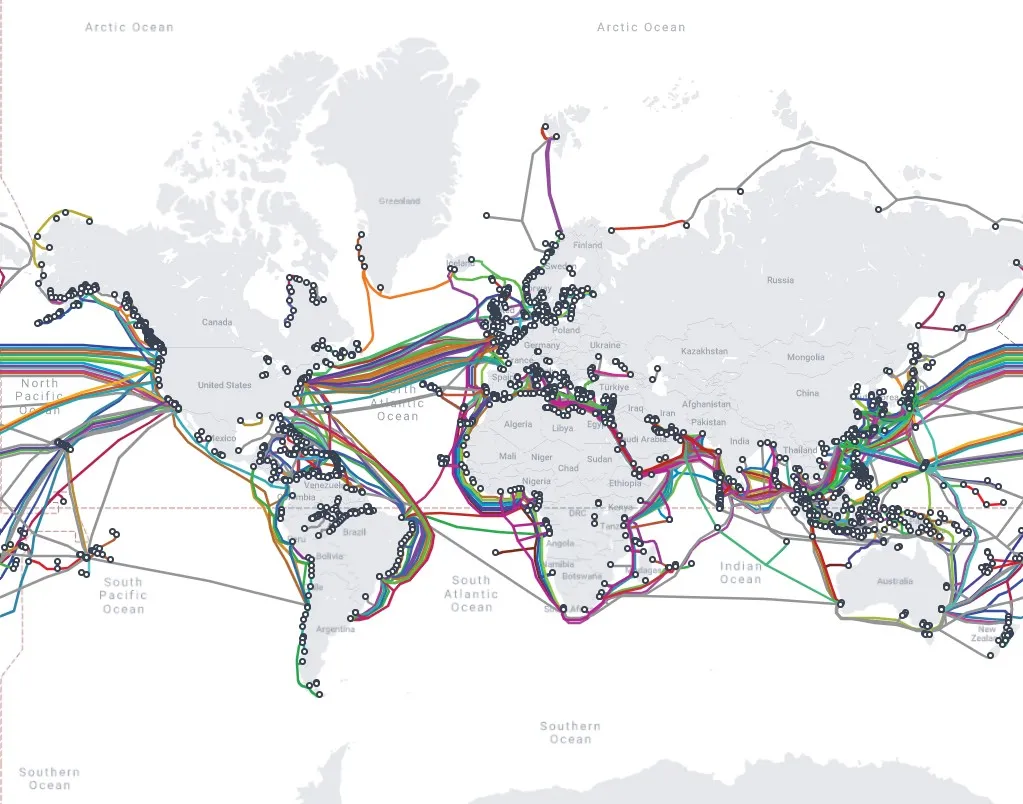
About Subsea Cables & Their Distribution
- Subsea cables are fibre-optic cables laid on the ocean floor that connect countries andcontinents .
- They carry more than 99% of international data traffic, making them indispensable to the functioning of the global digital economy.
- The network has historically been built through consortiums of telecom companies, cable operators and technology firms.
- However, hyperscalers (large technology and cloud-service companies) are increasingly investing directly in cable systems because of rapidly rising data and AI-related bandwidth requirements.
- The supply side is also concentrated. Alcatel Submarine Networks (France), SubCom (US) and NEC (Japan) are the principal manufacturers and together account for a very large share of the world’s deployed submarine cable infrastructure.
Significance of Subsea Cables
- Backbone of the Digital Economy: International banking, financial transactions, cloud services, e-commerce, government communication and everyday digital services depend heavily on submarine cables.
- Strategic Infrastructure: A damaged cable can reduce or interrupt international connectivity for an affected region, with consequences for businesses, governments and citizens.
- Enabler of AI and Data Economy: The expansion of cloud computing, artificial intelligence and data centres is increasing demand for high-capacity, low-latency international connections.
- Importance for Small Island States: For many small island and geographically isolated economies, dependence on a few cable links creates a significant single-point-of-failure risk.
- Cable resilience is therefore closely linked with economic and social resilience.
Fibre-Optic Cables
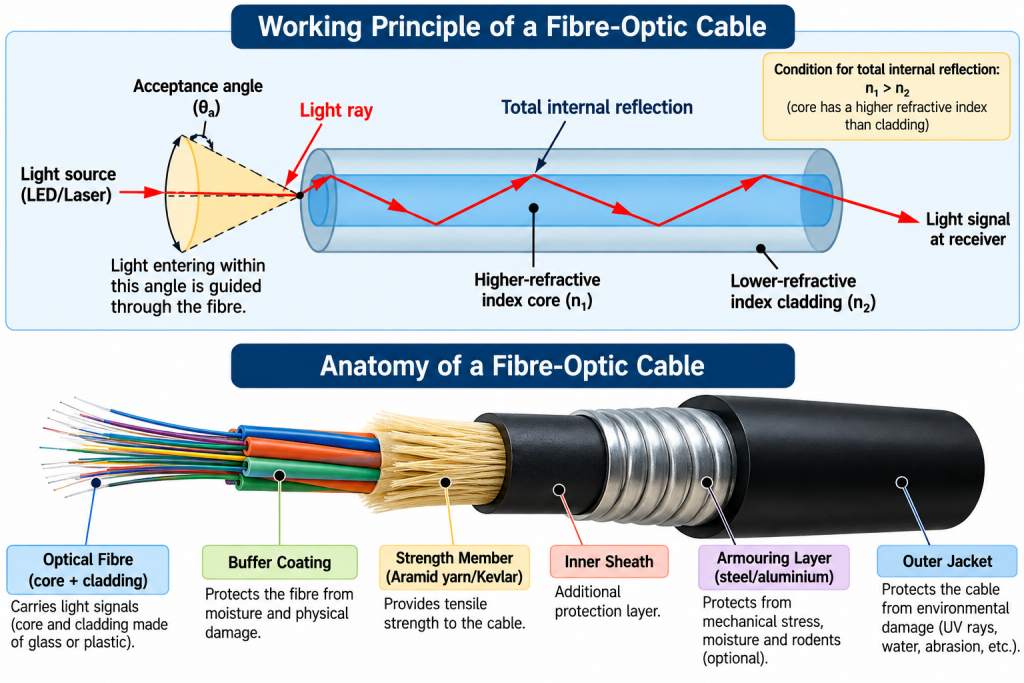
- These are communication cables that carry information on very fine strands of glass or plastic fibre.
- The data is transformed into light pulses and transferred down the cable via the principle of total internal reflection (TIR).
- Fibre optics can transmit data using light, allowing very high data-transfer speeds and a broad bandwidth. It makes fibre optics ideal for Internet and telephony.
- Fibre has low attenuation thus signals can be sent over long distances. Optical amplifiers/repeaters are used on long distances in undersea cables to boost the signal.
Why Are Subsea Cables Vulnerable?
- Physical Damage: Much of the cable damage is due to fishing activity, ship anchors, earthquakes, landslides and other marine action.
- Sabotage and Hybrid Threats: Recent incidents in the Baltic Sea and in the adjacent waters have raised worries of deliberate meddling.
- The difficulty of attribution makes underwater infrastructure desirable for grey zone or hybrid activities.
- Concentrated Repair Capacity: Repair of an undersea cable requires specialised vessels, equipment and qualified people.
- Limited worldwide repair capacity can extend outages following an incident.
- Supply-Chain Concentration: Reliance on a few manufacturers and specialised service providers represents strategic risks.
- Digital Sovereignty: The landing stations and the network infrastructure itself have larger consequences for digital sovereignty and strategic autonomy while content of cables is not automatically readable in general, whether encrypted or secured, the management of their routes.
India: Subsea Cables & Building Resilience
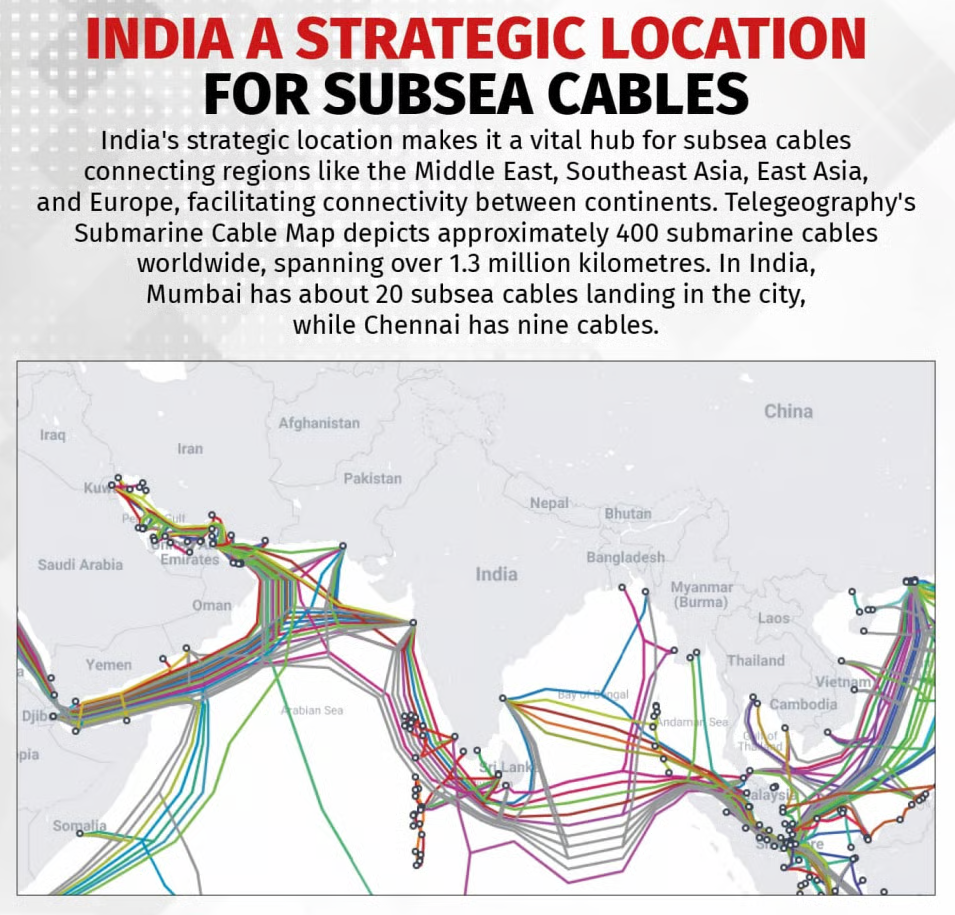
- India is an important node in the Indo-Pacific submarine-cable network, with international cables coming ashore on its west and east coastlines.
- The Submarine Networks database provides details of India’s cable systems and landing stations.
- India’s growing digital economy makes uninterrupted international connectivity strategically important.
- At the same time, concentration of cable landings, dependence on foreign specialised equipment and limited domestic repair capacity create vulnerabilities.
- India should therefore develop indigenous cable repair and maintenance capabilities.
- Faster regulatory clearances are equally important because delays in permissions can discourage investment in specialised repair infrastructure.
Way Forward
- India needs a ‘redundancy – resilience – rapid repair’ strategy to:
- diversify cable routes and landing locations;
- strengthen domestic repair vessels and skilled manpower;
- establish a coordinated national mechanism for cable monitoring and incident response;
- improve cooperation among the Navy, Coast Guard, telecom authorities and private operators;
- promote public-private investment in cable infrastructure; and
- deepen cooperation with Indian Ocean and Indo-Pacific partners.
Previous article
Ancient India’s Maritime Trade Networks
Next article
Armed Forces (Special Powers) Act, 1958
