

Red Sea
Syllabus: GS1/Geography
Context
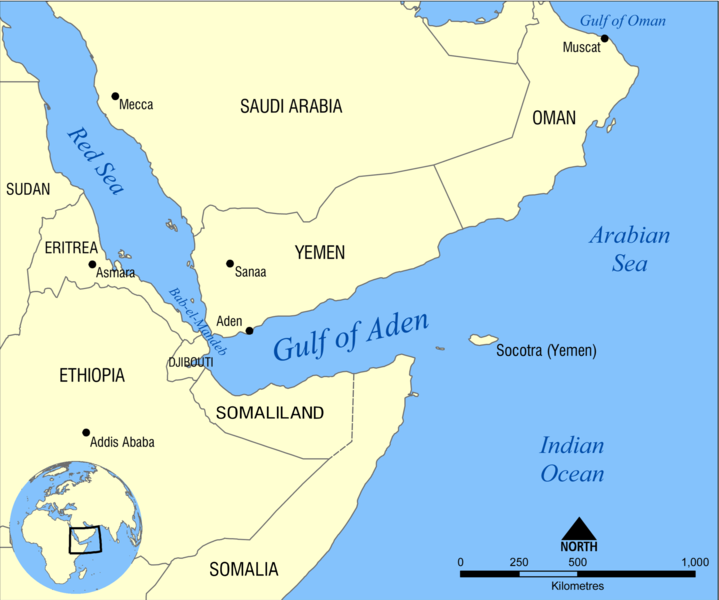
- The Iran-backed Houthis seized control of Yemen’s entire Red Sea coast and captured three strategic islands, in a lightning offensive that cemented their hold on a vital shipping corridor.
About
- Location: The Red Sea is a seawater inlet of the Indian Ocean, located between northeastern Africa and the Arabian Peninsula in Asia.
- Borders:
- It connects to the Indian Ocean through the Bab el-Mandeb Strait and the Gulf of Aden in the south.
- To its north lie the Sinai Peninsula, the Gulf of Aqaba, and the Gulf of Suez (leading to the Suez Canal).
- It separates the coasts of Egypt, Sudan and Eritrea to the west from Saudi Arabia and Yemen to the east.
- Trade: The Red Sea is a crucial global shipping corridor, carrying around 15% of global trade and nearly 30% of global container traffic.
Source: TH
7 Years of Pradhan Mantri Kisan Maandhan Yojana (PM-KMY)
Syllabus: GS2/ Governance
Context
- The Pradhan Mantri Kisan Maandhan Yojana (PM-KMY) has completed seven years.
About the Scheme
- PM-KMY is a voluntary and contributory old-age pension scheme designed to provide financial security to small and marginal farmers during their later years.
- Under the scheme, eligible subscribers receive a minimum assured pension of ₹3,000 per month after attaining the age of 60 years.
- It is a Central Sector Scheme administered by the Ministry of Agriculture & Farmers Welfare & implemented in partnership with the Life Insurance Corporation of India (LIC).
- The scheme also provides family pension support after the subscriber’s death.
- If a subscriber passes away while receiving the pension, the spouse is entitled to a family pension equal to 50% of the subscriber’s pension.
- This amounts to ₹1,500 per month. The benefit is available exclusively to the spouse and applies only if the spouse is not already a beneficiary of PM-KMY.
- The scheme also provides an option in case a subscriber dies before attaining the age of 60 years.
- If the beneficiary has made regular contributions, the spouse may join and continue the scheme by making the prescribed regular contributions.
- Alternatively, the spouse may exit the scheme as per the exit and withdrawal provisions.
- The scheme is open to small and marginal farmers throughout the country with cultivable landholdings of up to two hectares.
- Farmers must be between 18 and 40 years of age to enrol.
- To qualify, their names must appear in the land records of the respective states or union territories as of 1 August 2019.
Source: PIB
India’s Push for Overseas Lithium and Critical Minerals
Syllabus: GS2/ IR, GS3/ Economy
Context
- The Ministry of Mines is in talks with Australia and Chile to acquire lithium blocks, while it is also seeking five additional blocks in Argentina, as India steps up its efforts to secure supplies of the critical mineral.
Lithium
- Lithium is a chemical element with the symbol Li and atomic number 3. It is a soft, silvery-white alkali metal.
- Properties: Like all alkali metals, lithium is highly reactive and flammable, and must be stored in vacuum, inert atmosphere, or inert liquid such as purified kerosene or mineral oil.
- Significance: Lithium is a key component of lithium-ion batteries, which are widely used in electric vehicles, energy-storage systems and portable electronic devices.
Global Reserves
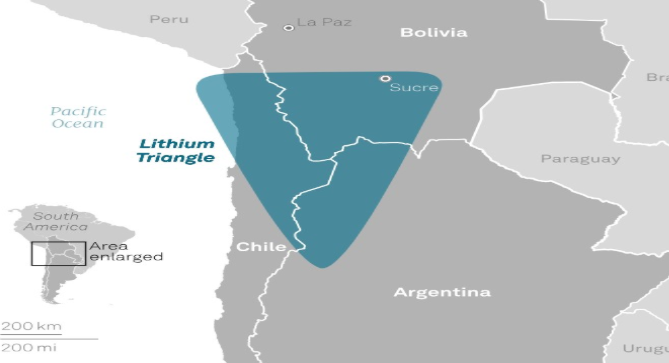
- Chile, Australia, Argentina, Bolivia and China contain most of the reserves discovered so far globally.
- Argentina, Bolivia and Chile, also known as the ‘Lithium Triangle’ contain 60% of the world’s Lithium reserves.
- In Argentina the lithium is present in salt pans in the Atacama desert and neighboring arid zones in the region.
Lithium in India
- In India, there is some potential to recover lithium from brines of Sambhar and Pachpadra areas in Rajasthan, and Rann of Kutch, Gujarat.
- In 2023, the Geological Survey of India (GSI) identified 5.9 million tonnes of inferred lithium resources in J&K.
Source: TH
The Bankers’ Books Evidence Act, 2026
Syllabus: GS2/Governance
Context
- The Bankers’ Books Evidence Act, 2026 will come into force from October 1, 2026, replacing the 1891 law.
About
- It will provide a modern legal framework for the use of banking records as evidence in legal proceedings.
- It adopts a technology-neutral approach, recognising banking records maintained in physical, electronic, digital, virtual, cloud-based and other contemporary forms.
- A key provision of the new law is the simplification and standardisation of certification of banking records.
- Such certification can be carried out through manual, digital or electronic signatures, facilitating the use of banking records in judicial and other legal proceedings.
- The legislation also provides greater clarity regarding the summoning of bank officials when the bank is not a party to the proceedings.
- A court will be required to record a “special cause” in writing before summoning such officials.
- The Act further empowers the Central Government to extend its provisions to specified financial sector entities or classes of entities, enabling the legal framework to adapt to developments in the wider financial sector.
Source: DD
Farakka Treaty
Syllabus: GS2/IR
Context
- Janata Dal (United) has launched a campaign across 12 Ganga-side districts of Bihar, calling for the state’s interests to be safeguarded in the Farakka Treaty, which is set to expire on 12 December 2026.
About
- The Farakka Treaty, also known as the Ganga Water Treaty, was signed on 12 December 1996 between Prime Minister H.D. Deve Gowda of India and Prime Minister Sheikh Hasina of Bangladesh.
- It governs the sharing of Ganga waters at the Farakka Barrage. During the lean period (11 March–11 May), 35,000 cusecs of water are allocated alternately to each country for 10-day periods, subject to water availability.
- The Farakka Barrage, built on the Bhagirathi River in West Bengal, was constructed to improve the navigability of the Kolkata Port by diverting water into the Hooghly River.
- Article XII provides that the treaty is renewable by mutual consent after the completion of its 30-year term.
Source: IE
Front-of-Pack Warning Labels (FoPL)
Syllabus: GS2/Governance
In News
- The Supreme Court has expressed concern over the Food Safety and Standards Authority of India’s (FSSAI) proposed two-phase rollout of front-of-pack warning labels (FoPL) on packaged foods high in sugar, salt and fat.
Front-of-Pack Warning labels (FoPL)
- Front-of-pack warning labels have been debated in India since 2018.
- FSSAI has proposed a red, hexagonal front-of-pack warning label for packaged foods high in added sugar, saturated fat or salt, to help consumers quickly identify unhealthy products.
- The recommended nutrient based on thresholds specified under the Dietary Guidelines for Indians, 2024, issued by the Indian Council of Medical Research-National Institute of Nutrition.
- The proposal envisions a two-step implementation.
- In step 1, the warnings would be applied to products high in at least two of the three nutrients and to specified highly sweetened beverages.
- In step 2, the warning would be applied to products high in any one of these nutrients.
Exclusions
- FSSAI’s proposed front-of-pack labelling framework would exclude single-ingredient foods and naturally high-fat, sugar or salt products such as ghee, edible oil, salt, sugar, jaggery and honey, while continuing to apply other food-safety and labelling requirements.
Supreme Court’s Observations
- The Supreme Court has raised concerns over the FSSAI’s two-phase front-of-pack warning label (FoPL) plan, cautioning that the second phase could be indefinitely delayed with no clear timeline.
- It challenged the rationale of the original emphasis on foods high in two nutrients, and advocated a threshold-based approach and different standards for ultra-processed and minimally processed foods.
- It encouraged the education of children in nutrition and suggested the use of words in conjunction with pictorial symbols for ease of understanding.
Source: TH
Copper
Syllabus: GS1/Geography; GS3/Economy
In News
- Copper prices have climbed to a record high of $14,708 a tonne amid uncertainty about global economic growth due to trade tensions and the conflict in West Asia.
Copper
- Copper (Cu) is a reddish metal of very high ductility and is an excellent conductor of heat and of electricity.
- It is found in nature in the metallic state.
- It is also found in minerals such as chalcocite, chalcopyrite and bornite.
- It is produced by smelting or leaching, often followed by electrodeposition.
- It was one of the first metals ever extracted and used by humans
- It has made vital contributions to sustaining and improving society since the dawn of civilization.
Use
- Copper is commonly used due to its excellent electrical and thermal conductivity, corrosion resistance, and malleability.
- Copper is alloyed with other metals such as zinc, tin, and nickel to produce brasses, bronzes, and nickel silvers.
- Tools, weapons, cooking vessels, household utensils, mirrors, and ornaments were all made of copper. Copper is also part of coinage metals
- It is resistant to corrosion and can be used for water pipes.
Data
- In 2025, the United States imported $16.2 billion worth of copper products.
- China accounted for 20% of these imports, followed by Mexico at 17%, the European Union at 14%, Canada at 10%, and Vietnam at 8%.
Source: IE
Lipulekh Pass
Syllabus: GS1/Geography
In News
- India-Tibet border trade through Lipulekh Pass has resumed.
Lipulekh Pass
- It is located at an elevation of about 5,334 metres in the Kumaon region.
- It is a high-altitude Himalayan pass in Pithoragarh district, Uttarakhand (India).
- It serves as a strategic tri-junction connecting India, China (Tibet), and Nepal.
- It is strategically and culturally important as a traditional route for Indian pilgrims on the Kailash Mansarovar Yatra.
Source: IE
Previous article
The Consumer Protection (E-Commerce) (Amendment) Rules, 2026
Next article
News In Short 12-09-2026
