


Syllabus: GS3/ Economy
Context
- The government has amended the Consumer Protection (E-Commerce) Rules 2020, to tighten norms on price transparency, sponsored listings, search result manipulation and dark patterns.
E-Commerce Market in India
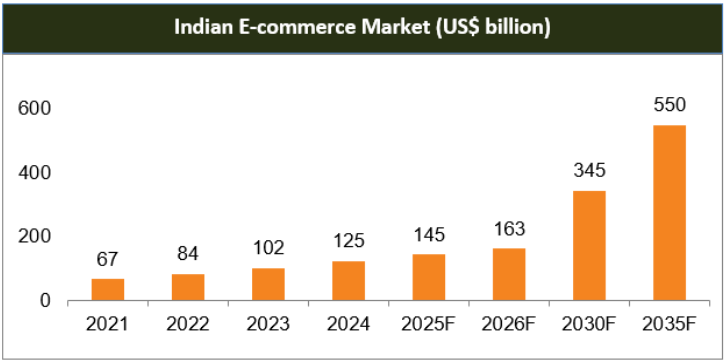
- India’s e-commerce industry, valued at US$ 125 billion in 2024, is projected to grow to US$ 345 billion by 2030, reflecting a compound annual growth rate (CAGR) of 18.4%.
- India had nearly 290–300 million online shoppers in 2025, with Tier-2+ cities contributing around 65% of incremental shoppers.
- Shopper penetration remains only 25–30% of internet users in smaller cities, leaving significant room for future growth.
- India has become the third-largest online shopper base after China and the US.
- The sector has benefited from increased internet penetration, rising affluence, and affordable data prices.
Key Provisions of the Amended Rules
- E-commerce entities will be prohibited from manipulating search results in ways that mislead consumers or reduce the relevance of results to their search queries.
- The entities will have to disclose the reduced price and prior price whenever a price cut is announced.
- The prior price has been defined as the lowest price at which the product was offered in the 30 days before the discount was announced.
- Every e-commerce entity has to become a partner in the convergence process of the National Consumer Helpline (NCH), strengthening the integration of online platforms with the national consumer grievance redressal mechanism.
- E-commerce entities will be required to comply with the Guidelines for Prevention and Regulation of Dark Patterns, 2023.
- They will also have to conduct a yearly self-audit and prominently display a certificate of compliance.
- On consumer grievances, every e-commerce entity will be required to provide complainants with a copy of the complaint as recorded by its grievance officer, adding greater transparency to the complaint-handling process.
- Marketplace e-commerce entities will have to provide consumers with key information about products and services, including best-before or use-before dates, return and refund policies, warranty details, delivery information and payment terms.
- For imported products, platforms will also be required to disclose the importer details and country of origin, giving consumers greater information about the products they purchase online.
E-Commerce Model in India
- Business to Consumer (B2C): Platforms like Amazon, Flipkart, and Myntra operate on this model
- Business to Business (B2B): It is particularly relevant for industries such as manufacturing, where companies procure raw materials, machinery, and other supplies from suppliers.
- Platforms like Udaan and Alibaba cater to this segment, facilitating bulk transactions and supply chain solutions.
- 100% FDI is allowed in B2B e-commerce.
- Consumer to Consumer (C2C): Platforms like OLX and Quikr enable individuals to list and sell their items, providing a marketplace for peer-to-peer transactions.
- Business to Administration (B2A) and Consumer to Administration (C2A): The Government e-Marketplace (GeM) is an example of a B2A platform, facilitating government procurement of goods and services.
Other steps of government
- The Government e-Marketplace (GeM) has also played a vital role in promoting e-commerce by providing a platform for government procurement.
- Draft National E-Commerce Policy, 2019: Focusing on data localization, consumer protection, intellectual property rights, and competition issues.
- Open Network for Digital Commerce: It is the decentralised online platform that will help reduce the cost of doing business for retailers.
- 100% FDI is allowed in B2B e-commerce & marketplace model of E-commerce.
- Government initiatives like the National Logistics Policy and Digital India are boosting e-commerce by improving connectivity, streamlining logistics, and expanding digital access.
Way Ahead
- As India’s e-commerce ecosystem grows beyond metropolitan markets, effective consumer protection will be at the core of sustaining trust in digital commerce.
- The modified rules can serve to create a regulatory environment where innovation, competitiveness and ease of doing business coexist with transparency and consumer welfare.
- But their success will depend on effective enforcement, consumer awareness and timely grievance redressal channels.
Previous article
India-Russia Bilateral Meet
Next article
News In Short 12-09-2026
