

Syllabus: GS2/ IR, GS3/ Economy
Context
- India’s experience with Russia and China has demonstrated that a lack of indigenous manufacturing competitiveness can negate the gains from economic diplomacy.
The Manufacturing Gap in India’s External Economic Relations
- India–Russia trade imbalance:
- India’s exports to Russia remain relatively limited compared with its imports, which are dominated by crude oil and other commodities. India’s exports to Russia are still under $5 billion, while imports from Russia were $63.8 billion in 2024-25.
- Russia is a substantial market for manufactured products, including automobiles, machinery, electronics and industrial equipment.
- However, India’s limited manufacturing capacity prevents it from fully exploiting this market, even when diplomatic relations provide favourable conditions for greater bilateral trade.
- Dependence on China:
- India’s trade relationship with China reflects the opposite problem, as Chinese exports include electronics, machinery, chemicals, pharmaceutical inputs, auto components and other intermediate goods.
- Bilateral trade between India and China reached about $151 billion in 2025-26, but India’s deficit rose to around $112 billion.
- Many Indian sectors rely on these imports as Chinese companies provide items at competitive costs with huge manufacturing scale and integrated supply chains.
Significance of Manufacturing for Economic Diplomacy
- Diplomacy cannot substitute industrial capacity: Trade agreements, diplomatic negotiations and investment partnerships can create opportunities, but they cannot by themselves generate globally competitive products.
- Strengthens strategic autonomy: A strong manufacturing base reduces excessive dependence on external suppliers for critical goods, technologies and industrial inputs.
- Export competitiveness: Large-scale manufacturing can help India diversify its export basket beyond traditional strengths such as petroleum products, pharmaceuticals, textiles and engineering goods.
- Deeper domestic supply chains can also increase the domestic value added in Indian exports.
Manufacturing Sector of India
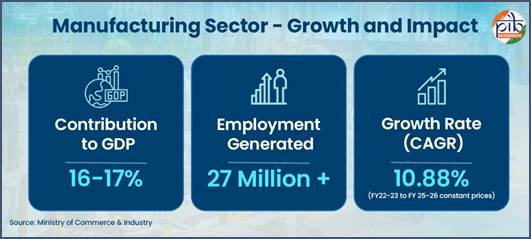
Challenge in India’s Manufacturing Sector
- High cost of doing business: Complex regulations, compliance requirements, logistics costs and delays in obtaining approvals can reduce the competitiveness of Indian manufacturing.
- Shallow domestic supply chains: Several sectors continue to depend significantly on imported components, machinery, raw materials and intermediate goods.
- This limits the extent to which India can capture value across the manufacturing chain.
- Limited scale: Chinese manufacturing benefits from large production volumes, extensive supplier networks and integrated industrial clusters.
- Indian firms often operate at smaller scales, which can make it difficult to compete on cost and delivery timelines in global markets.
- Technology and skill gaps: Advanced manufacturing increasingly requires sophisticated machinery, research capabilities, digital technologies and skilled workers.
- India needs stronger industry–academia linkages and greater private-sector investment in research and development.
Government Measures for Strengthening the Manufacturing Sector
- National Mission on Manufacturing (NMM): Announced in Budget 2025-26, it serves as a key catalyst for industrial growth, targeting a rise in manufacturing’s GDP share to 25% by 2035 and expansion of merchandise exports to USD 1.2 trillion through deeper global value chain integration.
- Production Linked Incentive (PLI) scheme: The primary aim was strengthening India’s manufacturing capabilities by offering financial incentives to eligible companies based on their incremental sales.
- The scheme initially targeted three sectors, and, over time, it has expanded to include 14 sectors, ranging from electronics and textiles to automobiles and food processing.
- Startup India: The initiative aims to build a strong ecosystem for nurturing innovation and Startups in the country.
- National Logistics Policy (NLP): The policy aims to lower the cost of logistics from the existing 13-14% and lead it to par with other developed countries.
- PM Gati Shakti: It was launched in 2021 to enhance the country’s infrastructure and promote seamless connectivity across various sectors.
- It will incorporate the infrastructure schemes of various Ministries and State Governments like Bharatmala, Sagarmala, inland waterways, dry/land ports, UDAN etc.
- Innovation financing: The government announced a Research, Development and Innovation (RDI) Fund with a ₹1 lakh crore outlay over six years, including ₹20,000 crore for FY26, aimed at boosting private investment in high-tech R&D and operationalising a Deep-Tech Fund of Funds.
What India Needs to Do?
- Move from incentives to competitiveness: Production incentives can catalyse investment, but long-term manufacturing success requires firms to become competitive even without perpetual fiscal support.
- Build complete supply chains: India should develop domestic capabilities across the entire production ecosystem, including components, machinery, raw materials, logistics and specialised services.
- Export-orientated manufacturing: India needs to identify sectors where it can develop a durable comparative advantage and integrate them into global value chains.
Way Ahead
- India’s economic diplomacy can create doors, but manufacturing competitiveness determines whether India can walk through them.
- The experience with Russia and China demonstrates that diplomatic influence cannot compensate for weak productive capacity.
- Therefore, India’s long-term economic and strategic autonomy requires a manufacturing ecosystem based on scale, productivity, technology, competitive supply chains and an investment-friendly regulatory environment.
Source: IE
Previous article
News In Short 11-09-2026
