

Tokenisation of Assets as the Next Frontier for India’s Digital Ecosystem
Syllabus: GS3/ Economy/ Science and Technology
Context
- Maharashtra has enacted the Maharashtra Digitisation and Exchange of Land Token Asset (DELTA) Act to build a blockchain-based system for the tokenisation of land and other immovable assets.
What is Asset Tokenisation?
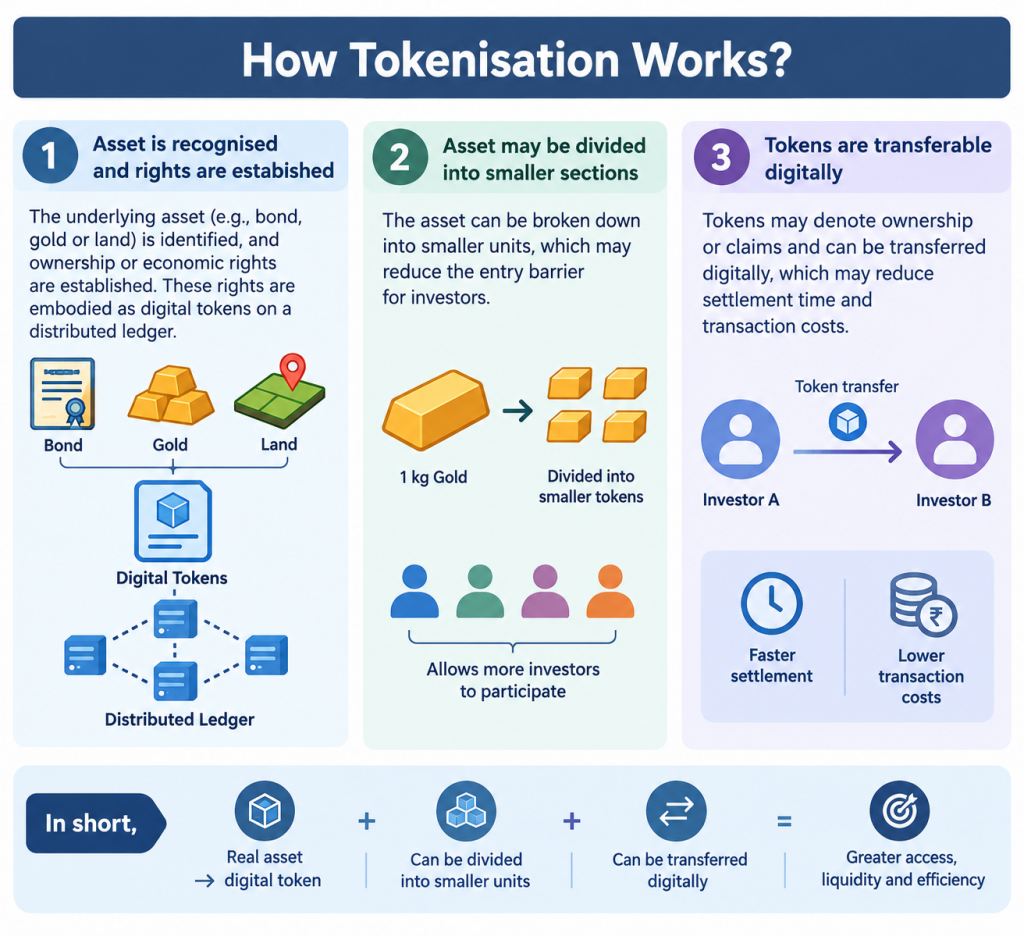
- Asset tokenisation is the process of transforming ownership or economic rights in a real-world or financial asset into digital tokens that are recorded on a blockchain or distributed ledger system.
- Tokenisation can allow a high-value asset to be divided into smaller units, enabling investors to obtain fractional exposure to assets that would otherwise require substantial capital.
- For instance, a ₹10 lakh bond can theoretically be broken up into smaller digital units, so that the investor can buy exposure to a smaller part of the asset.
India’s Emerging Tokenisation Framework
- The RBI launched the Unified Markets Interface (UMI) as a digital infrastructure project to democratise ownership and transactions in financial assets.
- SEBI is also working on a pilot project for corporate bond tokenisation.
Source: IE
Central Consumer Protection Authority (CCPA)
Syllabus: GS2/Health, GS3/Food Processing
Context
- The Central Consumer Protection Authority (CCPA) has taken action against food companies using “100%” claims, holding that such claims can create a misleading impression of absolute purity or complete composition.
About Central Consumer Protection Authority
- Section 10 of the Consumer Protection Act, 2019 establishes the Central Consumer Protection Authority which seeks to promote, protect and enforce the rights of consumers as a class.
- Powers & Functions of CCPA: It is empowered to:
- conduct investigations into violation of consumer rights and institute complaints / prosecution
- order recall of unsafe goods and services
- order discontinuation of unfair trade practices and misleading advertisements
- Impose penalties on manufacturers/endorsers/publishers of misleading advertisements.
Consumer Protection Act, 2019
- This Act replaced The Consumer Protection Act, 1986, and seeks to widen its scope in addressing consumer concerns.
- The new Act recognises offenses such as providing false information regarding the quality or quantity of a good or service, and misleading advertisements.
- Under Section 21 of the Act, the CCPA can order a false or misleading advertisement to be discontinued or modified.
- The Act came into force in July 2020 and empowers consumers and helps them in protecting their rights through its various notified rules and provisions.
Source: TH
Sagar Manthan Vessel
Syllabus: GS3/Defence; Science and Technology
In News
- Kolkata-based Garden Reach Shipbuilders and Engineers (GRSE) Ltd launched the ‘Sagar Manthan’ vessel.
‘Sagar Manthan’ vessel
- It is an indigenous ocean research vessel (ORV) being built for the National Centre for Polar and Ocean Research (NCPOR).
- It is expected to be commissioned by 2028 after extensive sea trials.
- It is an all-weather, multi-disciplinary platform developed under Vertical-4 (Deep Ocean Survey and Exploration) of India’s flagship Deep Ocean Mission (DOM) at a cost of about Rs. 840 Crore.
- It will have a speed of 14 knots at 90 per cent of its maximum continuous rating, with an estimated lifespan of 30 years.
- This vessel would strengthen India’s efforts to explore marine mineral resources, including manganese nodules and polymetallic sulphides in the Indian Ocean region.
Deep Ocean Mission
- Deep Ocean Mission was launched in 2021 & focusses on sustainably harnessing ocean wealth and strengthening the Blue Economy.
- India’s first manned submersible vehicle ‘MATSYA 6000’ is being developed as part of the Samudrayaan Project under Deep Ocean Mission.
Source: TH
Dark Matter could Form Tiny Black Holes inside Stars: Study
Syllabus: GS3/Space
Context
- A new study suggests that heavy dark matter particles trapped inside a dense star could accumulate at its core, collapse into a tiny black hole and gradually transform the entire star into a black hole.
About
- Their study focuses on two extremely dense types of stellar objects – millisecond pulsars and white dwarfs.
- An extremely dense star is essentially a dead star that has run out of nuclear fuel.
- A millisecond pulsar is a rapidly rotating neutron star that emits regular beams of electromagnetic radiation at intervals of less than 10 milliseconds, while a white dwarf is a hot, dense stellar remnant.
- The study suggests that ancient, extremely dense stars can act as natural laboratories for detecting or constraining ultra-heavy dark matter.
Dark Matter
- Unlike normal matter, dark matter does not interact with the electromagnetic force. This means it does not absorb, reflect or emit light, making it extremely hard to spot.
- Dark matter works like an attractive force, a kind of cosmic cement that holds the universe together. This is because dark matter does interact with gravity.
- Since dark matter doesn’t emit, absorb or reflect light, astronomers can only study its gravitational effect on visible matter, such as stars and galaxies.
- Roughly 68% of the universe is dark energy, dark matter makes up about 27% and the rest everything observed adds up to less than 5% of the universe.
What is a Black Hole?
- A black hole is an extremely dense object whose gravity is so strong that nothing, not even light, can escape it.
- It does not have a surface, like a planet or star. Instead, it is a region of space where matter has collapsed in on itself.
- This catastrophic collapse results in a huge amount of mass being concentrated in an incredibly small area.
- Formation: A black hole is formed when a really massive star runs out of fuel to fuse, blows up, leaving its core to implode under its weight to form a black hole.
- The centre of a black hole is a gravitational singularity, a point where the general theory of relativity breaks down, i.e. where its predictions don’t apply.
- A black hole’s great gravitational pull emerges as if from the singularity.
Source: TH
Lakes Alter the Global Carbon Cycle
Syllabus: GS3/Environment
In News
- New Swedish research shows that lake-rich Arctic stream networks significantly reshape the global carbon cycle by releasing more carbon to the atmosphere instead of transporting it downstream.
Carbon cycle
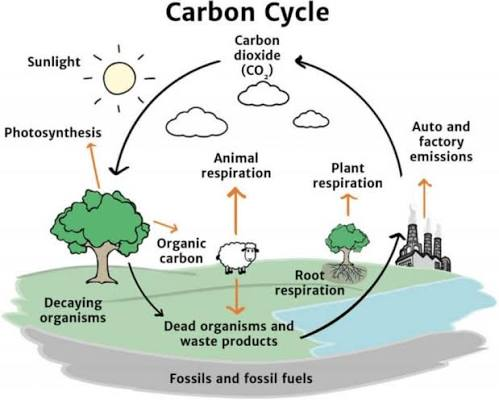
- The carbon cycle is the ongoing exchange of carbon between the atmosphere, oceans, rocks, sediments, and living creatures.
- Carbon is a key ingredient of life, found in molecules like DNA and proteins, and atmospheric CO2 helps regulate the temperature of the Earth.
- The most carbon is stored in rocks and sediments. Oceans, ecosystems, and the atmosphere are all substantial carbon reservoirs.
- Carbon is released back into the atmosphere when organisms die, volcanoes erupt, fires blaze, fossil fuels are burned, and through a variety of other mechanisms.
- The oceans also exchange and sequester carbon over extended time periods.
- The significant rise in atmospheric CO2 levels is disturbing this natural cycle due to human activities such as the combustion of fossil fuels and changes in land use.
Source : DTE
Osteoarthritis
Syllabus: GS2/Health; GS3/Science and Technology
In News
- Scientists are developing a cell-free regenerative therapy for osteoarthritis using extracellular vesicles derived from mesenchymal stromal cells found in menstrual blood.
Osteoarthritis
- It is a degenerative joint condition. It causes pain, swelling and stiffness, affecting a person’s ability to move freely.
- It is most common in the knees, hips, spine and hands. Major causing factors are injury, older age and overweight. It affects women more than men.
Source : TH
Previous article
Winter Waste Burning Worsens Urban Air Pollution
Next article
News In Short 10-09-2026
