


Syllabus: GS1/Physical Geography, GS3/Renewable Energy
Context
- India’s geothermal push gained momentum with the commissioning of its first two geothermal wells at Puga Valley, Ladakh, opening prospects for round-the-clock renewable power.
About Geothermal Energy
- Geothermal energy harnesses the natural heat within the Earth to generate electricity or provide direct heating and cooling.
- It is weather-independent and available round the clock, unlike solar and wind, making it a potential source of firm renewable energy.
- Earth’s internal heat arises from radioactive decay of uranium, thorium and potassium and residual heat from planetary formation.
- In geologically active regions, faults and fractures allow heat to approach the surface, creating reservoirs of hot water and steam.
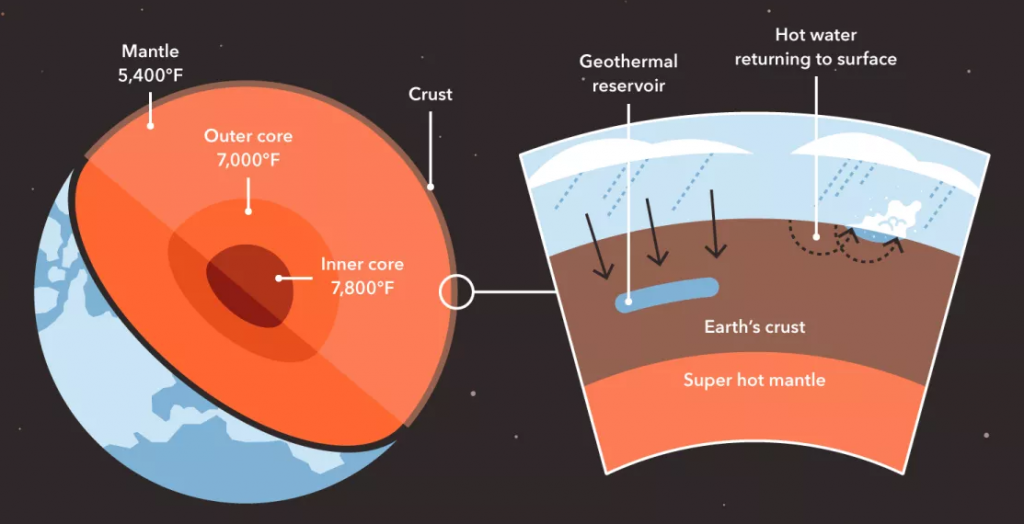
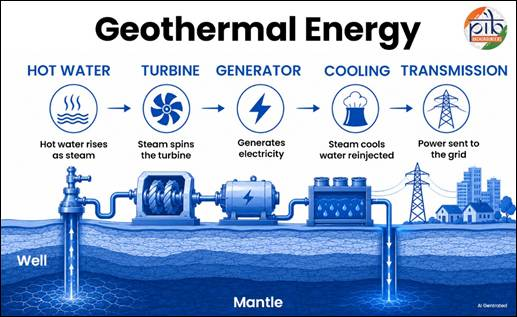
How does it generate power?
- Deep wells bring hot water/steam to the surface.
- Steam drives a turbine connected to a generator.
- Condensed water is reinjected into the reservoir, supporting continued production.
- Geothermal heat can also be directly used for district heating, agriculture, aquaculture and space heating/cooling.
India’s Geothermal Potential
- India’s diverse geology provides significant geothermal opportunities.
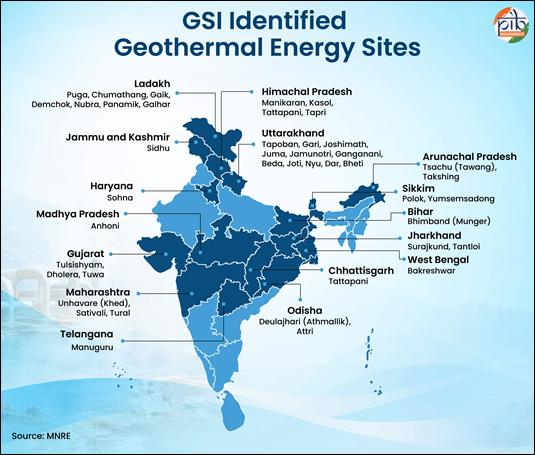
- 381 hot springs mapped by the Geological Survey of India (GSI).
- 10 geothermal provinces identified.
- Theoretical geothermal potential: nearly 10.6 GW (10,600 MW).
- 42 sites recognised as promising for power generation and direct heat use.
- Major provinces include Himalayan, Naga-Lusai, Andaman & Nicobar, Son-Narmada-Tapi (SONATA), West Coast, Cambay Graben, Aravalli, Mahanadi, Godavari and South Indian Cratonic regions.
Puga Valley: A Landmark Development
- In July 2026, ONGC Energy Centre commissioned India’s first two geothermal wells at Puga Valley, Ladakh, located at an altitude of over 14,000 feet.
- The two wells are 1,000 metres deep and will facilitate reservoir evaluation and pave the way for India’s first 1-MW demonstration geothermal power project.
- Temperatures of up to 135°C have been recorded beneath Puga Valley, according to the infographic on page 2 of the source document.
Emerging Applications & Projects
- India is moving from resource assessment towards field demonstrations:
- Ankleshwar, Gujarat: Pilot to assess electricity generation by retrofitting unproductive oil and gas wells.
- Gandhinagar, Gujarat: Solar-geothermal demonstration; three wells produce geothermal fluid at 70–80°C, with 50–90 kW electricity generation demonstrated.
- Tawang, Arunachal Pradesh: Geothermal assessment at five sites.
- Hyderabad: Development of geothermal cooling for air-conditioning.
- Shallow geothermal: Borehole Heat Exchangers being studied for heating and cooling.
Key Concerns in Geothermal Energy
- High Upfront Cost: Deep drilling, exploration and reservoir assessment require substantial capital; resource uncertainty increases financial risk.
- Geological Uncertainty: India’s geothermal resources are unevenly distributed, and identifying commercially viable reservoirs requires extensive geological and geochemical surveys.
- Induced Seismicity: Fluid injection/reinjection, particularly in Enhanced Geothermal Systems (EGS), can trigger micro-earthquakes and, in some cases, larger seismic events.
- Water-related Concerns: Geothermal operations may require significant water, while poor management can affect groundwater availability or quality.
- Environmental Impacts: Potential issues include land disturbance, gas/mineral release, thermal pollution and groundwater contamination if geothermal fluids are not properly managed.
- Technological Challenges: EGS/AGS, deep drilling and efficient reservoir management require advanced technology and specialised expertise.
- Resource Depletion: Poorly managed extraction can reduce reservoir pressure/temperature, affecting long-term productivity.
- Remote Locations: Many promising Indian sites, such as Puga Valley in Ladakh, are geographically difficult to access, increasing infrastructure and transmission costs.
- Limited Commercial Experience in India: Despite a theoretical potential of ~10.6 GW, India is still at the demonstration stage; commercial-scale geothermal power generation is yet to be established.
- Regulatory & Investment Challenges: Large-scale deployment requires clear regulations, risk-sharing mechanisms, private investment and reliable geothermal resource data.
Policy Push
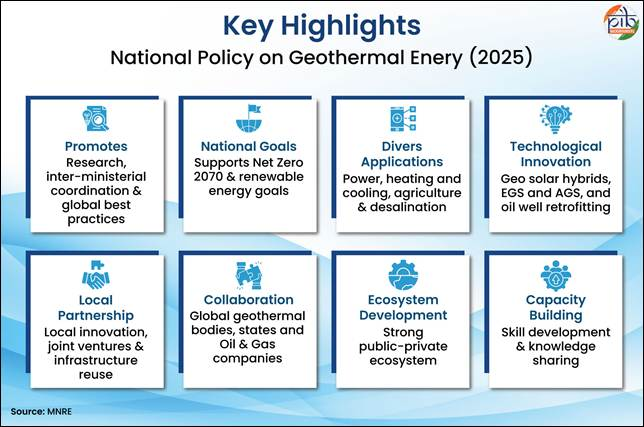
- The National Policy on Geothermal Energy, 2025, with MNRE as nodal ministry, seeks to make geothermal energy a major renewable-energy pillar. It promotes:
- Research, drilling and reservoir management;
- Ground Source Heat Pumps (GSHPs);
- Repurposing abandoned oil and gas wells;
- National geothermal data repository;
- Pilot projects and Centres of Excellence;
- Greater public-private participation;
- The RE-RTD programme supports indigenous and cost-effective geothermal technologies.
Way Forward
- India’s theoretical potential remains largely untapped, while commercial-scale geothermal power generation is yet to be established.
- Enhanced Geothermal Systems (EGS) and Advanced Geothermal Systems (AGS) can expand exploration beyond conventional geothermal zones.
- International cooperation with Australia, Iceland and Saudi Arabia can further support technology development and knowledge exchange.
- Globally, installed geothermal capacity reached 15.67 GW by end-2025, with Indonesia, the US, Philippines, Türkiye and New Zealand accounting for around 67%.
Previous article
News In Short 04-09-2026
Next article
Child Labour
